Resources
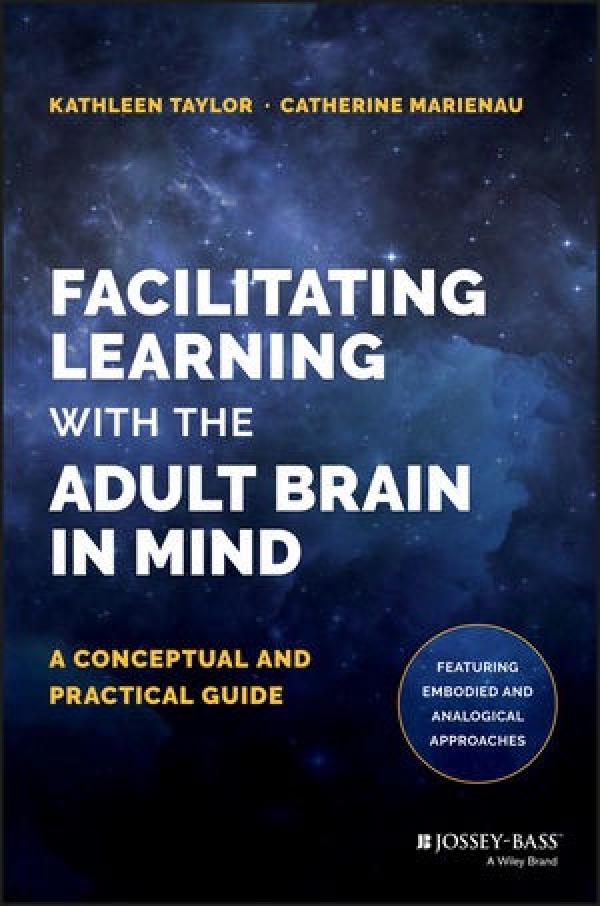
Neuroscience is a burgeoning field, and Kathleen Taylor and Catherine Marienau mine it skillfully to craft Facilitating Learning with the Adult Brain in Mind. This book is not structured like many teaching books – it begins, after all, with a drawing of “The Theater of Knowing,” to which the authors refer throughout. But to write it off because it is unfamiliar would be a mistake – this is a valuable book for any teacher of adults, no matter the subject. Taylor and Marienau had been searching for a book that would “describe in language accessible to non-neuroscientists… how the adult brain works and also how to use this understanding to construct more brain-aware approaches that help adults learn and perform more effectively in diverse settings” (ix). Eventually they discovered that “the book we wanted to read was the one we would have to write” (x). Readers are the beneficiaries here; the research is fresh, the applications diverse, and Marienau and Taylor model brain-aware approaches in how they structure the book. Part One distills brain science for the lay reader. For example, we learn that anxiety and curiosity function simultaneously in the brain, and good teaching should both stimulate the curious brain and reassure the anxious brain. “The science in Part One is grounded in brain research; however, we frequently use stories and metaphors to illuminate technical ideas. In similar fashion, we often describe the brain and its functions in analogical rather than anatomical terms,” the authors describe (xv). Part Two sets forth an array of practices – embodied, metaphorical, verbal, theoretical, and more – to enhance adult learning. Taylor and Marienau interviewed a number of practitioners whose best practices are illustrated here. Part Three brings theory and reflection into dialogue with both the neuroscience from Part One and the practices introduced in Part Two. “Rather than begin our book with theory, which is typical, we first illuminate practice in part Two because… theories are more meaningful when the brain can connect them to concrete experiences” (xvi). Key ideas are reviewed at the end of each chapter; visual illustrations and boxed examples enhance and expand on ideas introduced in the main text. The authors suggest additional reading at points, rather than devoting too much time to subthemes. They also provide opportunities for reflection at the conclusion of the chapters, encouraging readers to draw or sketch reflections as a way of accessing different brain functions. At various points, the reader will experience recognition: “Ah, that’s why this happens.” Other sections will inspire new approaches to try. “Without necessarily identifying them as such, many experienced facilitators use embodied, analogical activities in their workshops, classes, or coaching and consulting settings because they have found them to greatly enhance adults’ grasp of key concepts as well as their own practice” (175). Many college and seminary professors, by contrast, were never trained in teaching. Sections on multiple intelligences and Kolb’s model of experiential learning, then, offer an added boon to readers with less experience in educational theory. Parenthetically, reviewing this book was so influential that it has now become assigned reading for all adjunct faculty in a department to which I recommended it.
Cláudio Carvalhaes Associate Professor McCormick Theological Seminary All of the schools under the Association of Theological Schools are required to have a very clear and strong sense of educational effectiveness. One of the ways to gauge such effectiveness is by evaluating to what extent a course meets its stated ‘learning

Derek Nelson Associate Professor of Religion Wabash College On February 17 the Wabash community got word that police were on the campus looking for a suspect in a double murder. As it turned out, the suspect was an employee. He had taken a college van, and later ended his life
Sufia Uddin Associate Professor Connecticut College Since 9/11, colleges and universities have increased their course offerings in Islamic traditions and Muslim cultures. Yet, it seems that anti-Muslim rhetoric is everywhere. In Caleb Elfenbein’s recent blog, he points out that our students know only the world with our “war on terror”
Tat-siong Benny Liew Class of 1956 Professor in New Testament Studies College of the Holy Cross After about six months and fifteen horrible haircuts in the San Francisco Bay area I finally found somebody who could give me a decent haircut, and I became a loyal customer for the

Theological school deans are not just theological leaders for their institution, they must be EDUCATIONAL leaders. That is, they must implement sound educational practices related to curriculum, instruction, supervision, assessment, and administration. While faculty members can focus on course-level and individual student learning assessment, academic deans need to implement program-level assessment in order to evaluate the effectiveness of the school's curricular course of study. There is a variety of ways to assess the effectiveness of the curriculum, and there are several levels of assessment (program-level, course-level, student testing, student projects, etc.).
Invoking the name of the “Common Core” effort to establish national K-12 educational standards in its title, this is not a text directed primarily at college educators. It is important to ask, therefore, whether the authors’ approach is broad enough to answer the needs of the college classroom and whether their approach to teaching writing is of any use to the professor of theology or religious studies. The answer is “yes” to both. In an effort to “mine the gold” in the Common Core writing standards, Murphy and Smith identify six big ideas: teaching writing as a process, integrating the language arts, extending the range of student writing, spiraling and scaffolding, and collaborating. The emphasis on writing as process informs their entire project and the other themes are treated in individual chapters. Preparation for the book included conversations with “dozens of teachers,” with some “college teachers in the mix” (7). The second chapter provides a sample lesson plan and commentary designed to integrate the language arts; that is, reading, writing, speaking, and listening. Among the chapter’s helpful charts is a list of “strategies for writing with specifics” including “details,” “examples,” and “active verbs” (23). One can imagine a professor drawing from this list when helping a student enhance vague writing. Ideas for building student vocabularies and building community are equally transferable to the college environment. The third chapter takes on the challenge of extending the range of writing and acknowledges the difficulty students have when transitioning from descriptive to argumentative essays. With vignettes, ideas for writing exercises, and samples of student writing, the authors are able to provide some insight into the ways students struggle and how one might build bridges to help. In a particularly thoughtful college-level example, the professor has her students read exemplar restaurant reviews and collaboratively design a grading rubric based on the effective strategies observed in these reviews before writing their own. The fourth chapter examines how the pedagogical practices of spiraling and scaffolding produce better writers. By spiraling, the authors mean revisiting key concepts repeatedly at different layers of complexity. By scaffolding, they mean any temporary practice exercises or assistance intended to sharpen students’ skills. Within a list of examples is the suggestion that students spend some class time focusing on a single quote that supports their argument and assessing how to connect it to their own ideas. Reflecting on collaboration, the fifth chapter describes student-to-student, teacher-to-student, and teacher-to-teacher collaborative strategies. Drawing on the theme of collegiality, the authors use their final chapter to consider how teachers can best produce positive institutional change. This is the principle of the book as a whole: effective teaching practices should be sought among effective teachers. This slim volume will be of great interest to college educators. It provides meaningful insight into the struggles students experience when transitioning from high school to college writing and practical advice on how to help.
Reading, Writing, and Discussing at the Graduate Level A Guidebook for International Students by Rina Kim, Lillie R. Ablert, and Hang Gyun Sihn is a new resource for graduate international students and those who work with them in the academic setting. The three authors come from diverse personal and academic backgrounds and draw from their experiences as international students themselves and from working with international students in developing this text. They provide a guidebook for students who are proficient in English but struggle to understand the “academic culture and norms in the United States” (ix). Each chapter focuses on a different aspect of graduate level work; academic reading, in-class discussions, writing assignments, preparing oral presentations, and developing relationships with classmates and professors. The authors do a good job of stating the limited scope of their effort. They recognize that the text is not going to provide a comprehensive primer on academic writing or research, but they point out common ways in which international students are derailed in their efforts because they misunderstand expectations. Throughout the text, the authors draw on informal conversations they have had with students to illustrate common perspectives or misunderstandings. The scenarios they highlight help to clarify issues and suggest ways of moving forward. These scenarios provide some of the most helpful insights in the book. International students may find chapter two on “Engaging in Academic Discussions” and chapter five on “Developing Social and Academic Relationships” to be the most helpful because they discuss at length ways to build confidence and helpful hints for anticipating the atmosphere of classroom interactions in the United States. The most effective aspects of each chapter are the ways in which the authors show how perspectives and expectations differ even in basic items such as how reading lists are arranged in a syllabus or clarifying the expectation to write in your own words. The subtle nuances of the academic culture of the United States are dealt with in a relaxed manner, encouraging students to ask questions or seek help when necessary. The text does assume a high level of reading proficiency. This is stated clearly by the authors, but the writing might be too complex for the students who are seeking the type of assistance the book covers. Although the main audience is the international student, this book is probably more helpful for faculty members who are beginning to teach international students. The informal scenarios that are scattered throughout the book provide a helpful window into the mind of the international student. Faculty members or other mentors will find this text helpful as they shape assignments, engage international students in classroom discussions, and articulate expectations.
Digital Storytelling originated in the early 1990s in the matrix of what was then called “new media”: a mix of graphics, photography, videography, audio recording, and video and audio editing. As first developed at the Center for Digital Storytelling in California, workshop participants learned to create a two- to three-minute first-person story in a digital format that could be shared via the Internet. By 2000 when media production software became commonly available on personal computers, what had been the realm of professional artists and media producers became a potential playground where ordinary people of all ages could be empowered to craft and to share digitally a succinct, poignant, brief first-person video story. Since then, this form of storytelling has found advocates around the world: in small villages in Wales; in schools from elementary to college-level in the U.S.; in museum art programs in Australia; and in social service and social justice organizations in the U.S., Africa, and elsewhere; and in youth faith formation in Norway and Denmark. Major universities now offer education courses in this method, from the University of Cardiff in Wales to the University of Hawaii. ESL teachers have successfully employed this technique to help immigrants tell their stories. PhD students have written dissertations that explore the evolution and application of Digital Storytelling in a variety of settings, and media and cultural studies scholars have analyzed this phenomenon as it has been introduced in multiple cultures. While the original short format is referred to with initial capital letters, the wider field of digital media storytelling has evolved and now takes many forms. Patricia McGee has carved out a portion of this diverse world of digital storytelling and limited her comments to “Higher Education, Professional, and Adult Learning Settings,” which is still a very wide scope. She divides this well-researched work into three sections that provide excellent overviews of past storytelling traditions and new twenty-first century approaches; current institutional uses and emerging models for digital storytelling; and applications in diverse cultural and institutional contexts. She advises readers to turn to whichever section they find of most interest. Theological educators and religious studies professors will most benefit from exploring the third section on applications. With a little imagination, they can envision how the digital storytelling examples McGee cites can be translated for application in their classrooms and how their ministry students and graduates can use digital storytelling in youth ministry, faith formation, catechumenal processes, new members gatherings, church building transitions and anniversaries, and church websites. McGee, Associate Professor of Digital Learning Design at the University of Texas at San Antonio, is evidently a master of her wide-ranging, fast-evolving field. She is a good guide, one who will stretch the vision of theological and religious studies educators. By introducing this creative, communal digital storytelling process in their classrooms, their students can learn to empower themselves and others to claim their voice.
Two university educators who have led campus teaching and learning centers and worked as academic administrators have served us all well with their Facilitating Seven Ways of Learning. Davis and Arend seek explicitly to connect teaching practices to specific learning goals chosen for university classes. Not only do I recommend this book to you, but I will use it in my January PhD Teaching Seminar. At times the language of the book is a bit grand, talking about being “trapped” in a “lecture paradigm” with an “obsolete” view of learning (5, 8). They claim “confusion reigns as the paradigm crumbles (15).” I forgive them, for it does not continue too long. Perhaps the assumption was that a grand view was necessary to sell books to skeptical readers. Nevertheless, the book delivers what it promises: to help faculty, trained as scholars, researchers, and writers, to focus additionally on being effective teachers concerned about learning – for citizenship, personal development, and the ongoing generation of knowledge. Conversation about teaching is increasing in graduate schools, professional schools, and universities. At a recent consultation, I heard faculty members talk among themselves about how they trusted their colleagues, knew that individual classes were faithful and effective, and yet were concerned that their overall curricular goal for critical, integrative practical theological wisdom was not occurring. One mentioned that they all worked hard at fulfilling goals for individual classes, but had not attended to specific integrative commitments of their curriculum together. Facilitating Seven Ways of Learning is a way to begin addressing that concern. After assisting faculty to define course learning goals, the authors take seven explicit learning commitments and demonstrate effective pedagogical practices. The seven ways of learning are: building skills; acquiring knowledge; developing critical, creative, and dialogical thinking; cultivating problem-solving and decision-making abilities; exploring attitudes, feelings, and perspectives; practicing professional judgment; and reflecting on experience. One can see the influence of Bloom and Shulman here. The authors help faculty clarify how learning goals connect with these seven ways of learning and offer concrete strategies for teaching. To quibble: I am not certain that simply reflecting on experience is a goal. Is it not more a learning strategy for professional judgment, acquiring knowledge, or practicing decision-making skills? Regardless, this book will generate conversation among faculty members and will assist them to make the move from learning commitments to classroom strategies. As mentioned, I will use this book in my next PhD teaching seminar. Faculty are committed to assisting doctoral students to consider the vocation of teaching, connect academic study with teaching, and gain practical skill in course design and teaching practices. I have brought together bibliographies on theological education, course design, and learning strategies that I routinely share with graduate students. With Facilitating Seven Ways of Learning, students can practice naming commitments of their disciplines and their own scholarship, explore the learning goals they have for their students, dialogue with faculty mentors about the particular concerns of classes, and connect teaching practices to learning commitments. Clearly this book was written after years of experience in a college teaching center, empowering faculty colleagues. I recommend it.