Resources

At first blush, the rest of the world’s shift to virtual learning in March seemed immaterial to our constituents who are in a heavily online MA in Jewish Education. We are lucky to boast well-trained and experienced online faculty and, perhaps even more important, students who are whizzes with Zoom, Schoology, and an array of online educational tools. Our people are at home in their virtual academic community. They already knew to mute themselves when not speaking in a teleconference, so we were really ahead of the game! Honestly, we felt immune to the whiplash others were experiencing with the very abrupt shift to online teaching and learning. And yet, ‘business as usual’ has been very UNusual. As a parent of three myself, I was quick to recognize the double demands that would be placed on working parents. This affects both our faculty and student body, many of whom are caring for young children and/or aging parents while working full-time in Jewish education. With childcare centers closed and many dual-career families trying to work remotely, this complexity appeared on our radar quickly. A few weeks after moving all courses online, we announced that Hebrew College would not be holding an in-person graduation in June. Especially for distance students, who cannot wait to finally bring their families to campus, hug their classmates and teachers, and wear a cap and gown to symbolize all that they have invested in their degrees, this was a huge blow. And now, we have gone from a trickle to a steadier flow of job losses, furloughs, and professional uncertainty. For the soon-to-be-graduates, many have gone from looking at the many pathways forward for their careers to worrying about their next paycheck in their current role. Even though our students are well-versed in learning online and forging and maintaining deep relationships over Zoom and FaceTime, this experience has been difficult. And so, I imagine for those faculty and students for whom virtual learning is new, and are experiencing the same stressors and uncertainties as I’ve described, this experience is multi-layered and fraught. With that in mind, I’d like to share my approach to graduate education, which builds on what I’ve learned over a decade-plus teaching virtually and adapts it for the moment at hand. • Focus first on the ‘extracurricular.’ With so much uncertainty and added stress in their personal and professional lives, students need to use the reflective space of the classroom to process their experiences—and to channel them into future material for growth. To my mind, this now trumps any other course objective. Once grounded and feeling seen (and this must happen repeatedly throughout the crisis), students will have greater capacity to engage in the material and hopefully reach many of the original course objectives. Do this by creating distinct spaces and times for processing and opportunities to grieve for whatever feels lost—this may be one-to-ones with faculty, a discussion board set aside for this purpose only, and/or facilitated/recurring peer conversations. These multiple entries allow for all types of processing so that students can find their comfort zone. • Uncoverage over coverage. Given time lost in the shift to online learning, and significant class time invested in shoring students up by reinvesting in relationships and care, it seems impossible that everything can still be covered. Though I toyed with it briefly, I shied away from upping the expectations of time for my course this spring in recognition of the physical and emotional work so many students were balancing on the home front. So, I focus on uncoverage rather than coverage. What happens when we let go of covering every thinker in a time period? Does it allow us to delve more deeply into one theologian? Or perhaps explore a single theme across many generations of thinkers? Allowing students the space to unpack (or uncover) texts, analyze them critically, and relate them to what’s happening in their lives today may make for better integration and assimilation of the material in the end. • Expect less, but give more. Where you can, lighten the reading load by removing a non-essential reading, mark one or more tangential sessions optional, and let students know that you will approach their work with an especially generous heart this semester. This is not meant to suggest compromising our academic standards, but to adjust them in places where flexibility exists. Recognize that students may have less to give academically but at the same time need more mentorship, empathy, and care—and try to navigate your own personal-professional juggle to accommodate those needs. To me, this is the most important thing I will ever teach my students. As teachers of theology, religion, religious education and thought, we have an added responsibility—and privilege—to create caring communities that recognize the holistic nature of our students’ lives. I am always mindful that when I teach these students, who are themselves the shapers of young Jewish hearts and minds, I am modeling both a pedagogical and ethical approach to creating a classroom community—be it ‘real’ or really virtual.

The current Covid-19 crisis is an extraordinary example of how knowledge, in every discipline, is expanding globally at an accelerating rate. Within months of the virus’ first appearance, hundreds of research projects were mounted: an examination of its interaction with human genomes, the impact on transmission of various social distancing models, the usefulness of masks and ventilators, potential drug treatments, and so on. Every day, experts modify their understanding of the disease and its impact. This explosion of knowledge is a global phenomenon that is not restricted to Covid-19. Every field of study is constantly being flooded with new data, theories and practices. As a result, no individual can hope to master a field. And, no matter how narrowly a teacher defines a course, its content is inevitably outdated by the first class. What then do teachers really have to offer? When our seminary decided to move into online learning in 2013, I participated in a Wabash seminar to help me design an asynchronous course on 20th Century Theologians. In that seminar, I discovered one of the paradoxical things about online learning: the student has a large portion of the world’s knowledge at their fingertips, but can be paralyzed by its volume. They need help developing skills to hunt down and organize the specific information that matters most for them in their current project. “Tiny talking heads” dispensing wisdom (the content of many early online courses) won’t give them that. Nor will simple Google searches. The Wabash seminar showed us that our job as teachers is to show our students how to hunt: places where their elusive quarry tends to hide, which guides to trust, how to recognize it, make choices, bring it in. Or to use another metaphor, the seminar suggested that we are cartographers and guides. We help students map out a field of knowledge and then hunt for hidden treasure. We give them a satellite view of the landscape, and then drop them into the jungle with a set of experiments, landmarks, and search strategies that may lead them to a mind-blowing discovery. It is these skills that will enable them to find what they need in our evolving knowledge-scape long after I’m gone and my own knowledge is obsolete. There are, however, several challenges to this way of learning. First of all, hunting is hard work. And adult students have many demands on their lives. Often, they register for asynchronous courses because they can work on them in the “cracks” of student life—after work, when the kids are in bed, on lunch breaks and weekends. So adult students may only take up the hunt seriously if the course design—especially its upfront presentation and initial exercises—grip their imagination and fire their passions. They have to feel that this hunt could lead them to something that will make a real difference in the career for which they are preparing. And even still (perhaps especially) when they are convinced of the value of the knowledge, they have frequently implored me to “just tell me what I’m supposed to know!” Secondly, students live in a constant barrage of information from TV, internet, social media and cellphones--especially during a crisis like the one we are in. To stay sane, they learn to filter much of it out. And that’s good--staying focused is important on a hunt. However, students’ particular filters may not be set for the learning they need—their filters may strain out exactly the data most important for their growth. So, part of the teacher’s task is to help students wake up, notice, and critique those filters. I’ve used the “Monkey Business Illusion” on Youtube (https://www.youtube.com/watch?v=IGQmdoK_ZfY) to illustrate the problem. Finally, creating learning maps and discovery exercises isn’t always easy for teachers trained in an older “sage on the stage” paradigm. Often our own hunting skills have been developed intuitively. We know how to find what matters, but it isn’t always easy to articulate the process. Nor is it easy to craft an engaging way to introduce the process to students. I’ve found it enormously helpful to build connections with others who are teaching online. They’ve shared creative apps and mashups for introducing students to the search process and for presenting what they find, and they have been sympathetic guides for me when I too have gotten lost in the knowledge jungle.

Serving as both a campus pastor and an adjunct instructor, I know that web-based teaching can feel disconnected for the students I'm called to serve. I'm also not satisfied with this reality. Thankfully, neither are my colleagues. Together, we're learning how to better design our web-based content to move from online teaching to digital formation. Formation is teaching that is received and incorporated into the development of a student’s knowledge, skill, vocation, or identity; all formation includes teaching, but not all teaching results in formation. My desire to teach at the college level came from a yearning, even a calling, to connect with students in their critical years of identity development and vocational exploration. I want to empower them with reason, wisdom, and knowledge that they might find not just lucrative careers, but rewarding lives. In other words, I desire to teach in a way that promotes formation. Online education doesn't change that intent, but it surely changes the methods. • Relate your pedagogy to student's priorities. Many of my students now have entirely different schedules than when we were all on campus. Some are out of work entirely, while others are working twice as many hours in shipping centers and grocery stores to make up for job loss experienced by other family members. Expecting everyone to be available at the time we agreed upon when the world wasn’t in the midst of a pandemic doesn’t work with the entirely different set of priorities that have emerged for them—and for us. Adjusting some class times and providing asynchronous modules has been essential in retaining student engagement. • Reformat your office (on campus or at home) to enhance engagement. There are many content creators who have helped us think through simple logistics to make recorded and live interactions more engaging to your audience. This short and particularly helpful clip from the VlogBrothers offers some insight into space, lighting, and equipment. Helping your students see your face, hear your voice, and appreciate your context provides multiple points of connection for those on the other side of the screen. • Augment--or avoid--information dumps. Information dumps are a mixed bag. For many of our courses, a certain amount of information is essential. Many of us are used to giving that information via lectures, while others utilize activities in class that require creativity. While it’s relatively easy to record a lecture for students to watch, that doesn’t necessarily promote content retention. Youki Terada provides a helpful literature review and provides five strategies to promote increased cognitive recall. I’ve found success with two of those suggestions in particular. ◦ Peer-to-Peer engagement, a common tool in physical teaching, can still be accomplished in online learning. If meeting in a synchronous class, technology like Zoom allows educators to separate the class into smaller groups to promote discussion among peers and then return to the larger group for a report back on their discussion. In asynchronous models, additional assignments to meet outside of the lecture and reading provide students a similar opportunity. Students can record brief summaries of the conversation and send them to the instructor. This increases their repetition of the information as well as provides accountability for participation. ◦ Incorporating images with teaching helps many types of learners access an additional reference point for the essential information. I’ve had particular success utilizing a core image to guide a theme, sometimes for one class, a section, or even an entire semester. This provides a sort of touchstone, to which other selected images then relate. One hint here: too many images can become distracting and reduce student interest. I only utilize images--and, at times, videos--for major themes in any given class (usually about 3-5 per class). • Gamifying still increases engagement. My mother-in-law, Kim Conti, is a math whiz and Senior Lecturer with SUNY-Fredonia. She taught me the wonders of Kahoot, a learning platform she’s used to rave reviews in her classroom for courses like Math for School Teachers. Quizlet, another resource she commonly uses, reports that 90% of students who use it earn higher grades. These tools allow users to utilize content created by other professionals or create their own games. Initially designed for use in a physical classroom, they’re introducing new features for web-based interactions. In all of this, it’s important to remember that alternative delivery methods aren’t lesser delivery methods. We may, however, have less skill at these methods, which requires more of us to learn and employ new ways of forming our students. That, then, is the key to doing this all well. Simply taking all of our in-person content and deploying it in the easiest fashion (for us) on the web can be called online teaching, but it doesn’t necessarily promote digital formation. In periods of crisis--and indeed, in all eras of education--we ought to design courses in ways that promote true formation. The best online teaching utilizes web-based tools to create points of contact that foster digital formation. The above suggestions can enhance our practices in ways that promote digital formation through our delivery of online teaching.

In March 2020, when colleges and universities across the United States and the world started rapidly moving all of their courses online, a few colleagues reached out to me to ask about best practices for online teaching. I have been studying online teaching and learning for over a decade and can provide links for inclusive online course design, peer-reviewed academic articles, and handy best practice takeaways. But the truth is, what we are dealing with right now is not a “best practice” scenario. Now is not the time to try to do everything you might if you had the time and mental space to plan for an online class. Nor can we act as if there wasn’t a pandemic going on. What we are doing right now is emergency remote teaching. Does anything we knew about online teaching in the before time transfer over to this crisis scenario? In a word: yes. The most important and consistent finding in all of my research has been that making real human connections with students in online classes leads to better outcomes. This is a lesson that not only still applies, but is more important than ever. Building Rapport with Students When faculty make an effort to reach out and connect with students, or build rapport with them, their efforts have a powerful impact. When a student has a positive relationship with their instructor, they are more likely to stay enrolled in the class, to earn a better grade, and, ultimately, to graduate. When it comes to online teaching, however, many institutions and faculty members spend most of their time concerned with technology and far too little on human connection. The vast majority of institutional training programs focus on mastering the Learning Management System. Even in the midst of a pandemic crisis, many faculty members are concerned about uploading professionally-edited videos or learning how to use Zoom. Being able to use technology is important, but once basic functionality is achieved, the focus should be on connecting with students. In a recent survey of thousands of students at the University of Arkansas at Little Rock, only 15% of students said that they wanted their professors to be producing interesting and engaging content right now. More than twice as many students (31%), wanted professors who were available and answered their emails. The most popular response (42%), was professors who were flexible with assignments and deadlines. Thus, I would argue that the most important thing professors can do right now to ensure their students’ success is to connect with them on a human level. Techniques for Building Rapport How can we build rapport with our students? Both long-term and short-term teaching experiments offer a few key strategies. Ask for feedback. Students want to know that you care what they think. Connect with students through a short survey or even just adding an extra question onto the next quiz. Something as simple as “What do you want to ask me?” or “What can I do to best help you right now?” sends students a signal that you care about their input. Send personal emails. Taking the time to personally reach out and check in on a student can make a world of difference. This can be time consuming, so start with the students who haven’t show up for class in a while and may be struggling. There are mail merge tools available online that can enable you to reach many students without a lot of work. Humanize yourself. If your class just moved from face-to-face to online, you already have an advantage. Your students know you are a real human being and not just a grade-generating robot. You can further humanize yourself by leaving markers of everyday life in your videos—don’t edit it out when your cat jumps on your lap or your toddler asks for a cookie. Your students may have cats and toddlers too! These moments help them see you as a real person they can connect with. Be flexible. The situation we are dealing with is not business as usual. Communicate to your students your flexibility on deadlines, adjustments you are making to the syllabus or assignments, and your understanding of what they are going through. Make sure they know that you are willing to work with them. Looking Ahead Building rapport with students is more important than ever during this crisis. But the empathy and understanding we are fostering now are attitudes we need to take with us into future classes as well. Right now, everyone is in crisis, so it is easy to be compassionate. But every semester, some of our students will experience personal crises that are at least as disruptive at Covid-19. If we make real human connections with our students, we will be ready to help them be successful in our classes no matter what challenges they face. [caption id="" align="alignleft" width="695"] Students at University of Arkansas Little Rock, photo credit: Larry Rhodes.[/caption]

When Covid-19 became a pandemic, I was not ready to make a transition to online teaching out of the blue, in the middle of the course period, but I felt a great responsibility for my students since they were going through upheavals. So, I made a 3-minute video for them and shared it through email; I encouraged them to stay safe and strong. This initial video brought a message of hope and care to them. In these tumultuous times, I see myself as pastor, theologian, and scholar. I also sent a kind, informative email to them to make sure we were all on the same page in terms of the remaining course schedule. I reached most of my students through email, but three of them did not respond for two weeks. I was anxious about them and looked for them like a shepherd who has lost a sheep. I tried to contact them every way I could: by phone, through school staff, through social media. My attempt failed. Two weeks later, they responded to me with descriptions of personal and family crisis. I was so happy that all of my students were safe. My philosophy during this time is to streamline teaching or learning, to minimize the use of technology other than that with which they are already familiar (e.g., email and the Learning Management System [LMS]). I did not ask them to learn new online skills or to set up a Zoom account. In fact, “Online Meetings” was available through our school’s LMS. All I emphasized was the importance of fast communication through email. In this traditional tech way, I maintained close contact with them and understood their individual situations. With this teaching philosophy in mind, I prepared a weekly PPT with audio narrations (like lecturing in person, unlike just reading the text) and uploaded it to our LMS, along with the new course schedule and detailed instructions. Then, the students were asked to review my PPT several times and submit a response paper to the weekly question via email. They followed my instructions very well, but some of them were struggling, so I proposed weekly online tutoring times during which I could speak with some of them online “face-to-face.” One time I had 10 students in our virtual room and talked with them about various topics they brought up. It was a good, humbling, and eye-opening experience. We felt our close community in this together. I learned how to make a podcast with a smartphone application and created podcasts for my students. I ended up making a total of 13 podcasts, each an average of 6-7 minutes. They were like songs with critical information for the week. Each podcast had its style or color with background music. My students loved them. It's an irony that this unusual environment allowed me to obtain the necessary online teaching skills which I have wanted for a long time. While virtual teaching won’t replace face-to-face meetings, in the future we may serve some “special” students who cannot make class every time. I think we may need to use hybrid courses often to maximize the student learning experience. Now I am sitting at the chair at my home and thinking about my students who are going through this pandemic. I had the joy of reading their journals of “Reading and Learning,” which is part of the required assignments. They took journaling seriously and wrote it in creative ways. Below are some excerpts: I really have to say Dr. Kim; I like the way you have really made this transition WORK! You have kept us intact with emails, weekly videos, and now the podcasts. This has been a very smooth transition; you have answered a lot of our questions and concerns on your podcasts and you have been willing to pour out to us all that you have learned over your career. I love the part where you say 'Hello, this is Dr. Kim speaking to the World!' I am so thankful for the power points because you say more than you write on the slides. I can re-listen and that’s one of the luxuries we do not get in person. In coming to class, we hear it once, and then it's off to the next thing. However, with the podcasts and blogs, it's more personal and within reach. The past two weeks your voice has become a household voice, and I do not use any headphones so when I am listening to audio. Bless you, Dr. Kim, I just wanted to give you a quick “shout out”, since we have been schooling online. I call it a pleasure to get up in the mornings and get my cup of coffee and listen to your podcasts or re-listen to your PowerPoint with audio!

As everyone moved to online teaching and learning in mid-March, our faculty and students made the leap of faith onto various platforms. Faculty had to get ready over a weekend for synchronous teaching via Zoom (including Shabbat on which technology is not commonly used) so that the following week, fulltime ordination students would have their regular classes available (including our daily Beit midrash [collaborative exegesis seminar] and daily prayer). There was technology to set up, faculty to train on the technology, as well as the individual concerns and varieties of teaching. Students needed to be directed and advised, not to mention the current asynchronous online students on a different platform. These students were used to online learning, but now had children and work responsibilities at home and were separated from their usual equipment, resources, and books. In addition, a wonderful rabbinic colleague had just passed away from Covid-19 leaving a bereft family and congregation. It was a massive effort that week, so you can imagine how I felt at the end of that week when a faculty member suggested we offer a community-sustaining opportunity for our educators and students. She envisioned bringing people together, lowering the frenetic atmosphere, and offering pedagogic and spiritual resources to those who were leading their own institutions. It took some persuading, but gathering my last ounce of energy, I saw the wisdom of her proposal and agreed to teach the first session on the Monday before Passover. Knowing that Passover was about to commence for our community gave us that extra impetus to offer a message of comfort, hope, and promise of liberation to those who would be working through the holiday season. Come Monday morning, we commenced with a simple Hinneni–‘Here I am’ like Moses at the burning bush in the wilderness. It was a wonderful opportunity to connect and breathe together as colleagues, fellow Jewish educators, and students. Then I taught the midrash of the four children of the Passover Haggadah reminding everyone that the midrash is based on four hypothetical biblical children’s questions, three of which (the wayward, willing, and wondering) come before the event of the Exodus in chapter 13. Their questions of uncertainty and anxiety are the same questions we have about our current situation and they need response from our spiritual resources of hope and healing. The fourth biblical child (wise) comes to ask his/her question once the whole experience is over. A reflection on experience, the question (derived from a verse in Deuteronomy 6), requires we respond in a different theological way, as does the Deuteronomist. That learning was followed by a colleague inviting participants to reflect together about our questions of uncertainty. This colleague used the framework of the Gibbs cycle of reflective action--encouraging the expression of feelings around decision-making and personal and professional circumstances. It was a cathartic experience for the participants and it lifted the burdens upon us. Now we were a community of educators looking to each other and to our tradition of text and ritual for sustenance and healing. All my hesitations about this additional time online fell away as I realized that this was probably the most important spiritual solace we had had all week. We were also modelling a pedagogic practice for the participants to emulate with their own communities. After 75 minutes, we had a final moment of nehemta–a concluding spiritual expression of hope. One of our cantorial students introduced a piece of modern liturgical music by saying, “This is for you, our teachers who are on the front line of providing essential spiritual service.” The words of Debbie Friedman, beloved Jewish singer songwriter, melodiously flowed from his guitar: For our teachers and their students And for the students of their students We ask for peace and lovingkindness, and let us say: Amen. And for those who study Torah here and everywhere May they be blessed with all they need, and let us say: Amen. It was tranquil, contemplative, and uplifting. It was a selection (Kaddish de’Rabbanan) that traditionally marks a culmination of Torah study or the death of a Torah scholar. This time it did both. We then bid each other goodbye as we unmuted and wished each other a ‘fulfilling Pesach of enacted freedom.’ I very quickly wrote to my colleague, “Brilliant! When are we doing the next one!” “For our teachers” is now a biweekly webinar, an act of hope in a time of uncertainty.

It was just a few years ago when one of my graduate students lost her mother to a sudden unexpected illness. Despite the abrupt passing, three days later that student returned to class. Like any other day, she opened her laptop and took notes while listening to my lecture. Confounded by her composure, I talked to this student later and let her know that she could take extra time with any course-related work, and that I was giving her authorization to be absent and spend time with family. Yet she did not want to. She told me that being in class made her feel like everything was normal, as if her life was intact and unchanged. As a teacher, and of course, a former student, I empathized with her predicament. For many, school offers more than an education, but a place of community, sanctuary, sustenance, and security. In a matter of weeks, Covid-19 has radically altered how students are educated around the world. These transformations give us a glimpse of how our education system can and will change—for better and for worse. The pandemic has put students and educators in difficult circumstances, ranging from mere inconvenience to a total loss of one’s livelihood. It has also prompted new models of educational innovation that may have a lasting influence on the direction of learning and applications on the Internet. For myself, and nearly all the other faculty I know, we have been consistently relying on Zoom, a video platform, for online teaching, meetings, and teleconferencing. As the majority of educational faculty have shifted to online teaching, many of us have encountered the issues that come with it. First, we experience the unreliability of video conferencing as Zoom was not prepared for this heavy global usage. It has had to adapt quickly to the exponential surge in traffic. Second, we cannot ignore the difficulty of teaching online verses being in a physical classroom. Third, is the question of adequate means of evaluations for students and for students evaluating the professors. As a professor teaching online, I have had my share of difficulties and frustrations. The connection on my laptop has been faulty as I teach via Zoom, so I have resorted to using my phone data to teach rather than Wi-Fi. With the limited screen, I can only view two or three student’s faces at a time which isn’t the best way to stay engaged while teaching. During class, most students are on mute to cancel out distracting background noise, therefore, I sometimes feel like I am talking to a blank void because of the silence. I cannot imagine how difficult it must be for students to concentrate with the plethora of distractions both online and environmentally. In addition, it takes time for them to ask questions or participate in class discussions as they pause to unmute themselves. Furthermore, when the Wi-Fi is slow, some don’t have their videos on; it is even harder to teach looking at “blank” faces. Spontaneity is an important part of learning. Something a professor or a student shares may lead to further and deeper discussions which may not have been planned. This is often difficult to create in front of a laptop where the students are muted and sometimes their videos aren’t running. Teaching is about being present, engaging, dialogue, eye contact, body language, listening, and communion, and these cannot be simulated in front of laptop or cell phone. Videoconferencing ends up fostering instructor-centric learning, rather than multiway interaction which is ultimately collapsed into a one-way communication after a certain number of people join the conference. Looking through the materials gathered by instructional tech groups and learning centers, I see that the resources focus almost entirely on the operational “hows” of technology: recording lectures, making discussions, and examinations. However, it is not adequate to continue the learning-teaching venture. Past the digital connection, is the emotional one, particularly in times of uncertainty and rising anxiety. Of course, I do not question the shift to online or closed campuses, rather I think about how during periods of fear and anxiety, we must ensure students are not only learning effectively, but also are taking care of their mental health. We professors can provide solace, enrichment, and balance during a mentally and emotionally draining epidemic. Not only do I do my best to ensure that my classes are as positive and entertaining as they can be, but I also bring to attention that I am always available for support. I try to humanize myself and remind myself that so many students have left behind more than academics and classrooms. Above all, it is important for professors to ask our students what we can do to help them. In times of uncertainty, we can do our best to create space where students’ ideas and individual voices bring light to one another, as they do for us. While there is a surplus of uncertainties during this time, what we can be sure of is that Covid-19 has become the catalyst for educational institutions to explore new solutions in a short period of time. The question of student evaluations, therefore, needs to be seriously reexamined. With students under higher stress levels, educational institutions need to rethink how students are graded. With campus shut-downs, many libraries are closed and digital books and journals are limited. In the context of major world panic, economic alarm and growing illness, our students should be given leeway not just academically, but financially. Presently, we are seeing students and solution providers welcome the “learn anytime, anywhere” concept of online education. we have been reminded that the way of the future is through a range of mediums. Conventional in-person learning will be accompanied by novel education modalities, from live broadcasting, to virtual reality, to educational influencers akin to social influencers. We are finding that learning can be a practice integrated into daily routines, becoming a true ‘lifestyle.’ The rapid spread of Covid-19 has forced us to challenge ourselves and build resilience from incalculable threats, challenges, and insecurities. We must use this pandemic as an opportunity to remind ourselves that the skills we must impart to students in an unpredictable world include sophisticated decision making, creative problem-solving, and most importantly, adaptability. We do this to build resilience in them, and the future we help them create.

There’s no one way to go about developing a course. More often than not, it’s an individualized process driven by standards, one’s academic field, the course intent, and personal preferences, and habits. Below is one way to approach the development of your online or hybrid course. FIRST Prepare your syllabus and outline your course. Choose the course structure that best fits your student learning outcomes and the pedagogy appropriate to that end: fully online, hybrid, tutorial, synchronous or asynchronous, concepts-mastery, competency, skill-attainment, scaffolding, etc. Using a mindmap or a scope and sequence worksheet to plot your course can be very helpful. Determine the assessment of learning practices or instruments you will apply. Discern how much you really need in your syllabus and what best resides on your online course site. Hint: you really only need a two-page (printable) syllabus! SECOND Prepare the course learning support content: course reading checklist, handouts, bibliography, assessment rubrics, course project descriptions, work samples or models, etc. Post all documents in PDF format unless they are editable worksheets. Determine the student learning activities that support your course objectives, including assignments, quizzes, exams, course projects, discussion forums, exercises, etc. Be sure the student learning activities align with course learning outcomes. If your LMS uses competencies frameworks, be sure to align and link your student learning activities to the appropriate competencies framework. Rule of thumb: do not teach what you will not assess. THIRD Write the copy for your online course, including Induction components: introductions, orientation, transitions, closure, directions, instructions, prompts for forum discussion or exercises, session and course closure session, etc. Determine the pedagogical function of the discussion forums (discussion and dialogue, analysis, providing evidence of comprehension, critical reflection, theological interpretation, reflection on experience, etc.). Not all online courses or course sessions require student “discussion.” Avoid superfluous material: align learning objectives with content, student learning activities., and assessments. Repeat: do not teach what you will not assess. FOURTH Determine interactive and media components for your online course. The online environment is a visual and experiential platform, exploit that advantage to enhance the learning experience. Make wise choices and applications of media: recorded Powerpoint slides (Do not post Powerpoint format files), videos (a 20-minute video is too long), internet sites, recordings, etc. The criterion is that every component needs to have a pedagogical function related to your learning outcomes. Avoid superfluous material: align learning objectives with content, student learning activities, and assessments. Again: do not teach what you will not assess. THE LAST THING YOU WANT TO DO The last thing you want to do is set up your online course site. Determine the course format (weekly, thematically, etc.) Create a course banner to give your course site personality. Create your course modules using your copy from step 3 (copy and paste). Create your online Gradebook. Assignments you create should automatically populate your Gradebook. Determine how you will use the Gradebook (e.g., will you make it visible to your students?). Link writing assignments to the Turnitin function on your LMS if your institution uses it. Ask a colleague or your instructional design staff to review your course site.

With the spike of mental health issues, and the fear, loss, and uncertainty students are facing in the middle of this coronavirus pandemic, connecting with students is critical. In some cases, life-saving. Yet, amid our transition to online teaching, the complete disruption of “normal,” and personal issues to deal with, creating a connection with students can seem prohibitively difficult just when we need it most. Can this time of crisis present an opportunity for us to be conduits of hope, assurance, and inspiration to students? In a time when students are fearful as they face unchartered territory, we can help calm their fears and encourage them, by sharing our own struggles and how we overcame them. Our personal stories of overcoming challenges communicate to students that everything will be ok—that they will make it through this dark time. When my institute, Palm Beach Atlantic University, responded to our county order to close the campus, many students were distressed and scrambling to find a new residence. Seniors felt great loss as the reality sank in that they may not see their roommates, classmates, or professors again, and that there would likely be no graduation ceremony. How could I reassure and comfort the class? In our live conference, I talked about my own struggles. I began by admitting that I had uncertainty—I couldn’t yet answer most of their questions about residence, graduation, or internships. I disclosed that for me this pandemic had triggered memories of a trauma I experienced several years ago and had heightened my anxiety, and that with the world “falling apart,” I, too, was finding it hard to stay focused and motivated. I added, with a bit of humor, that the most stressful item keeping me awake at night was fear of running out of toilet paper and diapers for my baby! (Focusing on the minute is a typical response to trauma.) Then, I shared the story of when I survived a near-death experience and a difficult recovery. I made it through, and in the end, I was much stronger for it. Sharing our struggles builds immediate rapport with students. They realize that we’ve lived through hardships like theirs. We survived, and so will they. Our times of crisis—whether relational, health, financial, or otherwise—built our character, made us wiser, helped define who we are today, and revealed that we were stronger than we thought. This is a message that our students need to hear! It’s risky and humbling to share the story of one’s trauma or hardships, but our vulnerability creates a safe space that invites students to respond with openness and honesty. Letting students get to know us provides the personal connection that increases student learning. This atmosphere of student learning and engagement is vital for our current online settings. How can you connect to students in your online classes? Here are some practical suggestions: Create time and space in your class for connecting. Set aside the first few minutes of class time (or a conference) to give the students an opportunity to discuss how they are doing. It doesn’t need to be emotional or drawn out—you can say, “We only have a few minutes, so just take just a few seconds each and let us know how you are doing.” Assure them that it’s fine to be “great” as well. Jot down any major issues. Follow up with those students when the class is next together—perhaps invite them to give an update. (Remembering their comments and following up is a powerful demonstration of a truly caring professor!) These few moments provide insight into how the class is doing overall and can help you know their learning needs. Tell the students you support them, you care about them, you are thinking about them. These simple words can be life-giving—assuring the students that they are not alone. Remember, many of our students lack positive role models and a support network. You might be the only voice of reassurance and comfort to your students in this time of crisis. Communicate to the students that you understand and can relate to the struggles they are facing. This has never been easier because we actually are facing the same issues! Share some of your own difficulties in working off campus, changing your routines and schedule, and needing to stay isolated. Create a venue for students to share with one another and support each other, such as a discussion group. Have you connected with your students in other ways online? Please share below.
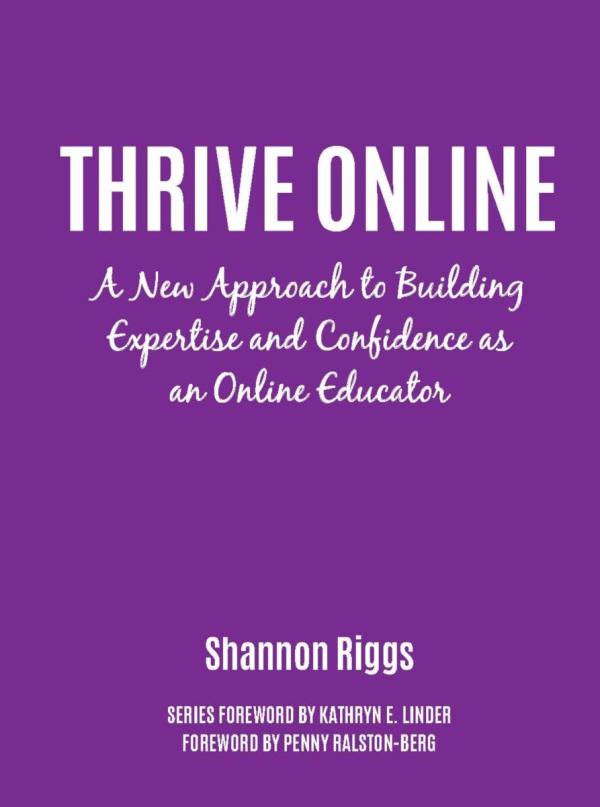
Research shows that online education, when designed and facilitated well, is as effective as traditional campus-based instruction. Despite the evidence, many faculty perceive online education as inferior to traditional instruction—and are often quite vocal in their skepticism. Simultaneously, however, more and more students are seeking online courses and degree programs. Thrive Online: A New Approach to Building Expertise and Confidence as an Online Educator is an invitation for the rising tide of online educators who are relatively new to teaching online, and also for those more experienced instructors who are increasingly frustrated by the dominant bias against online education. Readers will find: • An approach that empowers online educators to thrive professionally using a set of specific agentic behaviors • Strategies for approaching conversations about online learning in new ways that inform the skeptics and critics • Strategies that celebrate the additional skills and proficiencies developed by successful online educators • Guidance for educators who want to feel natural and fluent in the online learning environment • Guidance for enhancing the user-centered nature of online spaces to create student-centered learning environments • Encouragement for online educators to pursue leadership opportunities The internet is changing how people communicate and learn. Thrive Online: A New Approach to Building Expertise and Confidence as an Online Educator offers guidance, inspiration and strategies required to adapt and lead higher education through this change. This book is for higher education instructors who are seeking community, a sense of belonging, and the professional respect they deserve. Thriving is not a reaction to our environment, but rather a state of being we can create intentionally for ourselves. The time has come to change the conversation about online education. Add your voice – join the community and #ThriveOnline. (From the Publisher)