Resources

Students are in crisis. How can they keep up with their academic life when the pandemic has all but assured that their personal and emotional lives are experiencing some measure of turmoil or trauma? The novel coronavirus has upended every area of society. There is no sector of public or private life that it has not affected. Faculty at institutions of higher education have been reeling from figuring out how to transform their in-person classes into a virtual format in the blink of an eye. On the other side of these virtual classrooms, students are themselves reeling from all of the changes. Professors are telling stories of students flooding their inboxes with messages expressing anxiety, an inability to focus, and an inability to keep up with their assigned work. As a result, many realized that students are carrying so much emotional and psychological distress that they need professors to be sensitive and mindful of their circumstances outside of the classroom. Without a doubt, they are right; students are drowning and they need faculty to throw them a lifeline. Professors are seeing that they need to “shift gears” to exclusively online formats and shift their expectations and requirements for students. Higher education in the age of the Covid-19 has professors making changes that are sensitive to what is happening in the students’ lives outside of the virtual classroom. Many have taken their cue from those like UNC-Chapel Hill Professor Bandon L. Bayne who made headlines after he amended his own syllabus and expectations for his students when classes were forced to go entirely online. Bayne explained that he discovered that his students not only had “a whole range of differential access to material,” but also that students were all treading water trying to navigate their own anxieties about the pandemic and their varying family and life contexts. Thanks to the pandemic, many in higher education are realizing what has always been true--that they must keep in mind the whole student when teaching. They are learning that teaching during a pandemic means that being an educator entails more than pedagogy, it includes structuring classes around the premise that student circumstances outside of the classroom have a direct impact on their ability to navigate the classroom and to meet classroom expectations and requirements. Faculty are learning that this was always the case, even in the pre-pandemic world of higher education. In our current Covid-19 world, many rely on the Centers for Disease Control (CDC) for guidance and updates about this relatively unknown virus. Yet, the reality is that the CDC had already warned of a public health issue that has a direct impact on the functioning of students in higher education before they ever heard the words “Covid-19” or “coronavirus.” In November 2019, a few months before Covid-19 began spreading across the globe, the CDC declared trauma a public health issue. Additionally, before the CDC made this declaration, faculty across disciplines were seeing college students navigate what seemed like ever-increasing mental health crises. Increasingly, students have been dealing with mental health barriers coupled with rising rates of mass gun violence and campus sexual assaults. Experts have long suspected that many college students carry the effects of childhood trauma well into adulthood, in addition to having to navigate the challenges and realities of modern college life. Many of us who teach in higher education can testify to this pre-pandemic reality. We have known students whose educational experiences have been marred by mental health crises. Many bright and promising students are forced to forgo their educational pursuits in order to tend to untreated and unresolved trauma which commonly manifest themselves during the college years. Other students may not forgo their educational pursuits, but lean on maladaptive coping mechanisms or sacrifice the quality of that educational experience with an academic performance that is not indicative of their ability. These are all pre-pandemic realities. As a result, the needs of students during this pandemic is teaching educators to always be mindful of students’ circumstances outside the classroom in order to educate the whole student in the classroom. The students of this pandemic are tasked with more than meeting the expectations and requirements of the classroom (virtual, or otherwise). In this respect, while everything has changed, nothing has changed.
By this time in a semester, the ebbs and flows of a well-designed and well-facilitated class would, in normal circumstances, have allowed a community of scholars to flourish. These learning communities help promote critical dialogue with academic peers and help to foster a pluralism of varied perspectives that ultimately serves to elevate the collective outcomes. But what if this process is arrested before this can be achieved? The on-going pandemic has created a reality unlike anything we’ve seen, but, as educators, it is incumbent upon us to ensure that these features can continue to persist. Synchronous virtual instruction (Zoom, Google Meet, Webex, etc.) aims to take the place of the in-person component of our traditional means of teaching. While there is a distinct pleasure in being able to ‘meet’ as a class, the interpersonal conversations are limited and real connections are more challenging to create. In my experience, one reason for this is that virtual sessions are planned to be delivered in an online reality and not as a virtual representation of a normal reality. The best virtual session I ever planned with my students happened by accident because I did not plan it to be virtual. A sick baby necessitated an in-person session becoming virtual, so I adjusted my completed (in-person) plans to fit a virtual lesson setting instead. Findings from this fortuitous accident--shared below--have helped frame how my fellow faculty and I view online instructional delivery. In the scope of my normal lesson planning structure, I generally aim to promote engagement and discussion via a variety of activities that tend to be relatively short in length (~20-30 minutes). To accomplish this within a Zoom, I plan for small bits of synchronous time balanced against asynchronous tasks and breakout rooms to encourage engagement and to ensure that sessions are not rote or boring. By sharing the time amongst different components, lessons become more natural, and the time goes by quickly. Another hallmark of my instructional planning approach is that I strive to offer students opportunities to engage with one another around critical issues and to leverage their budding expertise to share their thinking with their peers. To translate this to a virtual environment, I rely heavily on Google Slides to build a mechanism whereby students can collaborate and engage with one another. For instance, to replicate a gallery walk or anchor chart presentation, I design a template slide for each group that gives students instructions and frames their work. From there, I share this document with each student and change the sharing privileges to “anyone with the link can edit.” This document then functions as a collaborative space for groups of students to work together on a task that they can then share with their peers. To broaden the social/connection aspects of this activity, I utilize the Breakout room feature in Zoom to assign students to random groups. A final area of focus when thinking about delivering instruction in a virtual way is to fashion opportunities for students to engage with one another on a more personal level. To help with this, I open and close with do now exercises and exit tickets that have less to do with the explicit content of the session, and more to do with promoting the well-being and engagement of students instead. While we always want to maximize the amount of time that students are exposed to instruction, in the unique environment of a Zoom, taking some time for these kinds of activities pay off. When all is said and done, our duty as educators requires us to do what we can to help lead our learners towards achieving their potential. As we continue to learn more about how best to work with our students in these uncertain times, a great first step is to think through planning and delivery using this lens: Plan as though you are delivering your lesson to a full class of students, Incorporate virtual techniques to approximate in-person experiences, and Allow yourself (and your students!) grace to spend time with each other and to value the benefit of social interaction. While learning will continue for many, for some, this transition to a virtual classroom will be crippling. Recreating a learning community in a virtual setting will help those students reestablish connection with their peers and their professors, and hopefully offer an avenue for all to reach higher levels of achievement.

My teaching style has always been a bit on the lighthearted side; I crack jokes, use ridiculous metaphors, draw inelegant pictures on the whiteboard and make my students guess what I’m trying to convey in an odd version of academic Pictionary. Being funny is a great way to keep students engaged! But now that my school, along with everyone else’s, has gone fully online for the duration of the semester, I’ve had to reframe my humor–what I usually think of as a useful teaching tactic, I now see as an indispensable tool for teaching effectively in a global pandemic. It’s already cliché to say that everybody’s stressed out by this health crisis, but the sheer variety of ways to be stressed is staggering, and my students seem to embody every one of them. I teach at a women’s college where traditional undergraduates learn alongside non-traditional working students; about a quarter of whom are parents. We’re heavy on the health sciences, so while lots of our undergrads are suddenly unemployed from their server and retail jobs, those who work in pharmacies, elder care, and hospitals are being begged to pick up extra shifts. My classes are an eclectic combination of the desperately bored and the profoundly overworked. The only thing they all seem to have in common is how badly they need a laugh right now. I can’t cure their anxiety, but I can offer them a momentary opportunity to forget about it while they’re smirking at one of my quips. These little breaks are a big part of how we can cope with our new normal. I usually rely on reading a room for my jokes, so I’ve had to get more creative. I’m terrible at creating dynamic PowerPoints, for example, and I’m now using them for nearly every lecture. To keep things interesting, I insert snarky comments into my slides making fun of my own dismal formatting and don’t call attention to them while I present, leaving them like Easter eggs for the attentive watcher. When I require Zoom meetings, I ask every attendee if they have a nearby pet or small child they can put on screen for the rest of us to coo over before beginning our discussion. I’m still teaching loads of content in the midst of all these less-serious moments, but it’s obvious that the content flows better when I make space to be a little silly. When my students pop up on webcam to talk about their upcoming papers, they’re visibly tense–this disappears almost immediately when I say that I do want to talk about their paper, but I also insisted on this meeting because I’m lonely and want to be reminded that other humans exist. They smile, I smile back, and for a second or two, they feel better–and then are better able to listen and learn. Beyond benefiting my students, prioritizing humor also helps me look forward to teaching and gives me a hint of that refreshing energy I used to get from being in the classroom with so many personalities. Staring at my laptop for hours on end is a little more bearable when I’m also thinking about whether there’s a way I can insert a picture of a chicken into my presentation so it’ll flash on screen at random intervals while I’m talking. Teaching is a haven for me amid my own apprehension, and it feels even more purposeful when I can try to make it haven for my students too. There is no one teaching style that will spell perfect success in this tumultuous time, but for even the most serious professor, I urge you–try for some silliness! Change your Zoom background so you look like you’re lecturing from the middle of the zombie apocalypse, offer pictures of your pet as a reward for students completing required tasks, come up with a rude nickname for your online learning platform (I like to refer to Canvas[1] as “that jerkwad”) and use it whenever part of your haphazardly constructed course site doesn’t work the way you thought it would. Give yourself the gift of being a little ridiculous, and you’ll find that your students’ attitudes–and their work–will benefit from the break. [1] No offense to Canvas. It is a beautiful, elegant system, even when I can’t for the life of me figure out why it keeps taking assignments off of the student to-do list.
The previous blog in this series focused on “long shot” (“big picture”) editing, specifically, revision tasks related to changing scenes and cutting. This final blog in the series zooms in to “medium-shot” and “close-up” editing. I realize that not all preachers have time to focus on revisions every week. While I cannot offer extra time, I can offer recommendations from filmmakers to preachers who have only 30 or 45 minutes to revise their sermon prior to Sunday morning. Medium-Shot Revisions Choose one major move/section of the sermon and focus on setting the scene with vivid language that sparks a variety of senses. The preacher does this by first visualizing the scene and providing a “thick description.” Filmmakers can be helpful guides since they make hundreds of choices in order to provide scenes that create the desired impact on the viewers. Looking carefully at their craft can hone the preacher’s skills for description. Try this exercise: Choose a scene from a favorite film. Press pause and write your responses to the following questions. Where is the scene? How do you know? What objects appear in the scene? What details give you clues about the characters in the scene? What is the major color scheme in the scene? What mood does it create? What do you think happened just prior to this scene and what is likely to happen after? What in the scene involves your hearing? your sense of smell? Now go back to the major move in the sermon and describe your scene using the same prompts. This process helps you visualize the scene so that you can describe it in a way that helps your hearers visualize it . . . without a screen. Writer Janet Burroway summarizes this well: “The first requisite of effective setting is to know it fully, to experience it mentally; and the second is to create it through significant detail.”[1] One caveat: refrain from getting carried away with details that don’t actually advance the main trajectory of the sermon. In other words, not everything from the exercise will appear in the sermon. Keep only those descriptors that move you to the next section. Close-Up Revisions We now zoom in on individual phrases and words. The art of choosing just the right word is not lost on the preacher. In fact, sometimes we agonize over just the right word. I would like to recommend that preachers spend time on the particular phrases that serve as transitions from one major move (section) to the other. Once again, films can assist. Take a segment of the film you engaged above and watch the film until you’ve identified two to three scene changes. Once you’ve done that, take a closer look at the transitions themselves. How does the filmmaker guide us from one scene to the next? Are there hints in the previous scene that we will be moving to a new scene? Or, is the scene change abrupt? If so, why? What effect does an abrupt scene change have on a viewer? Once you’ve engaged the transitions in the film, return to your sermon draft to analyze its transitions using similar questions. The first step is to make sure that there are transitions. Second, identify the roles the transitions play. In his book, The Witness of Preaching, homiletician Tom Long suggests that connectors (his word for transitions) accomplish four communication tasks: provide closure for previous segment indicate how upcoming section is related to previous anticipate the content of the next section helps listeners adopt a stance Finally, be creative and not clichéd. There are common transitions that belong specifically to the genre of sermons, for example, “In today’s gospel reading . . .” You’ve heard it. You’ve said it. But why not be more creative, especially since when you begin to talk about Peter, we know you are referring to the section of scripture that was just read. Instead, if you are transitioning from a contemporary story to something that happened with Jesus and disciples, try this: “We weren’t the first to be in awe of Jesus’ capacity to calm the treacherous seas of life. The disciples saw it first-hand . . .” Again, while I cannot gift preachers extra time, I hope these recommendations, gleaned from the wisdom of filmmakers and their work on the screen, might at least offer some editing possibilities if and when preachers find they have extra moments once they’ve got their “rough cut” on the page. [1] Janet Burroway, Imaginative Writing: The Elements of Craft (147).

Staying connected to students will be very important in the coming months–for their sense of well-being, for their academic success, and for their persistence. Managing student needs and expectations while teaching remotely can be more challenging than in the traditional classroom where students might catch you before or after class. Students might be in different time zones, have responsibilities that make it hard for them to participate in synchronous activities (in real time), or they may lack the technological capability necessary to connect. You will want to consider both synchronous and asynchronous options to make sure that all students have equitable access to your support. Asynchronous Options Despite the asynchronous nature of communication in many online courses, students often expect an immediate reply to their questions without considering the time of day they posted, or the possible complexity of the reply. One method for effectively addressing this concern is to clearly establish virtual office hours and a policy on when and how you will respond (e.g., within 24 hours). • Forums are a good way to respond to students if questions are relevant to more than one student and do not require confidentiality. On Canvas, you might occasionally post a discussion prompt such as “What questions do you have about the upcoming assignment?” You may just tell students that you will respond within a certain period of time. This reduces multiple email responses to the same question and also archives the questions and responses for later access. • Toward the end of a challenging unit, you might ask students to submit to you their “muddiest point”–what is it they still do not understand or are confused by. You could ask them to email you or answer anonymously through a Qualtrics survey. This allows you to respond in one post, video, or email to address the biggest challenges students are having with the material. • You can also ask students to post their questions about the material in a Google doc or discussion board in Canvas and let them respond to each other’s questions if they know the answers. This helps create connections and increases peer learning. In this strategy, you may want to wait to chime in until a pre-communicated period of time has passed so that you don’t inhibit participation. • Email can also work quite well, though you may want to designate a specific, consistent subject line (e.g., “Question about CHEM 100”) to keep track of the topics. You may be able to respond to the common questions or concerns at one time in a Q&A format. Synchronous Options Zoom, WebEx, and the good old-fashioned phone can work for real-time meetings. However, you will want to poll your students to determine possible times for everyone. • Synchronous office hours are sometimes an individual affair, but they also can be for groups when the focus is a need common to many students. This can be more fun and will save you a lot of time! In Zoom you have the option of setting up a waiting room where you invite students in one-by-one. You can have students make individual appointments with you, or in the case of a larger class, assign them to come in groups. You can also create “common concerns office hours” where all students can elect to join. • One way of determining common concerns: At the end of a virtual class, you can ask students to post their “muddiest point”using the whiteboard in Zoom or through Qualtrics to preserve anonymity. Or you can give them a few minutes to put their questions in the chat. You can then offer virtual office hours to respond to themes that emerge. You can also meet with groups about projects, conduct reviews before an exam, or host a drop-in Q&A–remember to record the session for those who can’t make it. • Providing a contact telephone number is another option, although instructors should clearly designate appropriate calling times, as well as how and when they will respond to voice mail messages. For some students, this might be their best way to join you. Students will often be working in the virtual classroom at all hours of the day or night, so maintaining clearly understood communication channels is essential for the ongoing success of the online course. Some additional things to plan for • The times during the semester when students will need more support, e.g., a week before an assignment is due or an exam will be held. • Whether you want students to drop in or schedule an appointment (in Zoom there is a virtual waiting room, and you can let a student or group of students in at their scheduled time)?

We’re in the middle of a pandemic with no clear end in sight. At the same time, many of us are taking a crash course in teaching online that we didn’t sign up for, and we’re handling it with varying degrees of success. Given all that, what should we focus on during the remaining weeks of our classes? Start by taking your students into account. How are they doing? I’m at a small, Catholic college, and I’m teaching required, first-year general education classes this semester. My students were OK for the first two weeks of online classes, but they seem worn out now. They tell me that their professors were understanding at first, but then they returned to business as normal, creating a pileup of papers and exams just as the students were getting more tired and discouraged. I didn’t like hearing that. For this semester, please, don’t worry about covering content and let’s lower our academic standards whenever it seems appropriate. Let’s focus on what our students need. So, what do our students need right now? Most important, they need our compassion and patience, and they need simple explanations of critical information. Even my stronger students are struggling to retain information because they are anxious, unfocused, and tired. Many of them worry needlessly and endlessly. One girl has asked me five times whether I’ll punish her for her intermittent Internet connectivity problems. I’ve reassured her repeatedly, but I suspect she’s still worried. And all that worrying is making her even more tired and less able to learn. I now spend the first few minutes of each class checking in, reassuring them, and reviewing basic information like course registration dates. With some trepidation, I promise that their other professors are reasonable people, and I coach them on how to talk to them. I use anonymous surveys to surface their concerns about their classes and the college. We discuss stress management and try to calm down. I’ve ordered all of them to take at least one full day off over Easter. I reassure, and explain again and again. I’ve lowered my academic expectations. When my students struggle with understanding basic instructions, it’s counterproductive to assign them long and difficult readings. So, I shorten the readings, and I use videos or pictures instead whenever possible. Comparing Michelangelo’s “Creation of Adam” to Harmonia Rosales’ reinterpretation, which presents God as a black woman, allowed us to discuss many of the same issues as the feminist reading I had on my syllabus. And dropping the reading made my students just grateful enough to engage with the images when I asked. I’m also revising the content of the last part of my course. As instructors in philosophy, theology, and religious studies, we are well positioned to have existential conversations with our students. After all, such questions are at the core of our disciplines! I’m focusing on questions at the intersection of my background and the current moment: Is happiness a choice, or do our circumstances determine whether we can be happy? What can we know and what should we do in the absence of certainty? Who do we trust? Why does God allow suffering? Does suffering make us better and stronger? How can religion be a source of strength? What about people who don’t believe in God? I’m inviting my students to draw on their experiences in their papers. They are crafting arguments about why God might allow the COVID-19 crisis and about how their experiences are making them stronger (or not). They are considering ways in which the burdens, yet again, fall disproportionally on some groups and asking how that might complicate the picture. They reflect upon how the crisis is affecting their own faith and on the possibility of staying happy and resilient in a crisis. I’m drawing on texts I’ve already read and questions I’ve thought about before. I’m too tired right now to invent anything new! Your version will be different, focusing on your questions rather than mine, using texts you’ve read, movies you’ve seen, and art that has moved you. Experiment. Invite the students into a conversation that uses your discipline to help make sense of their experiences right now. But don’t drive yourself crazy. If nothing comes to mind, stick to a gentler version of your original plan. Be kind to your students, but also to yourself.
Quarantine strips life down to the bare essentials. My work gets me out of bed each morning and through each day. Admittedly, before quarantine, the demands of work structured most of my days and a significant portion of my life. The difference is that during quarantine I am more willing to admit that I have been reduced to my work with little else left that is life-giving. Facing this reality allows me to face the truth that I have been living through a series of stressors. My life over the past five years has been marked by transitions: relocation to a new city, a new administrative role, a divorce, co-parenting arrangements for pre-teen, now teen boys, purchase of a new home and the attendant address changes, packing and unpacking. These were papered over by a full professional life packed with teaching, academic writing, professional conferencing, mentoring, administration, leadership in my various academic groups. These stressors built to a full boil with the death of my brother in mid-March and the experience of having to view his burial via YouTube. Quarantine has brought escape routes and pathways for deep connections that the hectic pace of academic life under “normal” circumstances would have eliminated with the constant demands for productivity and keeping on top of schedules. Quarantine has reduced my work from its tangible realities to greater screen time that facilitate the escape habits I have honed over the course of my career. Teaching online is not entirely new to me; what is new to me is teaching from the space where the majority of my life and critical life moments are lived out in front of screens and through pixilated images. As waves of grief have come over me in the past weeks, I recognize how work forces me to acknowledge and name my teaching as a coping strategy. The routines of the week require me to perform and to show up for class times, respond to discussion posts, read and grade student writing, attend meetings. I pushed myself through with sufficient practice of showing up and pretending competence. I now see that teaching during these times sits within a simulated world. Simulation has always fed my need to escape, as it has for many other persons. Simulating grief, pain, loss, and stress can only go so far, for as Bessel van der Kolk reminds us, “the body keeps the score.” Teaching can be a means of pretending things are ordinary. Making minimal changes to the syllabus, expanding topics to take account of the current context, or adjusting grade expectations. All these adaptations are coping mechanisms for me to tell myself, and my students, that we were carrying on with the ordinary events of academic life. In these online spaces, we facilitate a grand simulacra and escape to familiar worlds of knowledge and competence. I am fine with the escape only because it is a means of survival at this time. I recognize all too well that the theories of online education presume that the digital world serves as the adjunct to the flesh and blood realities of teachers and learners. Now we are truly in flipped classrooms where flesh and blood encounters form less and less of our daily realities and the digital becomes the default reality. In these days of disconnection, I am finding that other forms of social gatherings in online settings need to be named as pale reflections of the real thing. Part of my grief is wishing I had been next to my parents and siblings as we said goodbye to our older brother. I long for real connections, preferring the comfort of a friend’s voice over an email expressing condolences. I long to be in real conversations with a worshipping community, and not listening to someone talk at me through a screen. These real connections that formed the parts of our real-world communities are a long way off. Until then, I face the reality that I am my best human connection. In normal times I might find this thought too self-absorbed. If disconnection gets me to fall in love with me again, to love the parts of me that are energized by teaching, to love fiercely the liberative work of my academic research, then I am achieving what Derek Walcott refers to as loving “again the stranger who was your self.” Now I am thinking of ways to teach through my body and my responsiveness to my body’s pain, my vulnerability, and longings. This means inhabiting biblical characters with greater empathy and asking students to stretch their imaginations away from orthodox inspired interpretations of biblical texts to find real connections with the feelings, fears, and experiences of biblical texts that in many ways have been formed in the midst of trauma. I’m developing exercises that ask students to read texts as they look through their windows at the world they mostly experience through imagined senses and translate those experiences into looking at the ancient world in the Bible as if peering at them standing at the window of their homes. I am learning how to harness the genius of D-Nice’s Club Quarantine parties that call people together around a screen event lived out in bodily movements in individual homes. To teach online now not only means attending to the onscreen activities, the strategies of well-crafted pixilated pedagogy, but also doing the hard work to pay attention to what happens offline with us as teachers and with our students.

Discussion forums in online classrooms are unfortunately named. The name evokes just talking about stuff. This can be a good use of the discussion forum; dialogue is an important part of higher education. The opportunity to test and develop ideas in conversation with trusted colleagues, both classmates and professors—yes, the discussion forum is a place to do that. But, I find I often get into a rut in these forums. I introduce and assign readings, then ask a series of questions to jumpstart a conversation. At its worst, this is about making sure that students are doing the reading and making some sense of it, a kind of accountability busy work. At its best, this is a way to integrate and work critically together with those materials in ways that help them come alive and become true conversation partners for the developing wisdom of my students. I am always looking for other ways to better use these dialogical spaces with students. One of the metaphors that has been helpful for me is to use these spaces for students to “curate” materials for one another. By “curate,” I mean something like this: “to collect, select and present information or items such as pictures, video, music, etc. for people to use or enjoy, using your professional or expert knowledge.” For example, wise curating is what Maria Popova does in her excellent podcast and website, “Brain Pickings” (https://www.brainpickings.org/). Curating in discussion forums can take all sorts of forms, depending on your purposes and the disciplined knowledges you are attempting to teach. Here are some of the ways I have used it as a religious educator and practical theologian: • Curating Examples from Daily Life: When I am reading dense theoretical pieces with students (imagine Pierre Bourdieu or Paulo Freire), I invite them to find a website, image, or current event that illustrates one of the key theoretical concepts in the reading. This brings about a great deal of reflection on the concepts as the students try to imagine what might serve as a useful example of the concept in action. They often consider and reject many concepts as they try to find the one they will share, thus generating a more careful review of the reading. They post a link to the event or website and explain the concept that they see it illustrating to their colleagues. This has the subtle effect of helping them imagine that engaging these theories is not to demonstrate their competence for a grade, but to gain tools to better understand how the world works. It also serves as a test for the theories as we begin to see which ones have heuristic value making sense of daily life. • Curating Images: When we are working in my practical theology class on forming theological questions grounded in human experience, I invite students to offer a photographic image from their home or neighborhood that raises significant theological questions for them. As the collection of images are curated, they begin to see how questions are related to particular contexts and communities, as well as begin to think about what makes a question theological at all. Their colleagues’ reflections on their images generate a range of different theological questions and demonstrate the role of perspectival framing not just in the answering of questions, but also in their initial framing. • Curating Practices: In a religious education class I ask students to search the web for examples of contemporary religious educational practice happening inside or outside of communities of faith. They share the examples and analyze them, naming their strengths and limitations and how they might imagine using them in their own practice as educators. This not only gives them practice in identifying and analyzing resources, but also expands all of our knowledge about what is currently happening in the practice of the field and how it relates to the academic texts we have been reading. • Curating Stereotypes, or Common Misunderstandings and Misrepresentations: In youth ministry classes, I have students curate examples of the ways that adolescents are stereotyped and used as tropes in popular culture. They then take apart those stereotypes and tropes and compare them to what we’ve gleaned from developmental, sociological, and cultural studies of adolescence we have been reading. This enables them to identify where the tropes may have roots in those theories, but also where they have become distorted. Curating would serve different purposes in different disciplines, and I am sure you have creative ideas here. Students might curate examples of a particular Biblical text or historical event in visual art, poetry, literature, or song and talk about the interpretive choices made in that artwork. They might collect examples of practices from religious traditions in popular culture, or on YouTube, and analyze how they are represented in those forums in relation to the academic interpretations you are reading about those same practices. They might curate helpful video lectures or social media posts of an author you are reading, giving them a chance to listen to their embodied voices and discover something of the human behind the academic work you are reading. They might find examples of how historical events that you are studying are depicted on websites intended for elementary or middle schoolers and talk about the implications of historiographical choices made in those settings. They might curate academic articles that build on the theory you are reading in an area that is relevant to their own vocational path. The beautiful thing about online discussion forums is that curating, posting a photo or link, and then writing a brief analysis of the artifact, is very easy to construct. It leverages the investigative power of the students and allows them to follow their interests, integrate knowledge, engage in application and analysis, and discover connection between the subject matter and the broader world in which they live.
When we suddenly made the transition online, I wanted to try to maintain as much normalcy for my students (and myself) as possible. I teach a small, honors section of our introductory Religions of the World course. There are only 11 students enrolled this semester—a real luxury. I thought we might be able to continue synchronously, if they all were able. So, I asked: Did they have the technology to make it happen? Did they have the availability? Did they have the space? Did they have the desire? They did. After our first synchronous class session, the Monday after an extended Spring Break, I asked my class, anonymously, how it worked using Zoom for our class that day, in a PollEverywhere poll (which they were used to doing face-to-face). This is the kind of check in, a form of formative assessment, that I love. If I want to know what students think or how a class activity is going for them, I ask. Among their replies: “I really liked how we could all see each other” and “It will be a good way to keep the community feel.” We made it to the end of the first week, during which time I led whole-group discussions among all students, offered mini lectures, used Zoom’s breakout rooms to set up pair and group work, asked them to do quick writes and type their thoughts in the chat box, showed videos, and even had them share drawings on the computer screens. In their weekly reflections, which I’ve written about elsewhere, I asked them to respond to one additional question: “How did it go having our class online this first week?” As expected, students were struggling with motivation and time management, known challenges in any online learning environment. But they also shared: “This is the only class I use Zoom for and it also feels the most normal because of the level of interaction;” “I think having class online this week went well, especially since we are using Zoom, which I think helps preserve the community feel of our class;” I like the fact that we are able to break out into smaller groups and still have discussions with each other;” “I am really happy we are able to maintain the personal contact and the feeling that our class is a community.” What my students have reminded me, in this moment of social distancing, working remotely, and self-imposed isolation, is just how much they crave connection, how much they benefit from learning in place and among people. I work hard, in a variety of ways, to create this community in my face-to-face classes—and I have worked hard to maintain that communal feeling, even though we are now all separated, flung across the corners of the United States, with our cats crawling across the video feed and our classroom attire now consisting of grungy sweatshirts and bed covers. What this COVID-19 crisis has underscored for me is just how much students knowingly appreciate and crave those connections too. There are lots of ways to stay engaged and connected with your classroom community without all meeting at the regular class time as I’m doing. I recognize that what I’m doing may not be possible, or even advisable, for all religion instructors, given class sizes, content, personal comfort with technology, instructor and student availability, and so forth. Perhaps it’s as simple as creating an announcement on your LMS just to ask students how they’re doing—not academically, but as people. Perhaps it’s creating a Google Voice Number so that you can give students a way to text you, without giving out your private contact information. Perhaps it’s holding online office hours, through Zoom, WebEx, or Google Hangouts, so students can see you if they’re in need of a friendly face. Perhaps it’s calling all of your advisees, as one of my colleagues did, or reaching out to former students with a mass email. Perhaps it’s creating opportunities for pair or group work, for instance, through an online discussion board. Perhaps it’s simply sharing with students that you’re feeling anxious or stressed or worried or discombobulated too. On our campus, we are hearing from students (and sometimes from their concerned parents) just how disconnected, discouraged, and dissatisfied they are now that the human dimension of learning has largely been taken from them. Students do not simply want to read a textbook and submit a short essay in response. They want to talk to their peers; they want to hear from a real, live instructor; they want to sit in the same space; they want to learn in the context of others. A student once asked me, a few semesters back, if I thought learning always takes place among others. I said yes. Another student disagreed. By way of evidence, he said that he taught himself how to play guitar. I asked how he did that. He said he watched YouTube videos. Okay, I said, but who created those videos? There was a long pause. Learning is communal. Never has there been, paradoxically, a moment when this has been more clear—to me and to my students.
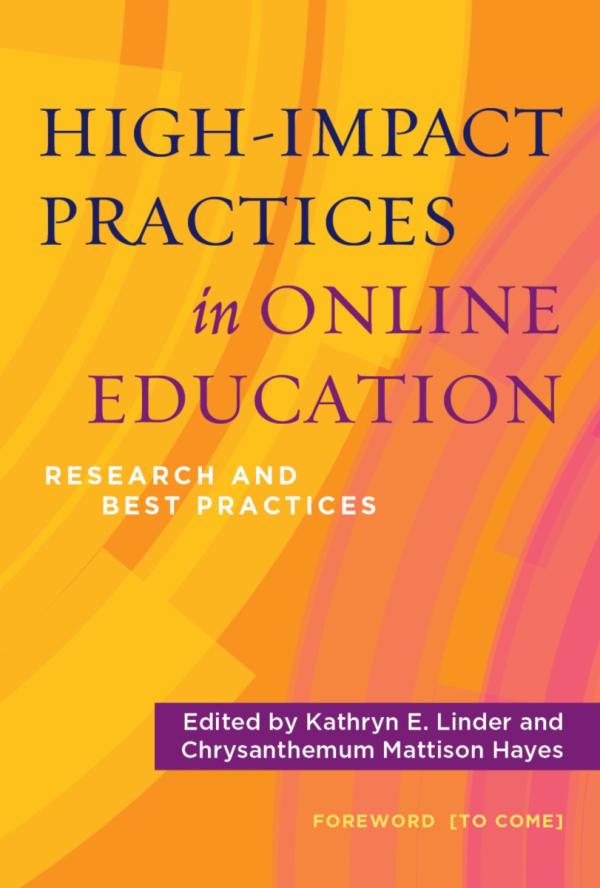
What are the potential benefits of high-impact practices (HIPs) for online education? That is the key question addressed in this well-researched collection of essays. Whether the reader is new to innovative theory and techniques in online education or an experienced distance educator, they will find a valuable resource here. Each contributor provides a helpful short list of key takeaways and a solid bibliography at the end of their chapter. The introduction and conclusion by the editors, Linder and Hayes, set the framework for the discussion and aptly describe possible future directions for teaching online, blended, or face-to-face courses. High-Impact Practices in Online Education reads like a dynamic conversation on research with practical recommendations for how to strengthen a variety of teaching contexts. Each topic selected for inclusion covers a specific high-impact educational practice. That list was largely identified in 2008 by George D. Kuh as ten critical components of undergraduate education. First-year seminars, learning communities (LCs), writing-intensive courses, and internships were among those featured components. These practices are still considered high-impact, but newer practices, such as ePortfolios, have been added in subsequent years. All have become part of developing educational strategies to impact student retention and graduation rates. So, where will readers find what they most need in this collection? For some, a particular topic will draw their attention. My suggestion is to resist that impulse. Try, instead, reading the introduction and conclusion before sampling individual chapters. Understanding the context for the conversation about HIPs matters. The research and literature in this emerging field has been somewhat scattered, but a representative sample is nicely gathered and incorporated into this single volume. There are no chapters specifically on theological education or religious studies. That said, there is much of worth to educators in those disciplines. For example, June Griffin’s “Writing-Intensive Classes” or Pamela D. Pike’s “Internships” speak directly to theological and religious educators. The same can be said about Stefanie Buck’s “High Impact Practices and Library and Information Resources.” No doubt other readers will discover other favorites as well. Remember that any one of these chapters could make a dramatic difference in most teaching and student learning. Is there one overarching idea offered as a takeaway? Yes, and it is that best practice principles are, in the end, more important than modalities. That is a valuable point to have in mind as exciting new technologies continue to emerge.