Resources
If your school is in the process of transitioning to online learning, Integrating Pedagogy and Technology may be the only book you need – it certainly should be one of the first you read. Bernauer and Tomei’s work is brimming with very useful information for schools in transition. The authors have devised what they call an “Integrated Readiness Matrix” (IRM) to assist institutions both in discerning how ready their faculty may be for this change and in moving them toward greater technological and pedagogical proficiency. “The goal of the IRM and this textbook is simple: move higher education faculty incrementally from lower left quadrants to more advanced upper right quadrants” (80). Considering how best to integrate technology into instruction “requires all faculty to be conversant with the theories of learning, the taxonomies and domains of learning, a new methodology for preparing and developing college faculty for a career of classroom teaching” (vii). The book includes a chapter on educational psychology, exploring the unique features of five pedagogies: behaviorism, cognitivism, humanism, constructivism, and connectivism. It builds to address taxonomies of learning, pedagogical skills and competencies, and technological skills and competencies. The lists of competencies and learning objectives for faculty development in chapters eight and nine are worth going over with faculty even by themselves. The authors, from Robert Morris University in Pittsburgh, model educational theory, using advance organizers at the beginning of each chapter, for example. Chapters may end with review sections, indices of concepts addressed in particularly complex chapters, suggested readings, and so forth. The preface introduces preconditions for using the Integrated Readiness Matrix, which is considered “sufficiently valid and reliable to serve as a basis for faculty self-assessment and professional faculty development,” to determine where each faculty member’s pedagogical and technological skills need bolstering (vii). Another strength of this book is its applicability to various kinds of learners and institutional contexts. This material is valuable whether you are teaching undergraduates, graduate students, or other adult learners. Your field does not matter; this is not one of those texts where everything must be translated in order to be useful to theological or religious-studies faculty. Reflective teachers and institutional administrators concerned about how to develop faculty competencies will both find appropriate and important resources here. Many institutions of higher learning are already in the process of transitioning to more online offerings. But this often happens in a haphazard, unorganized way, leaving certain faculty to carry the technological burden for the entire institution. Alternately, online expectations are introduced or imposed, but faculty are not empowered and trained to make the best use of technological tools, or pedagogical considerations do not enter the discussion. This book can be used to assist entire departments in training faculty, generating conversation about the pedagogical sophistication necessary to use technology well, and balancing technological and pedagogical considerations while transitioning to online learning.
For many reasons, universities and seminaries are asking faculty to teach more courses online. As a result, professors are ever vigilant for online strategies and tools that could help them with communication, interaction, and live online collaboration between professor and learners, learner and learner, and learners and course content. For professors in religious studies and theology who want to or are required to teach live online, this book is a good place to start. Based on years of research and experience, Cornelius, Gordon, and Schyma propose best practice guidelines in using web conferencing technology and provide helpful tips for teaching that is learner centered. Each of the ten chapters begins with an outline and concludes with a helpful summary. The usefulness of this book is its breadth in the coverage of materials for teaching in a web conference classroom. Chapter 1 covers creating the virtual classroom environment by using web conferencing technology to create the learning space that inspires learning and teaching. Chapters 2 to 8 follow, in a logical manner, the actual design of a live online course and cover preparation to teach in a virtual classroom, welcoming students to the virtual classroom, bringing professor and students together to the learning space, engaging learners, gaining feedback, helping learners work together, and assessing for learning. The authors conclude in chapters 9 and 10 with thoughts and tools to help professors assess their skills in the live online teaching environment and creative and inclusive ways of using web conferencing technology to support diverse groups of learners. Within each chapter there is a wealth of information and practical suggestions. From the beginning to the end the authors cover topics and practices such as: creating learning space, strategies to inspire students and professor, exploring the technology, planning live online sessions, building trust and rapport, engaging learners through activities, collaboration and group work, effective group activities, and student centered assessment. For instance, chapter 5 provides a good example of the breadth of information as it relates to engaging learners. The authors explain the importance of engaging learners; give examples of activities that can be used in any context, followed by step-by-step practical ways to introduce learning activities and activities that maintain student engagement. What is further helpful in this chapter and each of the chapters in the book is the way the authors cleverly interweave their narrative with actual teaching and learning experiences from teachers and learners that gives genuineness to the teaching and learning situation. In summary, Live Online Learning Strategies for the Web Conferencing Classroom succeedsbecause of thebreadth of information and depth of its application. Because it is written in non-technical language, this book will be especially helpful for new instructors who are beginning to teach online live. Its focus on teaching and learning issues and student-centered learning is a welcomed resource. w
Do students learn as well online as they do in the face-to-face classroom? Miller argues not only that they can, if the instruction is well-designed, but also that online tools and resources are uniquely able to deliver instructional experiences that take advantage of the innate properties of human learning. “[W]hat technology allows us to do,” she claims, “is amplify and expand the repertoire of techniques that effective teachers use to elicit the attention, effort, and engagement that are the basis for learning” (xii). Miller realizes that many faculty do not share her positive view of technology in instruction, however. She opens her book by targeting that resistance with well-reasoned and supported counterarguments: in chapter 1, she counters the fear that teaching with technology is a faddish, passing phenomenon with a recounting of its potential lasting value to both administrators and instructors; in chapter 2, she presents evidence for the effectiveness of online learning and against typical worries about its effects on students; and in chapter 3, she debunks several major myths about learners and computing that have made instructors skeptical or misdirected their efforts. Having assuaged common concerns about instructional technology, Miller moves on in chapters 4 through 8 to discuss current psychological theory on the functioning of attention, memory, reasoning, the effect of multimedia elements on learning and motivation, paired in each case with practical strategies to help online instruction optimize these elements. Her evidence is compelling even as it is presented at an accessible level for an audience with little to no background in psychology. Finally, in chapter 9, she presents possibly the most valuable portion of the entire work: a demonstration of all of her principles in practice, in the form of a sample design process and syllabus annotated to show their use of cognitive best practices. The value of Miller’s overall guidance is only slightly undermined by its fuzzy definition of learning for these purposes. Even as she describes how technology can impact learning, learning itself seems to be equated variously with retention, course completion, grades, and reasoning at different points in the text. In all fairness, each of these measures may well suffice at times for the instructor of a large introductory psychology class, which is the primary use case Miller discusses in this book; and to her credit, she does acknowledge the limitations of each of these as measures of student learning, and also explicitly notes the need for learning experiences that foster deep critical thought, and that engage students at the highest levels of Bloom’s Taxonomy. Nonetheless, a more intentional definition of what is meant by learning would do a great deal to strengthen her argument that online resources can support it. Despite this limitation, however, this book is a useful, readable guide to an area of instruction whose study is still in its early stages, unusually and gratefully practical even while firmly grounded in theory. It provides a valuable reframing of, and supplement to, the core principles of instructional design, and I expect it to inform my online and even face-to-face instructional practice for some time to come. I would recommend it for any academic library and for the personal collection of any instructor teaching, or considering teaching, in an online or blended environment.
“Teachers are like new parents,” Cari Crumly asserts. “[T]hey don’t want to be told how to raise their children or, in this case, how to teach their students. Yet, sometimes, even the least-experienced teacher can introduce new methods that engage, encourage, and promote motivation and participation among students” (4). Crumly lays down the gauntlet repeatedly in this book: “student-centered learning will revolutionize your classroom and reinvigorate your career” (5). As Crumly notes, “student-centered learning is a learning model placing the learner in the center of the learning process. Students are active participants in their learning, learning at their own pace and using their own strategies; they are more intrinsically than extrinsically motivated; and learning is more individualized than standardized” (4). Certainly there are situations in which (and learners for whom) more external structure is appropriate, but Crumly makes a very persuasive case for those being the exception rather than the rule. The good news is that if you are a teacher-centered professor, Pedagogies for Student-Centered Learning gives you everything you need to make changes in your teaching. There is an historical timeline to remind readers that student-centered learning is not a new fad; it’s been with us for centuries. There is a section on teacher-centered classrooms, so we can check whether we are (or are not) as student-centered as we’d like to think we are. There is information on understanding your learning population. There are examples from real classrooms about how student-centered learning can play out, and how it benefits students. Each chapter contains questions for investigation. There is also a list of instructional tactics, with commonly used exercises and the advantages of using each one. Appendices and URLs point readers to even more resources, and Pamela Dietz adds a section on how to bring faculty, administrators, and tech support on board. If you are a visual learner, there are a number of graphical elements that will assist in your assimilation of the material presented. Fortress Press’s new Seminarium: The Elements of Great Teaching series is ideal for twenty-first-century readers. QR codes dot the pages – but don’t worry, if you don’t do QR codes, the URLs are available in footnotes. This book is full of great, useful information – and points readers to more useful information online. Certainly, there are some distractions (for example, misrepresentations of quotations from other thinkers at times). Definitions of student-centered learning can become repetitive over the course of the book. And Sarah d’Angelo’s chapter on student-centered learning in a theater classroom contains a bit more information than is likely to be useful for religious-studies and seminary faculty. But none of these detracts from the benefits of the book as a whole. I have been reviewing books on teaching for ten years or more – this is easily one of the most helpful books I have ever reviewed, and one to which I will return often. I have attempted student-centered learning in a number of courses and contexts; it can be very hard to pull off successfully, and does require a rethinking of our role as faculty. While Crumly suggests that “The student-centered classroom, whether on ground or online, is characterized by individualization, interaction, and integration,” I did wonder how this might work in an online environment (10). I look forward to further exploring these possibilities.
What is the unique value of higher education? What is effective instruction? Is there a cost crisis that is threatening the value and efficacy of higher education? Can technology offer a solution? These are a few of the questions posed by William Bowen and others in Higher Education in the Digital Age. This readable and thought-provoking book consists largely of lectures delivered by Bowen at Stanford University in 2012. The discussion of these issues is expanded to include other voices of leadership in higher education, all of whom contribute responses to Bowen’s original lectures. Bowen addresses the pressures facing university administrators who must balance all aspects of post-secondary education: cost to students, quality of education, financial support of research, and costs of personnel. The first two of three sections are lectures Bowen delivered at Stanford. The first lecture describes the economic issues facing institutions of higher education, including problems of affordability and the lack of productivity-increases in higher education compared to other industries. The second lecture implores leaders in higher education to address the dual issues of rising tuition and rising expenditures and to, at the very least, try to slow the rates of increase. His possible solutions look to technology (online or hybrid instruction) to increase productivity. In so doing, he opens up a larger discussion on what qualifies as actual learning and what costs (to quality of education and to funding for development and implementation) are acceptable. The discussion among higher education leaders and administrators in the third section of the book is its greatest value. The discussion hits on many of the economic and societal issues Bowen brings up: the flattening of family incomes, rising tuition rates, issues of completion rates, the pros and cons of MOOCs (Massive Open Online Courses), and issues raised by the existence of for-profit degree-granting institutions. All of the authors come from top tier research institutions: Harvard, Stanford, Columbia, and Princeton. One wonders how different the conversation would be if more publicly-funded universities, smaller liberal arts colleges, or community colleges participated in the discussion. While some of the writers acknowledge this bias and seek to qualify it by examining data from other types of institutions, their solutions (that require a large amount of funding) seem removed from the reality at other institutions. In spite of this limitation, the authors of Higher Education ask questions that invite reflection and conversation, given the financial situation in which many institutions find themselves. What value do we offer our students? Will the drive to increase productivity take that value away? Does technology offer opportunities to improve education while also increasing productivity? Can online learning maintain what is most valuable in a liberal arts education? The solutions offered are not a total fix (by the authors’ own admission), but the dialogue initiated in Higher Education presents administrators, faculty, and staff with an opportunity to rethink and innovate traditional teaching methods.
This volume consists of fourteen chapters designed “to provide a useful handbook on adopting interactive Web 2.0 tools that promote effective human-computer interaction (HCI) in ePedagogical practice for education and training” (xv). Each essay presents data for the consideration of educators and administrators who are preparing to be or who are actively involved in virtual education. Primarily, the contributors explore using Web 2.0 tools such as Blackboard/Moodle, Facebook, Twitter, YouTube, wikis, and blogs, but there is much more. The chapters are divided into four sections. The first contains essays to help the reader think clearly about methodology as it relates to the continual evolution of online education. The second section consists of essays focusing on differences between synchronous (everyone must meet at the same time either in physical or virtual space) and asynchronous learning (done on one’s own time, such as watching recorded lectures or using message boards to communicate with other students). The third section focuses on how educators might measure student development in a virtual environment. The final section is the most technical with essays dedicated to the use of software and online systems. This book does not offer quick-and-easy steps for one to follow toward successful ePedagogy. It is dense, heavily technical at points, and it requires readers to set aside time to read attentively. An educator of theological studies will have to creatively search for ways to transfer information to their own setting since none of the essays are directly related to this field. The essays are social-scientific in nature. The testing conditions and criteria are unique to each particular essay, taking place in geopolitical regions as distinct as Australia, Canada, Indonesia, Taiwan, the United States, and Vietnam. The diversity is promising, offering encounters with a wide-array of scenarios wherein Web 2.0 tools function. On the other hand, the principles offered cannot be understood in a vacuum without reference to context. This book may be best used as an occasional reference. In other words, it is not the type of practical book one would read through in a few sessions. The most useful part of each chapter for the casual reader may be the list of works referenced at the end of each study. These short bibliographies invite further exploration. In summary, readers will find insightful academic essays that will assist them in their professional development as educators in a virtual context. The essays are based on data acquired through rigorous research. The uniqueness of each case study requires the reader to actively sift universals from particulars in order to determine what information may assist them in their own work, and the technical nature of the book will require non-experts to familiarize themselves with much of the vocabulary.
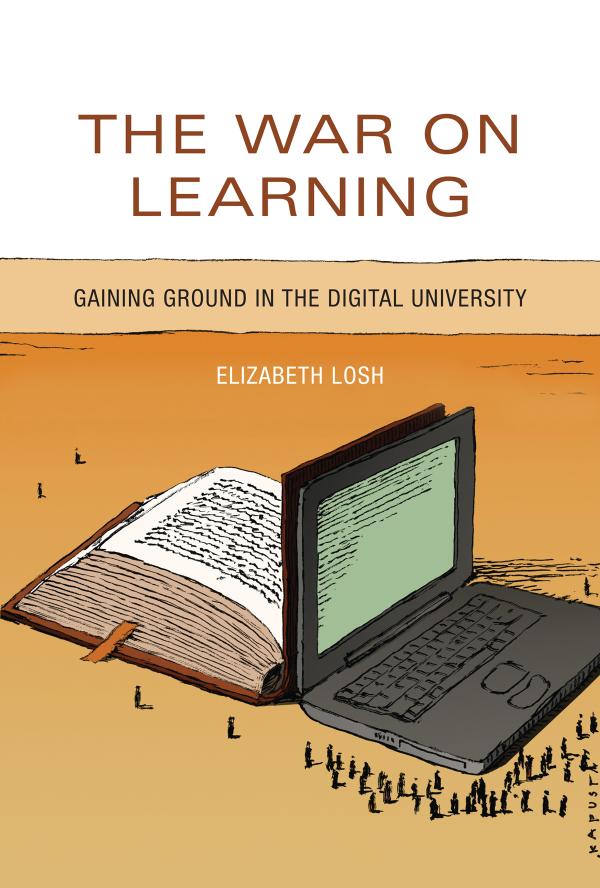
The War on Learning is an important contribution to public debate on new instructional technologies and the future of the university. A scholar of media history and digital rhetoric, Elizabeth Losh clarifies charged issues with her knowledge of historical context and a talent for cutting through publicity to identify the most important facts. In her first chapter, Losh describes how Good Morning America hoped to use her as “a voice of moral outrage” in response to online videos showcasing techniques for cheating on exams (19). To their disappointment, Losh was unwilling to paint an uncomplicated “us versus them” picture of how professors and students use technology. Losh’s thesis is that both sides are engaged in an “incredibly destructive war on learning itself by emphasizing competition and conflict rather than cooperation” (26). In her second chapter, Losh uses her teaching experiences to illuminate the “rhetoric of crisis” around the status of education in our culture (46). As a literature review which explains key moments in a conflict that is wide enough to include policing of student Internet activity and calls for the end of universities as we know them, it is here that Losh’s thesis is at its most persuasive. In the third chapter, “On Camera,” Losh explains how the online sharing of lectures turned one professor into a beloved celebrity and another into an object of ridicule. The war on learning is a costly distraction from the “digital literacy and competence in digital rhetoric” that is professionally important for both professors and students (89). The pedagogy of distance learning is reviewed in chapter 4 with the salient observation that the online lecture “often is more likely to resemble a traffic school tutorial rather than a compelling professorial performance” (109). Chapter 5 discusses “The Rhetoric of the Open Courseware Movement” with a critique of the optimism around platforms like Coursera and edX that is nevertheless respectful of their potential. Chapter 6 examines the technological struggle over plagiarism and the rise of Turnitin as a somewhat ethically ambiguous policing tool. Chapters 7 and 8 consider the merits of gadget distribution (for example, iPods and iPads) and efforts to create educational video games respectively. In the ninth chapter, Losh lays out six clear suggestions for making the digital university “more inclusive, generative, just, and constructive” based on “two decades in the trenches” (224). Losh argues that knowledge of the history of instructional technology and reflection on learning as process rather than product should precede elaborate plans for the digital university. This is not a book for professors seeking a step-by-step guide for bringing technology into their classrooms. Losh, in fact, mentions that she wrote this volume with college presidents in mind (14). I recommend it to anyone wanting a broader picture of how technology might impact the future of university education. With well-chosen case studies Losh provides a crash course on the history of instructional technologies and deep reflection on their implications.