Resources
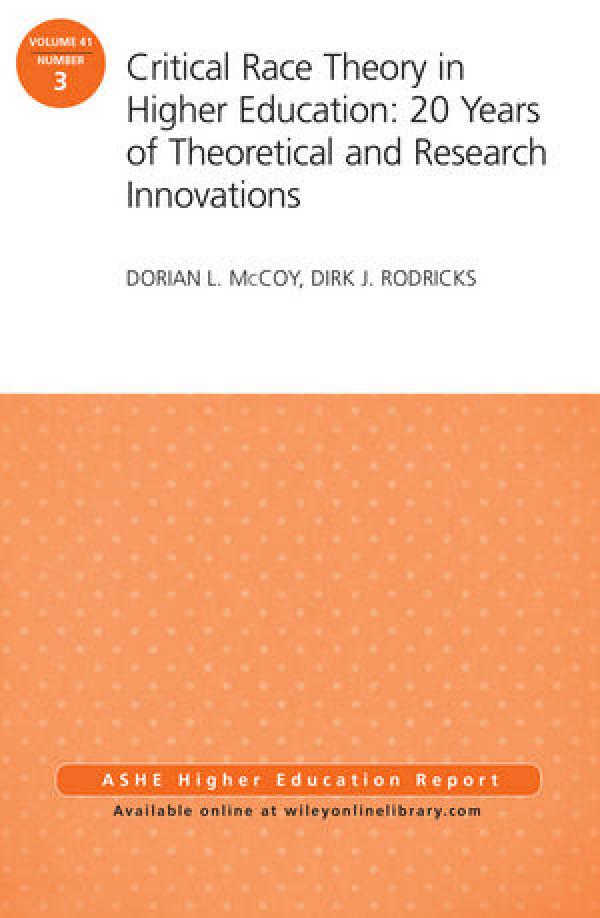
">Click Here for Book Review Abstract: Critical race theory (CRT) was introduced in 1995 and for almost twenty years, the theory has been used as a tool to examine People of Color’s experiences with racism in higher education. This monograph reviews the critical race literature with a focus on race and racism’s continued role and presence in higher education, including: • legal studies and history, • methodology and student development theory, • the use of storytelling and counterstories, and • the types of and research on microaggressions. The goal of the editors is to illuminate CRT as a theoretical framework, analytical tool, and research methodology in higher education. As part of critical race theory, scholars and educators are called upon to extend their commitment to social justice and to the eradication of racism and other forms of oppression. This is the 3rd issue of the 41st volume of the Jossey-Bass series ASHE Higher Education Report. Each monograph is the definitive analysis of a tough higher education issue, based on thorough research of pertinent literature and institutional experiences. Topics are identified by a national survey. Noted practitioners and scholars are then commissioned to write the reports, with experts providing critical reviews of each manuscript before publication. (From the Publisher)
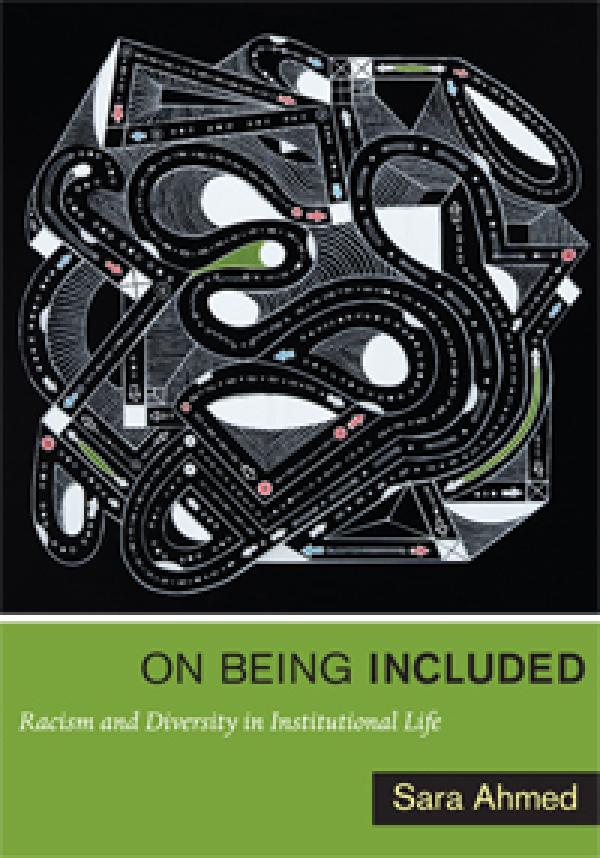
Click Here for Book Review Abstract: What does diversity do? What are we doing when we use the language of diversity? Sara Ahmed offers an account of the diversity world based on interviews with diversity practitioners in higher education, as well as her own experience of doing diversity work. Diversity is an ordinary, even unremarkable, feature of institutional life. Yet diversity practitioners often experience institutions as resistant to their work, as captured through their use of the metaphor of the "brick wall." On Being Included offers an explanation of this apparent paradox. It explores the gap between symbolic commitments to diversity and the experience of those who embody diversity. Commitments to diversity are understood as "non-performatives" that do not bring about what they name. The book provides an account of institutional whiteness and shows how racism can be obscured by the institutionalization of diversity. Diversity is used as evidence that institutions do not have a problem with racism. On Being Included offers a critique of what happens when diversity is offered as a solution. It also shows how diversity workers generate knowledge of institutions in attempting to transform them. (From the Publisher)
Click Here for Book Review Abstract: If you find yourself thinking or saying any of the following, this is a book you need to pick up. I know or suspect that I am underpaid, but I hate negotiating. I do everything else first and then write in the time left over. I’m not sure exactly what the promotion requirements are in my department. Since earning tenure, my service load has increased and my research is suffering. I don’t get enough time with my family. This is a practical guide for women in academe – whether adjuncts, professors or administrators – who often encounter barriers and hostility, especially if women of color, and generally carry a heavier load of service, as well as household and care responsibilities, than their male colleagues. Rena Seltzer, a respected life coach and trainer who has worked with women professors and academic leaders for many years, offers succinct advice on how you can prioritize the multiplicity of demands on your life, negotiate better, create support networks, and move your career forward. Using telling but disguised vignettes of the experiences of women she has mentored, Rena Seltzer offers insights and strategies for managing the situations that all women face – such as challenges to their authority – while also paying attention to how they often play out differently for Latinas, Black and Asian women. She covers issues that arise from early career to senior administrator positions. This is a book you can read cover to cover or dip into as you encounter concerns about time management; your authority and influence; work/life balance; problems with teaching; leadership; negotiating better; finding time to write; developing your networks and social support; or navigating tenure and promotion and your career beyond. (From the Publisher)
Click Here for Book Review Abstract: Presents the key experiences of a diverse group of teachers and students in their journeys of becoming social justice educator/scholars. This innovative book is a collection of autoethnographies by a diverse group of contributors who describe and theorize about the critical moments in their development as social justice educator/scholars in the face of colonizing forces. Using a rhizomatic approach, the editors’ meta-analysis identifies patterns of similarity and differences and theorizes about the exercise of agency in resistance and identity formation. In our increasingly diverse society, Becoming Critical is a wonderful resource for teacher education and sociology of education as it presents an alternative methodological approach for qualitative inquiry. The book contributes to students’ understanding of the development of critical theories—especially as they pertain to identities. The contributors make use of the work of critical scholars such as Collins, hooks, Weber, Foucault, and others relevant to the lives of students and educators today. (From the Publisher)
Click Here for Book Review Abstract: Theological education, like theology itself, is becoming a truly a global enterprise. As such, theological education has to form, teach, and train leaders of faith communities prepared to lead in a transnational world. The teaching of theology with a global awareness has to wrestle with the nature and scope of the theological curriculum, teaching methods, and the context of learning. Teaching Global Theologies directly addresses both method and content by identifying local resources, successful pedagogies of inclusion, and best practices for teaching theology in a global context. The contributors to Teaching Global Theologies are Catholic, mainline Protestant, and evangelical scholars from different racial and ethnic backgrounds, each with sustained connections with other parts of the world. Teaching Global Theologies capitalizes on this diversity to uncover neglected sources for a global theology even as it does so in constructive conversation with the long tradition of Christian thought. Bringing missing voices and neglected theological sources into conversation with the historical tradition enriches that tradition even as it uncovers questions of power, race, ethnicity, class, gender, and sexuality. Teachers are offered successful pedagogies for bringing these questions into the classroom and best practices to promote students’ global consciousness, shape them as ecclesial leaders, and form them as global citizens. (From the Publisher)
Those Good Gertrudes explores the professional, civic, and personal roles of women teachers. Its voice, themes, and findings build from the mostly unpublished writings of many women and their families, colleagues, and pupils. Geraldine J. Clifford studied personal history manuscripts in archives and consulted printed autobiographies, diaries, correspondence, oral histories, interviews—even film and fiction—to probe the multifaceted imagery that has surrounded teaching. This work stands alone: it is broad ranging, inclusive, and comparative. It surveys a long past where schoolteaching was essentially men's work, with women relegated to restricted niches such as teaching rudiments of the vernacular language to young children and socializing girls for traditional gender roles. Clifford documents and explains the emergence of women as the prototypical schoolteachers in the United States, a process apparent in the late colonial period and continuing through the nineteenth century, when they became the majority of American public and private schoolteachers. She finds that this trend continues in the twenty-first century, despite the diversion of women to competing professions, a precipitous reduction in the number of Roman Catholic nuns, and repeated efforts and incentives to recruit and retain male teachers. Cross-national comparisons suggest that America's early reliance on women teachers quickened and extended the reach of schools across the nation’s social classes, religious and ethnic groupings, and cultural and physical landscapes. The capstone of Clifford’s distinguished career, Those Good Gertrudes will engage scholars in the history of education and women’s history, teachers past, present, and future, and readers with vivid memories of their own teachers. The first woman to receive a Guggenheim Fellowship for research in education, Geraldine J. Clifford is professor emerita at the University of California, Berkeley. Her previous books include Ed School: A Brief for Professional Education. (From the Publisher)
Click Here for Book Review Abstract: In this wide-ranging book, Elana Michelson invites us to revisit basic understandings of the 'experiential learner'. How does experience come to be seen as the basis of knowledge? How do gender, class, and race enter into the ways in which knowledge is valued? What political and cultural belief systems underlie such practices as the assessment of prior learning and the writing of life narratives? Drawing on a range of disciplines, from feminist theory and the politics of knowledge to literary criticism, Michelson argues that particular understandings of `experiential learning’ have been central to modern Western cultures and the power relationships that underlie them. Presented in four parts, this challenging and lively book asks educators of adults to think in new ways about their assumptions, theories, and practices: - Part I provides readers with a short history of the notion of experiential learning. - Part II brings the insights and concerns of feminist theory to bear on mainstream theories of experiential learning. - Part III examines the assessment of prior experiential learning for academic credit and/or professional credentials. - Part IV addresses a second pedagogical practice that is ubiquitous in adult learning, namely, the assigning of life narratives. Gender, Experience, and Knowledge in Adult Learning will be of value to scholars and graduate students exploring adult and experiential learning, as well as academics wishing to introduce students to a broad range of feminist, critical-race, materialist and postmodernist thinking in the field. (From the Publisher)
A forum on race and teaching theology and religion, launched in the wake of the August 2014 shooting of Michael Brown and subsequent protests and police response in Ferguson, Missouri, but framed more broadly to encompass teaching for racial and social justice, dismantling the structures of white privilege in academia, and diversifying the faculty, the students, and the canon.
This is an edited transcript of a conversation between two founding women on the delights and demands of teaching and learning within and beyond traditional institutional life, facilitated by Lisa M. Hess of the journal's Editorial Board. The conscious feminine practices of a women's writing school, Women Writing for (a) Change (Cincinnati, Ohio), created the circle-container for the sharing of words and wisdom. Narrative, pedagogical, and organizational issues arose as the circle listened and examined the realities of contributing as a woman in higher education, yesterday and today.
Click Here for Book Review Abstract: What do women academics classify as challenging, inequitable, or “hostile” work environments and experiences? How do these vary by women’s race/ethnicity, rank, sexual orientation, or other social locations? How do academic cultures and organizational structures work independently and in tandem to foster or challenge such work climates? What actions can institutions and individuals–independently and collectively–take toward equity in the academy? Despite tremendous progress toward gender equality and equity in institutions of higher education, deep patterns of discrimination against women in the academy persist. From the “chilly climate” to the “old boys’ club,” women academics must navigate structures and cultures that continue to marginalize, penalize, and undermine their success. This book is a “tool kit” for advancing greater gender equality and equity in higher education. It presents the latest research on issues of concern to them, and to anyone interested in a more equitable academy. It documents the challenging, sometimes hostile experiences of women academics through feminist analysis of qualitative and quantitative data, including narratives from women of different races and ethnicities across disciplines, ranks, and university types. The contributors’ research draws upon the experiences of women academics including those with under-examined identities such as lesbian, feminist, married or unmarried, and contingent faculty. And, it offers new perspectives on persistent issues such as family policies, pay and promotion inequalities, and disproportionate service burdens. The editors provide case studies of women who have encountered antagonistic workplaces, and offer action steps, best practices, and more than 100 online resources for individuals navigating similar situations. Beyond women in academe, this book is for their allies and for administrators interested in changing the climates, cultures, and policies that allow gender inequality to exist on their campuses, and to researchers/scholars investigating these phenomena. It aims to disrupt complacency amongst those who claim that things are “better” or “good enough” and to provide readers with strategies and resources to counter barriers created by culture, climate, or institutional structures. (From the Publisher)