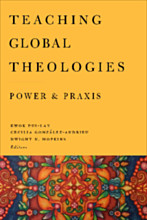
- Author
- Pui-lan, Kwok; Gonz√°lez-Andrieu, Cecilia; and Hopkins, Dwight N., eds.
- Publisher
- Baylor University Press, Waco, TX
- ISBN
- 9781481302852
- Table of Contents
-
Acknowledgments
Introduction
Part I - Global Theology and Why It Matters
ch. 1 Teaching Theology from a Global Perspective (Kwok Pui-lan)
ch. 2 Listening for Fresh Voices in the History of the Church (William A. Dyrness)
ch. 3 Teaching Global Theology in a Comparative Mode (Veli-Matti Kärkkäinen)
Part II - Identity, Power, and Pedagogy
ch. 4 The Good of Education: Accessibility, Economy, Class, and Power (Cecilia Gonz√°lez-Andrieu)
ch. 5 Identity Cross-Dressing while Teaching in a Global Context (Miguel A. Del La Torre)
ch. 6 Teaching Global Theology with Local Resources: A Chinese Theologian’s Strategies (Lai Pan-chiu)
ch. 7 Pedagogy for Being Human in Global Comparison (Dwight N. Hopkins)
Part III - Praxis and Responsibility
ch. 8 Teaching to Transform: Theological Education, Global Consciousness, and the Making of Global Citizens (Teresia Hinga)
ch. 9 Hablando Se Entiende la Gente: Tower of Babble or Gift of Tongues? (Loida I. Martell-Otero)
ch. 10 The Geopolitical and the Glocal: Situating Global Theological Voices in Theological Education (Eleazar S. Fernandez)
Notes
List of Contributors
Index
Click Here for Book Review
Abstract: Theological education, like theology itself, is becoming a truly a global enterprise. As such, theological education has to form, teach, and train leaders of faith communities prepared to lead in a transnational world. The teaching of theology with a global awareness has to wrestle with the nature and scope of the theological curriculum, teaching methods, and the context of learning. Teaching Global Theologies directly addresses both method and content by identifying local resources, successful pedagogies of inclusion, and best practices for teaching theology in a global context. The contributors to Teaching Global Theologies are Catholic, mainline Protestant, and evangelical scholars from different racial and ethnic backgrounds, each with sustained connections with other parts of the world. Teaching Global Theologies capitalizes on this diversity to uncover neglected sources for a global theology even as it does so in constructive conversation with the long tradition of Christian thought. Bringing missing voices and neglected theological sources into conversation with the historical tradition enriches that tradition even as it uncovers questions of power, race, ethnicity, class, gender, and sexuality. Teachers are offered successful pedagogies for bringing these questions into the classroom and best practices to promote students’ global consciousness, shape them as ecclesial leaders, and form them as global citizens. (From the Publisher)
Abstract: Theological education, like theology itself, is becoming a truly a global enterprise. As such, theological education has to form, teach, and train leaders of faith communities prepared to lead in a transnational world. The teaching of theology with a global awareness has to wrestle with the nature and scope of the theological curriculum, teaching methods, and the context of learning. Teaching Global Theologies directly addresses both method and content by identifying local resources, successful pedagogies of inclusion, and best practices for teaching theology in a global context. The contributors to Teaching Global Theologies are Catholic, mainline Protestant, and evangelical scholars from different racial and ethnic backgrounds, each with sustained connections with other parts of the world. Teaching Global Theologies capitalizes on this diversity to uncover neglected sources for a global theology even as it does so in constructive conversation with the long tradition of Christian thought. Bringing missing voices and neglected theological sources into conversation with the historical tradition enriches that tradition even as it uncovers questions of power, race, ethnicity, class, gender, and sexuality. Teachers are offered successful pedagogies for bringing these questions into the classroom and best practices to promote students’ global consciousness, shape them as ecclesial leaders, and form them as global citizens. (From the Publisher)