Resources

There was a time not long ago when the only complaints students levied against professors were that they assigned too much work or that their lectures were delivered in a soporific monotone. Today, radical changes in the composition of the university, the ongoing revision of canons and curricula, and the politicization of knowledge have profoundly altered the landscape, introducing an identity-based definition of credibility as an entirely new precondition of authority. As a result, questions that previous generations of educators never considered have taken on a central importance: Can whites teach African American literature effectively and legitimately? What is at issue when a man teaches a women's studies course? How effectively can a straight woman educate students about gay and lesbian history? What are the political implications of the study of the colonizers by the colonized? More generally, how does the identity of an educator affect his or her credibility with students and with other educators? In incident after well-publicized incident, these abstract questions have turned up in America's classrooms and in national media, often trivialized as the latest example of PC excess. Going beyond simplistic headlines, Teaching What You're Not broaches these and many other difficult questions. With contributions from scholars in a variety of disciplines, the book examines the ways in which historical, cultural, and personal identities impact on pedagogy and scholarship. Teaching What You're Not gets at the heart of the ongoing debates about identity politics in the academy, and society at large. (From the Publisher)
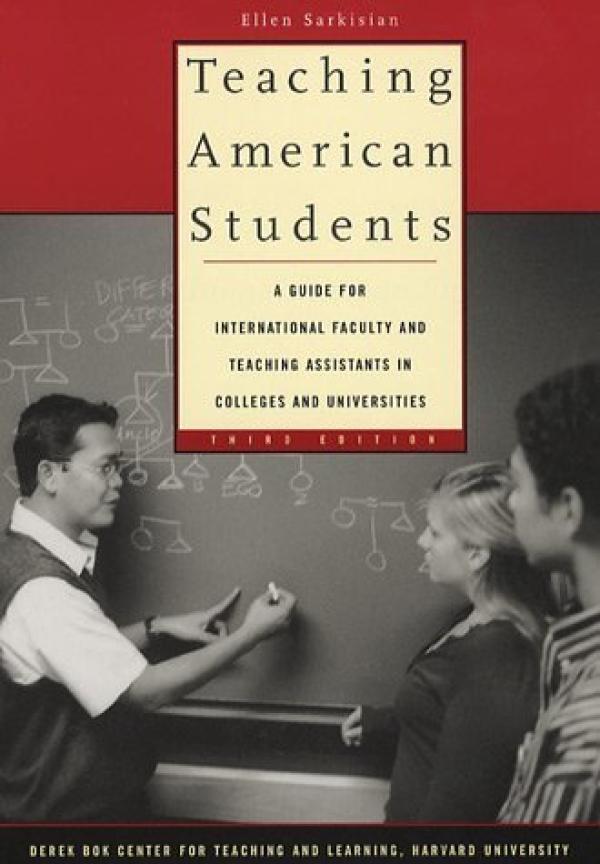
Many faculty and graduate students from other countries expect language difficulties when they teach, but are unprepared for other surprises: different cultures make different assumptions about the academic background of college students, how students learn, the appropriate roles of teachers and students, and even the fundamental purpose of a college education. The third edition of Teaching American Students explains the expectations of undergraduates at American colleges and universities and offers practical strategies for teaching, including how to give clear presentations, how to teach interactively, and how to communicate effectively. Also included are illustrative examples as well as advice from international faculty and teaching assistants. Appendices offer concrete suggestions on topics from planning the first day of class to grading papers and problem sets. (From the Publisher)

With a mixture of autobiographical facts and literary insights, the author (English, Kalamazoo Coll.) supports her belief that the ``motherheart must be at the center of all teaching.'' Teachers should ``create an environment where human beings can grow in and toward the fullness of themselves.'' This type of teaching is exemplified by the women teachers in higher education of the mid-1800s who, as the author found following her ``calling'' to Kalamazoo College, were the leaders in a profession that often brings teacher and student together in crisis situations, situations that the author believes are better confronted from a feminist perspective. This is a well-written, often humorous account of one woman's entry into the feminist side of academe. (From the Publisher)

Everyday Knowledge and Uncommon Truths: Women of the Academy draws on the life experience and varied backgrounds of academic women from the United States, Australia, New Zealand, and Canada. To provide diverse perspectives on women's experiences of being and knowing in and outside the academy, contributors draw on a range of critical approaches derived from feminism, post-structuralism, postmodernism, critical education theory, discourse theory and analysis, narrative inquiry, and life histories. (From the Publisher)
One of the most significant changes in theological education during the past two decades has been a dramatic rise in the enrollment of women in the seminaries. In this ground-breaking book, Rebecca Chopp explores the impact these new voices are having on theological education. She looks at how women and men are actually forming a new Christian praxis through their engagement with feminist practices and thought that often exist outside the sphere of official recognition. This important book will be a starting point for dialogue about the role theological education will play as this new Christian praxis emerges. (From the Publisher)
Controversies about affirmative action hires, admission policies, intercultural relations in the classroom, the role of ethnic studies departments, and changes in course curriculum all seem to swirl around the changing ethnic composition of the campus. How do we all get along? Tackling this question are authors Bowser, Auletta, and Jones, who suggest some practical strategies for dealing with questions of racism, diversity, and intercultural communication. (From the Publisher)

Roger S. Nam During my three years as a student at Chongshin Theological Seminary in Seoul, Korea, I never heard a single discussion related to diversity. The student body was roughly 90% male. Every student and faculty member was a member of the Korean Presbyterian Church, and engaged in some.
This book is dedicated to a full-orbed challenge to discrimination – and promotion of multiculturalism – in higher education, from the classroom to “changes in the cultures, structures, and policies of the institution” (194). It will benefit faculty and administrators seeking to better understand, promote, and implement solutions regarding various diversities in university contexts. While Christian educators may question certain philosophical and religious presuppositions being advocated, many descriptive, reflective, and practical insights can be critically embraced for pedagogy and classroom, course development, broader curricular intentions, and governing cultures and mechanisms. Perhaps centrally beneficial to faculty are the narratives of diverse women and men faculty – white and of color, representing both natural science and social science disciplines – responding to a face-to-face interview protocol of open-ended and broad questions: queries seeking responses to eight topical areas primarily focused on teaching and diversity, race and gendered experiences, general diversity issues in higher education, and agential roles in supporting or bringing change involving diversity and multiculturalism (26-28). This work’s broad purpose is to explore how university faculty members of various races, ethnicities, and genders – awarded for undergraduate teaching effectiveness in diverse classroom environments – engage demands and expectations from students, from higher education as a social institution, and from themselves, in racially and ethnically diverse classrooms: especially toward improving the teaching-learning process (viii-ix). The book comprises four parts: background and context, difference and diversity in classroom interactions, identity role examination, and larger contexts and change. Each part contains three chapters. References are extensive and effectively utilized and the index is well-designed. The opening chapter argues that white male dominance in university settings significantly affects white women and faculty of color, as well as students, especially of non-majority groups. Negatively, this includes exclusion and discrimination via traditions that focus on individualistic value orientation and norms that “diminish the importance of teamwork and skills in interactions among the faculty,” leading to a sense of isolation and lack of community (3). In the classroom the individual achievement emphasis, combined with presumed universalistic norms related to tests or criteria as indicators of merit, entail pedagogical approaches that minimize students’ cultural and socioeconomic identities, backgrounds, and relationships, undermining collaborative learning. Nevertheless, all faculty are responsible for personal and organizational change, whether white faculty especially using their authority to adopt practices that challenge the commonplace habitus, or underrepresented faculty utilizing the margin for building communities of marginalized faculty and links to communities and groups outside academia (19). Chapter 2 outlines the project/study design and purpose, “to explore the ways in which faculty members’ social identities impact their experience in the university, especially but not solely in the classroom” (21), while Chapter 3 describes and elaborates “five major constitutive elements of conflict in the educational setting” – the instructor, the student, the pedagogical approach, the classroom space, and the course material – that help readers decipher “how varied forms of conflict emerge given the different ways in which these elements converge” (39). Each element is expounded in later chapters. It seems appropriate to conclude this review with a primary thesis of the book: “ultimately, whatever the causes of perceived challenges to authority and expertise, the key pedagogical dilemma for faculty is to work at ensuring and preserving the authority that has a place in relationships with students while also maintaining an inquiring, empowering, and vibrant educational climate” (63).