Home » Resources » Scholarship on Teaching » Becoming Critical: The Emergence of Social Justice Scholars
Scholarship
March 29, 2017
Becoming Critical: The Emergence of Social Justice Scholars
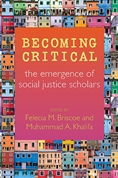
- Author
- Briscoe, Felecia M.; and Khalifa, Muhammad A., eds.
- Publisher
- SUNY Press, Albany, NY
- ISBN
- 9781438456553
- Table of Contents
-
Section I: Introduction and Overview of Book
ch. 1 Introduction and Conceptual Framework: Critical Theory, Social Justice, Power, and Autoethnography (Felecia M. Briscoe and Muhammad A. Khalifa)
Section II: Critical Race Autoethnographic Case Studies
Section II Introduction: Authoethnography and Critical Race Theory (Muhammad A. Khalifa)
ch. 2 Auditioning for Whiteness: Autoethnography and Critical Race Theory in the Early Schooling Experiences of an African-American Man (Michael E. Jennings)
ch. 3 To Keep It Real or Not to Keep It Real: The Dialectics of the Chapellian Contradiction (Nosakhere Griffin-EL)
ch. 4 Blue Collar Scholar: Social Class, Race, and Life as a Black Man in Academe (Mark S. Giles)
ch. 5 Too Black, Yet Not Black Enough: Challenging White Supremacy in U.S. Teacher Education and the Making of Two Radical Social Misfits (Brenda G. Ju√°rez and Cleveland Hayes)
ch. 6 Unbecoming … Responding to Colorblindness: An Autoethnography (Joy Howard)
Section III: Critical Feminist Autoethnographic Case Studies
Section III Introduction: Critical Feminisms: Gendered Experiences of Oppression and Resistance (Felecia M. Briscoe)
ch. 7 From Fundamentalist Mormon to the Academy: A “Plyg” Girl’s Experiences with the Evolving Sexist Double-Blind (Felecia M. Briscoe)
ch. 8 Where Did the Girls Go?: The Role of Socialization and Institutions in Silencing Female Voices (Damaris Moraa Choti)
Section IV: Critical Intersectional Autoethnographic Case Studies
Section IV Introduction: Intersecting Dimensions of Identity, Oppression, and Resistance (Felecia M. Briscoe)
ch. 9 “You Look Like a Wetback; You Shouldn’t Have Any Trouble”: Deals We Make with the Devil on the Road Less Traveled (Elizabeth de la Portilla)
ch. 10 A Critical Autoethnography of a Black Man from Detroit: Resisting the White Imaginative’s Criminalization of Black Men (Muhammad A. Khalifa)
ch. 11 Working the Hyphens: Ethnographic Snapshots in Becoming Critical-Female-Black-Scholars (Aisha El-Amin, B. Genise Henry, and Crystal T. Laura)
ch. 12 We’re All Half-Breeds Now … in a Not so Ivory Tower (Miguel de Oliver)
Section V: Advances in Rhizomatic Understanding
ch. 13 Autoethnographic Sensemaking: What Does Our Criticality Mean? Patterns and Divergences (Muhammad A. Khalifa and Felecia M. Briscoe)
ch. 14 Rage, Love, Transcendence in the the Co-Construction of Critical Scholars Identities: Escaping the Iron Cage of Technical-Rationality (Felecia M. Briscoe and Muhammad A. Khalifa)
References
Contributors’ Professional Biographies
Index
Click Here for Book Review
Abstract: Presents the key experiences of a diverse group of teachers and students in their journeys of becoming social justice educator/scholars.
This innovative book is a collection of autoethnographies by a diverse group of contributors who describe and theorize about the critical moments in their development as social justice educator/scholars in the face of colonizing forces. Using a rhizomatic approach, the editors’ meta-analysis identifies patterns of similarity and differences and theorizes about the exercise of agency in resistance and identity formation. In our increasingly diverse society, Becoming Critical is a wonderful resource for teacher education and sociology of education as it presents an alternative methodological approach for qualitative inquiry. The book contributes to students’ understanding of the development of critical theories—especially as they pertain to identities. The contributors make use of the work of critical scholars such as Collins, hooks, Weber, Foucault, and others relevant to the lives of students and educators today. (From the Publisher)
Abstract: Presents the key experiences of a diverse group of teachers and students in their journeys of becoming social justice educator/scholars.
This innovative book is a collection of autoethnographies by a diverse group of contributors who describe and theorize about the critical moments in their development as social justice educator/scholars in the face of colonizing forces. Using a rhizomatic approach, the editors’ meta-analysis identifies patterns of similarity and differences and theorizes about the exercise of agency in resistance and identity formation. In our increasingly diverse society, Becoming Critical is a wonderful resource for teacher education and sociology of education as it presents an alternative methodological approach for qualitative inquiry. The book contributes to students’ understanding of the development of critical theories—especially as they pertain to identities. The contributors make use of the work of critical scholars such as Collins, hooks, Weber, Foucault, and others relevant to the lives of students and educators today. (From the Publisher)