Home » Resources » Scholarship on Teaching » Gender, Experience, and Knowledge in Adult Learning: Alisoun's Daughters
Scholarship
March 29, 2017
Gender, Experience, and Knowledge in Adult Learning: Alisoun’s Daughters
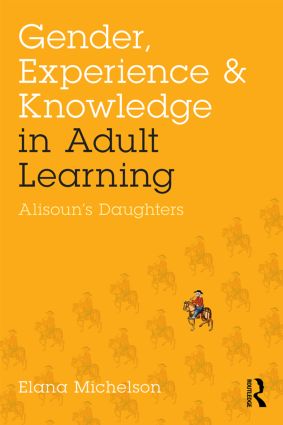
- Author
- Michelson, Elana
- Publisher
- Routledge, New York, NY
- ISBN
- 9781138892170
- Table of Contents
-
List of figures
Acknowledgements
Credit list
Introduction
Part I - The politics of experience
ch. 1 Purging the transgressive from experiential learning
ch. 2 Gender, reason, and the universal knower
ch. 3 Othering rationality
Part II - Gender, experience, and the body
ch. 4 Body, culture, and the feminist claims for experience
ch. 5 The body in question
ch. 6 Mind and matter: Dewey, Kolb, and embodied knowing
Part III - Power and the assessment of experiential learning
ch. 7 Conservatism and transgression in the assessment of experiential learning
ch. 8 Queering the assessment of experiential learning
ch. 9 Practice studies, complexity, and the assessment of experiential learning
Part IV - Narrating the self
ch. 10 Autobiography and adult learning
ch. 11 Textualizing the self: genre, experience, and adult learning
ch. 12 The ghosts of war: trauma, narrative, and adult learning
Conclusion
Bibliograpy
Index
Click Here for Book Review
Abstract: In this wide-ranging book, Elana Michelson invites us to revisit basic understandings of the 'experiential learner'. How does experience come to be seen as the basis of knowledge? How do gender, class, and race enter into the ways in which knowledge is valued? What political and cultural belief systems underlie such practices as the assessment of prior learning and the writing of life narratives?
Drawing on a range of disciplines, from feminist theory and the politics of knowledge to literary criticism, Michelson argues that particular understandings of `experiential learning’ have been central to modern Western cultures and the power relationships that underlie them. Presented in four parts, this challenging and lively book asks educators of adults to think in new ways about their assumptions, theories, and practices:
- Part I provides readers with a short history of the notion of experiential learning.
- Part II brings the insights and concerns of feminist theory to bear on mainstream theories of experiential learning.
- Part III examines the assessment of prior experiential learning for academic credit and/or professional credentials.
- Part IV addresses a second pedagogical practice that is ubiquitous in adult learning, namely, the assigning of life narratives.
Gender, Experience, and Knowledge in Adult Learning will be of value to scholars and graduate students exploring adult and experiential learning, as well as academics wishing to introduce students to a broad range of feminist, critical-race, materialist and postmodernist thinking in the field. (From the Publisher)
Abstract: In this wide-ranging book, Elana Michelson invites us to revisit basic understandings of the 'experiential learner'. How does experience come to be seen as the basis of knowledge? How do gender, class, and race enter into the ways in which knowledge is valued? What political and cultural belief systems underlie such practices as the assessment of prior learning and the writing of life narratives?
Drawing on a range of disciplines, from feminist theory and the politics of knowledge to literary criticism, Michelson argues that particular understandings of `experiential learning’ have been central to modern Western cultures and the power relationships that underlie them. Presented in four parts, this challenging and lively book asks educators of adults to think in new ways about their assumptions, theories, and practices:
- Part I provides readers with a short history of the notion of experiential learning.
- Part II brings the insights and concerns of feminist theory to bear on mainstream theories of experiential learning.
- Part III examines the assessment of prior experiential learning for academic credit and/or professional credentials.
- Part IV addresses a second pedagogical practice that is ubiquitous in adult learning, namely, the assigning of life narratives.
Gender, Experience, and Knowledge in Adult Learning will be of value to scholars and graduate students exploring adult and experiential learning, as well as academics wishing to introduce students to a broad range of feminist, critical-race, materialist and postmodernist thinking in the field. (From the Publisher)