Resources
Click Here for Book Review This book provides a detailed look at the current state of Latino/a theological education in the United States. This includes consideration of the career development and opinions of Latinos/as in seminary education, as well attention to other important modes of Latino/a theological education, like non-degree programs and Hispanic-serving organizations like the HTI and HSP. Another goal of this project was to make recommendations for ways in which schools of theology can do a better job preparing the next generation of Latino/a religious leaders to serve as bridge builders for the future. Thus, we paid special attention to how hospitable theological educational institus are to Hispanics. This book also offers recommendations on improving Latino/a recruitment, revamping the curriculum and Hispanic ministry education, tending better to the sense of community on campuses, and so much more. (From the Publisher)
Click Here for Book Review In recent decades, American universities have begun to tout the “diversity” of their faculty and student bodies. But what kinds of diversity are being championed in their admissions and hiring practices, and what kinds are being neglected? Is diversity enough to solve the structural inequalities that plague our universities? And how might we articulate the value of diversity in the first place? Transforming the Academy begins to answer these questions by bringing together a mix of faculty—male and female, cisgender and queer, immigrant and native-born, tenured and contingent, white, black, multiracial, and other—from public and private universities across the United States. Whether describing contentious power dynamics within their classrooms or recounting protests that occurred on their campuses, the book’s contributors offer bracingly honest inside accounts of both the conflicts and the learning experiences that can emerge from being a representative of diversity. The collection’s authors are united by their commitment to an ideal of the American university as an inclusive and transformative space, one where students from all backgrounds can simultaneously feel intellectually challenged and personally supported. Yet Transforming the Academy also offers a wide range of perspectives on how to best achieve these goals, a diversity of opinion that is sure to inspire lively debate. (From the Publisher)
This issue uses the powerful narrative of autoethnography to make visible the existence of international professors and teaching assistants who speak English as a Second Language. These important, but often invisible, individuals contribute daily to the education of students within the US postsecondary educational system. This volume covers a variety of experiences, such as: - Faculty of color teaching intercultural communication - International teaching assistants’ attitudes toward their US students - The challenges to existing cultural assumptions in the US classroom. These experiences - in the form of challenges and contributions - are foregrounded and highlighted in their own right. This is the 138th volume of the quarterly Jossey-Bass higher education series New Directions for Teaching and Learning. It offers a comprehensive range of ideas and techniques for improving college teaching based on the experience of seasoned instructors and the latest findings of educational and psychological researchers. (From the Publisher)
Click Here for Book Review For 10,000 years, Alaska’s Native peoples have survived and thrived in some of the harshest conditions in the world. During that time, they perfected teaching and learning practices that ensured the survival of their communities and the wellbeing of their natural environments. Those ancient practices offer fresh insights for educators who care about the state of our world and seek ways to make education more relevant and engaging. This book describes a unique higher education project that broke some difficult silences between academic and Native communities by introducing a small group of non-Native faculty members to traditional Alaska Native ways of teaching and learning. It presents a model for a Native-designed and run faculty development intensive, strategies for applying indigenous pedagogies in western learning environments, reflection on education by Alaska Native Elders, and reports from participants on what they learned and what they tried in their classrooms. It is intended to stimulate discussion and reflection about best practices in higher education. (From the Publisher)
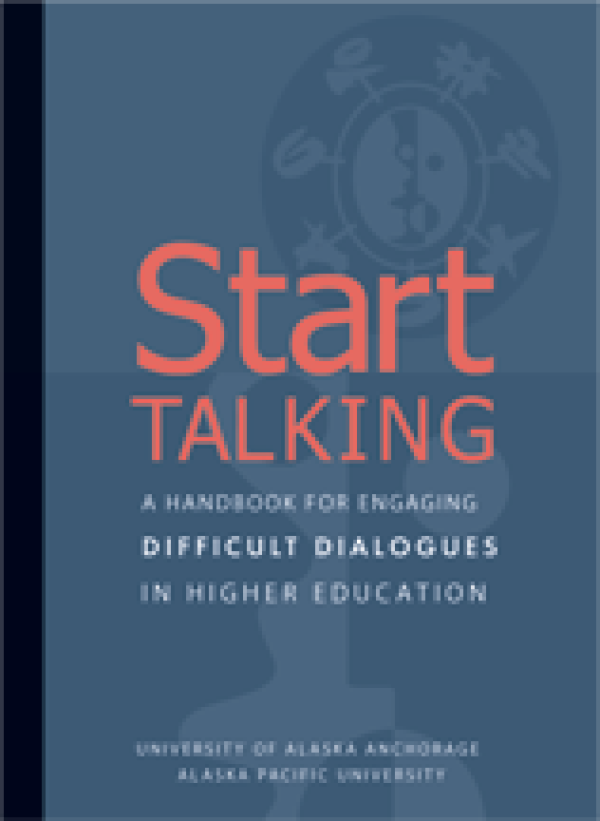
Click Here for Book Review The University of Alaska Anchorage and Alaska Pacific University created Start Talking: A Handbook for Engaging Difficult Dialogues in Higher Education, a field manual for professors who wish to engage their students more effectively in conversations about the most important issues of our time. The book addresses themes of academic freedom; classroom safety; rhetoric and debate; race, class and culture; science and religion; and business, politics and social justice. For information about the project, including faculty intensives on difficult dialogues and indigenous ways of teaching and learning, see UAA Initiatives. (From the Publisher)

Daryl G. Smith has devoted her career to studying and fostering diversity in higher education. She has witnessed and encouraged the evolution of diversity from an issue addressed sporadically on college campuses to a reality of the modern university experience. In Diversity’s Promise for Higher Education, Smith brings together scholarly and field research relevant to the next generation of diversity work. The book argues that achieving excellence in a diverse society requires increasing the institutional capacity for diversity while simultaneously working to understand how diversity is tied to better leadership, positive change, research in virtually every field, student success, accountability, and more equitable hiring practices. To become more relevant to society, the nation, and the world while remaining true to their core missions, colleges and universities must continue to see diversity—like technology—as central, not parallel, to their work. In Diversity’s Promise for Higher Education, Smith proposes a set of clear and realistic practices that will help colleges and universities locate diversity as a strategic imperative and pursue diversity efforts that are inclusive of the varied—and growing—issues apparent on campuses without losing focus on the critical unfinished business of the past. In this edition, which is aimed at administrators, faculty, researchers, and students of higher education, Smith emphasizes a transdisciplinary approach to the topic of diversity, drawing on an updated list of sources from a wealth of literatures and fields. The tables have been refreshed to include data on faculty diversity over a twenty-year period and the book includes new information about gender identity, stereotype threat, student success, the growing role of chief diversity officers, the international emergence of diversity issues, faculty hiring, and implicit bias. (From the Publisher)
Diversity is defined as those numerous elements of difference between groups of people that play significant roles in social institutions, including (but not limited to) race and ethnicity, gender, socioeconomic class, sexual orientation, and culture. Since doctoral degree recipients go on to assume roles as faculty and educators, diversity in doctoral programs is significant. By supporting graduate diversity across the academic disciplines, universities ensure that the nation’s intellectual capacities and opportunities are fully realized. The authors consider diversity broadly from multiple perspectives, from race and ethnicity to institutional type, academic discipline, and national origin. They demonstrate how diversity operates through these venues and definitions, and hope to stimulate a conversation about a key aspect of American higher education. This volume is the 163rd volume of the Jossey-Bass quarterly report series New Directions for Higher Education. Addressed to presidents, vice presidents, deans, and other higher education decision makers on all kinds of campuses, New Directions for Higher Education provides timely information and authoritative advice about major issues and administrative problems confronting every institution. (From the Publisher)
Click Here for Book Review Abstract: This volume offers new perspectives from Indigenous leaders in academic affairs, student affairs and central administration to improve colleges and universities in service to Indigenous students and professionals. It discusses and illustrates ways that leadership norms, values, assumptions and behaviors can often find their origins in cultural identities, and how such assumptions can affect the evolvement of colleges and universities in serving Indigenous Peoples. It contributes to leadership development and reflection among novice, experienced, and emerging leaders in higher education and provides key recommendations for transforming higher education. This book introduces readers to relationships between Indigenous identities and leadership in diverse educational environments and institutions and will benefit policy makers in education, student affairs professionals, scholars, faculty and students. (From the Publisher)
Highlighting the voices and experiences of Black graduate students at Historically Black Colleges and Universities (HBCUs), this book features the perspectives of students from a variety of academic backgrounds and institutional settings. Contributors discuss their motivation to attend an HBCU for graduate studies, their experiences, and how these helped prepare them for their career. To be prepared to serve the increasing number of Black students with access to graduate programs at HBCUs, university administrators, faculty, and staff require a better understanding of these students’ needs and how to meet them. Addressing some of today’s most urgent issues and educational challenges, this book expands the literature on HBCUs and provides insight into the role their graduate schools play in building a diverse academic and professional community. (From the Publisher)
In May 2008, a group of women of color who teach religious studies in predominantly white colleges and universities came together at Texas Christian University in a Wabash Center for Teaching Theology and Religion consultation. The group examined what happens, both to them and with students, when women of color enter the space of the religion classroom, how their presence affects teaching and learning, and what strategies we might employ to ease interactions among students and teachers. This essay is a reflection on a crucial theme that we discovered in the consultation: authority.