Home » Resources » Scholarship on Teaching » Those Good Gertrudes: A Social History of Women Teachers in America
Scholarship
March 29, 2017
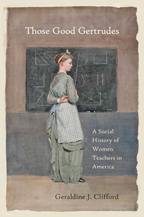
Those Good Gertrudes: A Social History of Women Teachers in America
- Author
- Clifford, Geraldine J.
- Publisher
- Johns Hopkins University Press, Baltimore, MD
- ISBN
- 9781421414331
- Table of Contents
-
Introduction
ch. 1 “It Is Well That Women Should Be Unlettered”: Before Teaching School Was “Women’s Work”
ch. 2 “School Dames in Each Quarter”: America’s Army of Gertrudes
ch. 3 “A Sisterhood of Instruction, Essential to the World’s Progress”: Societal Pressures and Women’s Opportunities, 1700-1900
ch. 4 “Overflowing from the Domestic Circle”: Individual and Family Factors in Choosing to Teach
ch. 5 “An Honorable Breadwinning Weapon”: Who Became Teachers?
ch. 6 “The Presiding Genius of His Home and Heart”: Her Marital Status and Domestic Arrangements
ch. 7 “In the Mind’s Eye”: Images and Expectations of the Teacher
ch. 8 “Higher Prospects for a Useful Life”: The Teacher as Trained Professional
ch. 9 “Laboring Conscientiously, Though Perhaps Obscurely”: Certain Realities of Being a Teacher
ch. 10 “The Great Perplexities of the Teacher-Life”: Gertrudes Talk and Their Pupils Reminisce
ch. 11 “That Our Daughters May Be as Cornerstones”: Women Teachers and Messianic America
ch. 12 “The Feast of Reason and Flow of Soul”: The Political Rights and Civic Duties of Women
ch. 13 “A Lady Well Qualified to Show the Way”: Widening Women’s Work
Notes
An Essential Reference Guide
Archives Consulted for the Good Gertrudes Project
Index
Those Good Gertrudes explores the professional, civic, and personal roles of women teachers. Its voice, themes, and findings build from the mostly unpublished writings of many women and their families, colleagues, and pupils. Geraldine J. Clifford studied personal history manuscripts in archives and consulted printed autobiographies, diaries, correspondence, oral histories, interviews—even film and fiction—to probe the multifaceted imagery that has surrounded teaching.
This work stands alone: it is broad ranging, inclusive, and comparative. It surveys a long past where schoolteaching was essentially men's work, with women relegated to restricted niches such as teaching rudiments of the vernacular language to young children and socializing girls for traditional gender roles. Clifford documents and explains the emergence of women as the prototypical schoolteachers in the United States, a process apparent in the late colonial period and continuing through the nineteenth century, when they became the majority of American public and private schoolteachers. She finds that this trend continues in the twenty-first century, despite the diversion of women to competing professions, a precipitous reduction in the number of Roman Catholic nuns, and repeated efforts and incentives to recruit and retain male teachers.
Cross-national comparisons suggest that America's early reliance on women teachers quickened and extended the reach of schools across the nation’s social classes, religious and ethnic groupings, and cultural and physical landscapes.
The capstone of Clifford’s distinguished career, Those Good Gertrudes will engage scholars in the history of education and women’s history, teachers past, present, and future, and readers with vivid memories of their own teachers.
The first woman to receive a Guggenheim Fellowship for research in education, Geraldine J. Clifford is professor emerita at the University of California, Berkeley. Her previous books include Ed School: A Brief for Professional Education. (From the Publisher)
This work stands alone: it is broad ranging, inclusive, and comparative. It surveys a long past where schoolteaching was essentially men's work, with women relegated to restricted niches such as teaching rudiments of the vernacular language to young children and socializing girls for traditional gender roles. Clifford documents and explains the emergence of women as the prototypical schoolteachers in the United States, a process apparent in the late colonial period and continuing through the nineteenth century, when they became the majority of American public and private schoolteachers. She finds that this trend continues in the twenty-first century, despite the diversion of women to competing professions, a precipitous reduction in the number of Roman Catholic nuns, and repeated efforts and incentives to recruit and retain male teachers.
Cross-national comparisons suggest that America's early reliance on women teachers quickened and extended the reach of schools across the nation’s social classes, religious and ethnic groupings, and cultural and physical landscapes.
The capstone of Clifford’s distinguished career, Those Good Gertrudes will engage scholars in the history of education and women’s history, teachers past, present, and future, and readers with vivid memories of their own teachers.
The first woman to receive a Guggenheim Fellowship for research in education, Geraldine J. Clifford is professor emerita at the University of California, Berkeley. Her previous books include Ed School: A Brief for Professional Education. (From the Publisher)