Resources

Nancy Lynne Westfield Associate Professor of Religious Education Drew Theological School It is a challenge to do what you teach. “If you know these things happy are ye if you do them.” (John 13:17, King James Version – or the version of my childhood bible study) - my grandfather’s favorite.

Caleb Elfenbein Assistant Professor Grinnell College The core learning goal of my introduction to Islam is that “Islam” is not a thing. Islam does not say anything. Islam does not do anything. Islam holds no power over anyone. Given the incredible diversity across time and space that marks the practices
Cláudio Carvalhaes Associate Professor McCormick Theological Seminary In Brazil There has been a recent uprising of students fighting for justice and better education. Several political developments have spurred the revolt of fourteen- to seventeen-year-old students in defiance of arbitrary laws of governors. Let me mention four events. First, it was

Theological school deans are not just theological leaders for their institution, they must be EDUCATIONAL leaders. That is, they must implement sound educational practices related to curriculum, instruction, supervision, assessment, and administration. There is a variety of ways to assess...

Tat-siong Benny Liew Class of 1956 Professor in New Testament Studies College of the Holy Cross “You are now entering the real world.” This is undoubtedly one of the most popular remarks that college/university graduates hear around the time of their commencement ceremony. The comment implies, of course, that life

Joshua Canzona Georgetown University In his “Homage to Joe Sacco,” Edward Said celebrates the author of Palestine and gives us one of the best love letters to comics ever written. He shares his first comic book experience, “Everything about the enticing book of colored pictures, but specially its untidy, sprawling.
Nancy Lynne Westfield Associate Professor of Religious Education Drew Theological School The proximity of violence is the terror. Violence is not new – it is, for much of our society and in many, many ways, a preferred way of life. The illusion is that violence can be controlled, patrolled, contained,
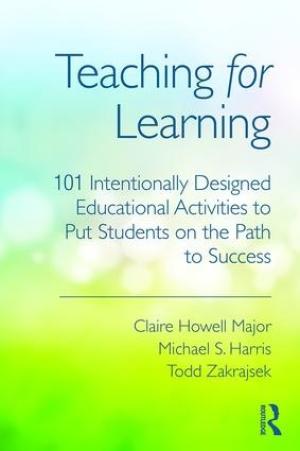
The authors of this extremely helpful book open with an observation that is often true: there is a lot of research on how to teach effectively, but “this information tends to be inaccessible to most instructors, as it has been published piecemeal in journals that instructors frequently do not read” (xi). To help remedy this lamentable situation, they have sifted through hundreds of studies in teaching and learning in order to compile a list of educational activities that both work in real world settings and are supported by research. In other words, if you have ever wondered what kinds of teaching actually lead to learning (retention, critical thinking skills, creative application), and you would like to do a better job of varying your pedagogical approaches, then this book will be of interest to you. Each of the eight chapters focus on a particular kind of teaching and learning format, including lecture, discussion, peer teaching, academic games, reading strategies, writing, graphic organizers, and metacognitive reflection. In clear prose, the authors explain the strengths and drawbacks of each kind of teaching as well as what researchers have found concerning each approach’s effectiveness. For example, lectures work better when instructors keep the lectures short, focused on essentials, and when accompanied with frequent quizzing and guides to effective note-taking. After establishing what works according to research, the authors provide detailed “Intentionally Designed Educational Activities” (IDEAs) to help instructors teach in a way that has been proven to lead to learning. Again, using lecture as an example, some of the suggested activities include guided note-taking, a “find the flaw” exercise, the Socratic seminar, and lecture bingo. The IDEAs, which are delightful and often fun, are cross-referenced with other teaching activities in the book and include helpful “pro-tips” to give additional guidance on implementation. This clear structure makes the book one that can be read cover-to-cover as well as a handy reference volume for specific classroom situations. Both seasoned and new teachers will get a lot out of this book. New instructors will find the help they need when trying to translate their graduate education into effective teaching. More seasoned teachers will find some tried-and-true methods confirmed but will also encounter new ideas to reinvigorate the classroom. While some of the 101 IDEAs in the book are clearly designed for mathematics or scientific fields, the vast majority are well-suited to humanities and social sciences and will be right at home in religious studies and theological departments at both undergraduate and graduate levels. This book has the potential to greatly improve our day-to-day teaching; our students will be grateful.
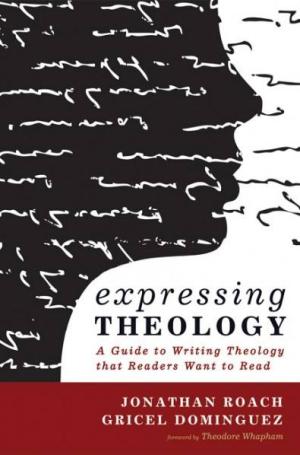
Jonathan Roach and Gricel Dominguez helpfully remind us that theological writing should be beautiful, compelling, and engaging, but I am not quite sure that I am ready to join their writing revolution. Expressing Theology addresses a broad audience. Epistles to undergraduate students in theology, graduate students, dissertation writers, and “authors in training” dot the text. And the book certainly offers sound advice to writers of theology at any stage in their careers. Chapters five through seven fill the writers toolbox. Here the reader finds the usual contents of a writing primer. Roach and Dominguez introduce the writing process and discuss each step along the way: from drafting to writing techniques, to grammar, and the all-important revision and editing stages. I like that advice from Strunk and White is mixed with wisdom from Gustavo Gutiérrez and examples come from Martin Luther King Jr. and Qoheleth. Perhaps the best things about these chapters are the pacing and style. The authors move through these technical pieces without becoming nearly as dry as many writing guides. The more expressly theological material comes in chapters one through four. I think the authors are really smart to begin talking about engaged theology with a chapter on the writer’s identity and location. Writers are encouraged to own their unique perspectives and to write out of their own experiences. The section on sources somewhat predictably uses an only slightly modified version of Wesley’s quadrilateral, but it is not unhelpful. The chapter on audience prescribes writing theology as a conversation rather than a preachment and I could not agree with this sentiment more. I am convinced! Theological writing should be beautiful and compelling. But I remain a little wary of the revolution that Roach and Dominguez have asked me to join. Throughout the text, the authors attack abstract and “boring” theology as they often repeat the mantra, “keep your feet on the ground.” The theologians among those most often cited are Anne Lamott, Kathleen Norris, and Thomas Merton, all of whom are beautiful writers to be sure and certainly theologians of a sort, but not really shapers of the history of thinking about God. Of course, I do not want to advocate that theology be ungrounded, but I repeatedly wondered if the sort of exacting, often dense, and sometimes technical theology that I read and write would be excised in this revolution. As I read Expressing Theology, I remembered myself reading Tillich and Whitehead for the first time and pondering the world anew as I read sentence by sentence at a painfully slow pace. I thought of Rosemary Radford Ruether so meticulously uprooting essentialisms and utopias, page after page. I relived the moment that tears came to my eyes, when after two hundred pages of groundwork, Jürgen Moltmann declared “Ecce Deus! Behold God on the cross!” (Moltmann, The Crucified God [Minneapolis: Fortress Press, 1993] 205) as God became the godforsaken. I hope that Roach and Dominguez would agree that these too are beautiful and compelling theologies. Perhaps their advice will lead some authors to engaging, elegant, yet complex and careful writing like these.
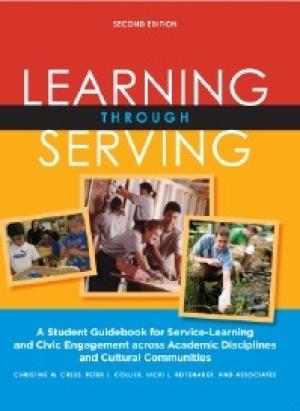
First published in 2005, Learning through Serving is a collection of critical thought on the nature of service-learning, as well as a practical field guide for educators looking to expand their skills in this arena. Cress, Collier, Reitenauer, and their colleagues at Portland State University seek to respond to the organic growth of service programs in contemporary higher education – both curricular and extracurricular. Fundamentally, the authors consider service-learning as a liberatory pedagogical tool that induces students to take control of their own learning, and deconstructs the banking model of schooling (famously attacked by Paolo Freire) that remains dominant in much contemporary education. Learning through Serving is intentionally transdisciplinary, and will certainly be helpful for religious studies or theology educators who employ community-based learning or service-learning models. The wealth of experience the authors share, their diverse voices, and lucid consideration of socially-engaged pedagogy yield great value for those seeking to deepen their practice of service-learning. The authors’ goals are to assist educators and students in thinking through their community service experiences, in the interest of holistic conscientious formation: “In sum, the book is about how to make academic sense of civic service in preparing for students’ roles as future citizen leaders” (xix). Although some readers might balk at the emphasis on “leadership” – and even the use of the term “service” itself – the authors consider a variety of leadership styles suited for different contexts, and make considerable effort to attend to questions of privilege and social justice. This is interspersed throughout the text, but the authors also dedicate a full chapter (“Creating Cultural Connections”) to addressing these issues explicitly. This guide was constructed with the intention that it would be read in the context of an academic class – thus the chapters are arranged to build on one another throughout the course of a semester. Learning through Serving is composed as a textbook, placing great emphasis on clarity and structure, without sacrificing substance for the sake of readability. The different chapters oscillate between hands-on course planning and more theoretical treatments of civic engagement and democratic philosophy. The new edition makes a particular effort to attend to the global interconnectedness that increasingly defines contemporary digital realities. Service-learning courses have traditionally cultivated porous boundaries between “town” and “gown,” but in an academic climate that increasingly embraces remote student enrollment, service-learning benefits from critically considering how it might adjust to accommodate – and even take advantage of – new developments in university structure, while empowering students to be responsible citizens. Cress and her colleagues are experienced enough to know that, in practice, service-learning courses rarely go as planned, and that for a variety of reasons, instructors may have to adjust their approach mid-semester. Ultimately, the service component of a class aspires to be interwoven into the fabric of the more formal coursework, integrating the two elements into a mutually-enhancing, symbiotic whole. Learning through Serving offers a wealth of pedagogical advice for service-learning courses, but also situates service-learning within a larger commitment to civic engagement and building a more just society. It contains invaluable nuts-and-bolts course planning assistance, and gives wise counsel on how to develop enduring, reciprocal community partnerships that build capacity for the long haul.
Wabash Center Staff Contact
Rachelle Green, Ph.D.
Associate Director
Wabash Center
greenr@wabash.edu