Resources
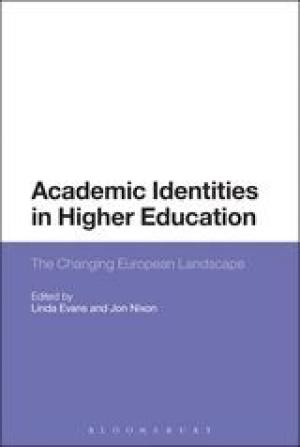
Academic identity, like all identity, is fluid. This volume places questions about academic identity in the equally fluid context of “Europe,” which is here defined as at once united and fragmented, particularly after the economic crises of 2008. This volume pulls together thirteen articles in three sections: Frameworks and Perspectives, Academic Trajectories, and Formations and Re-formations. The authors are not sociologists of life course or scholars who study academic identity; they are, more usefully for this volume, speaking from their own contexts and experiences in European higher education from the late twentieth into the early twenty-first centuries. The editors have done a fine job choosing and grouping these essays, many of which were written by authors in their second or third languages to comply with market demands for English publication. This is one of the many strengths of the book, as it illustrates the kinds of demands that are placed on European academics that are absent in many ways from American contexts. Nevertheless, much is familiar here: academics in neoliberal systems of mass higher education struggle with ever-increasing bureaucracy, top-down management, and the encroachment of academic “professionalism.” Pressure to be represented well in world rankings tends to encourage institutional systems of assessment and auditing of outcomes that shape the academic enterprise as an inward-looking, self-serving part of a labor-driven economy and individual academics as cogs in the machine. As Jon Nixon states in his introduction, treating academic work like labor, as a matter of “pre-specified outcomes and destinations,” produces an unfortunate mismatch: “Academic identity is – to come full circle – a process that is uncertain in direction and indeterminate in outcome” (13). To treat academic work as labor is to misunderstand the potential benefits of outward-looking institutions that value intellectual autonomy and innovation above target-setting and performance measures. Many of the chapters in this volume could stand alone as case studies; each presents its own particular balance of interrogating biographical, institutional, or broader contextual identities and each brings a coherent and defined voice to the shared project. It is impossible to capture the richness of each of these chapters here, and each somehow manages to consider an individual life within the vast institutional, sociocultural, historical, and political contexts in which that life is lived. Although there is nothing specific to either religious studies or theology in this volume, there is much here that will resonate with academics who struggle with being pulled away from research and teaching to comply with institutional mandates. This volume should help academics in all disciplines to reflect on the power of context and particularly institutional context to shape lives and careers. Implicit here is a call to embrace the best in higher education despite the “regulations, financial incentives, rewards, quality standards, as well as academic, public, and professional values” (6) that constrain and give shape to our identities. These essays hint that a mix of resilience and subversion might well be the academic’s best allies.
This is the new side bar for Web Site On Religion, this page is named (custom-sidebar-website_on_religion)
This is the new side bar for Syllabi, this page is named (custom-sidebar-syllabi)
This is the new side bar for scholarship, this page is named (custom-sidebar-scholarship)
This is the new side bar for Blog, this page is named (custom-sidebar-post)
This is the new side bar for programs, this page is named (custom-sidebar-page)
This is the new side bar for grants, this page is named (custom-sidebar-grants)
This is the new side bar for Books Reviews, this page is named (custom-sidebar-book_reviews)
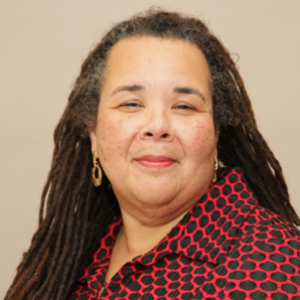
My grandmother used to speak in adages, parables, metaphors, similes and symbols. Now I call her proclivity for language, literature, and meaning-making “wisdom-speak.” Then, I thought she was being corny. She knew her wisdom-speak was meant to teach me enough until I am ready to know more. Her adages came from bible verses, poetry lines, and quotes from novels, cultural remembrances and living life as an African American woman in the USA, born in 1887. Folks like Langston Hughes, Booker T. Washington, Sojourner Truth, Pearl Bailey, Jesus, and Sarah Vaughn were regularly invoked. Wisdom-speak is colorful, witty language - easy to recall and recite, with a depth of multiple meanings. Wisdom-speak is part of everyday conversation. It is a pithy quote or well-placed refrain woven into a conversation like salt on fried fish. It is accompanied by a hmmm or tongue click, a foot pat, a shoulder shrug or an eye roll. Wisdom-speak is a body, mind and spirit lesson. Grandmother Vyola would say, “All that is is not visible.” As a child, I thought she meant that there is more to creation than what can be witnessed with the naked eye. If knowing is only about what is directly in front of us – then we miss so very much of all that is. Learning to see the invisible is the task of knowing. Learning the ways of the wind and the saints, angels, ancestors, cherubim and seraphim; the dream world and the day dreaming world; the ways of prayer and meditation are the learning of the invisible. Then as a young adult, I decided she was talking about identity politics and the politics of domination. The genderless politics of patriarchy, with its racist undertones and dictates, considers much of “all that is” to be too much for women, many children, and most men. The truncation of imagination engineered by systems of domination and control renders the capacity of many people as inferior thus negating all that is. Poverty drastically limits opportunities for in-depth exploration – so when we meet persons who have carved out an education in the wake of social depravity we should be in awe. As a young adult, I came to understand good teaching meant finding ways of seeing the manifestations of oppression in my own classrooms, church, society, and world. And I encountered Alice Walker and figured Grandmother Vyloa was talking about what Dr. Walker was talking about. Grandmother Vyola is resonant with novelist, poet Alice Walker’s four-part definition of a “Womanist” from In Search of Our Mothers’ Gardens: Womanist Prose, 1983. The first part of the definition reads in part: “….Wanting to know more and in greater depth than is considered ‘good’ for one.” It seems as though Vyola and Alice were cut from the same cloth. In the last few days, I have turned my attention exclusively toward preparation for school. I have my head down as I put finishing touches on my syllabi, design learning activities, schedule guest colleagues, locate films, and order art supplies. My mode is one of efficiency and my mood is closed off. I am, in my planning, working from an attitude of indubitability. I have a clarity about what I will teach, how I will teach and what my students will learn. While immersed in my preparations, grandmother whispered in my ear. Grandmother Vyola says that patent planning is not good for me or my students. She advises that the better way is to be more opened ended – like Jesus’ parables. Allow the students’ voice to affect most aspects of the course design, not just the convenient parts. Consider that you cannot see all there is to see so leave room for your own learning while you teach. Most of all, the plan that that which is revealed will be marvelous and know it is unplannable, but can be readied for – Get Ready! I have learned to pause when grandmother speaks. I take a second look at my plans and see that I have relied, a bit, on stale redundancy and a few too many current conventions. I recognize that when I start telling myself I know what will happen, what can happen in my own classroom – I am in danger of not allowing for surprise, the unexpected, or the un-expectable activity of Spirit. My grandmothers Vyola and Alice remind me that my certainty is likely a trap. If I plan for only what I know, only what I can see, only for what I can do – then I am not being womanish, not acknowledging all that is in the world. With this wisdom, I have begun to incorporate more ways of acknowledging the hegemonic forces which hide in our midst. I have adjusted and added ways which invoke the freedoms of learning for my students – freedoms like their own questioning, curiosity, and concerns being integrated into the full length of the course. School starts the week before Labor Day --- I am less certain of my plans and better for it.
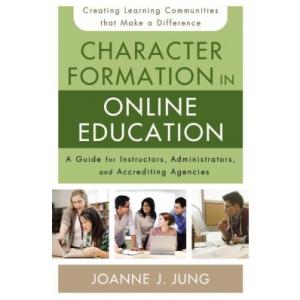
Joanne Jung’s overview of character formation in online education serves as an introductory resource for the topic. It is primarily intended to be a practical and accessible guide for faculty and administrators at religious institutions that offer online courses. Throughout the book Jung tackles the “skepticism among educators about character formation in online education” (15). The book examines various aspects of online learning and how it contributes to character formation. In the beginning section, Jung addresses the purpose of online education alongside best practices for online pedagogy. She provides an overview of Learning Management Systems, which house online classes, as well as an overview of the course design process, which involves working as a team with a curriculum and instruction expert. The second section discusses best practices of pedagogy within online courses, focusing on a holistic view of human personhood that drives one’s approach to character formation. Jung discusses practical means for using discussion forums, hybrid classroom formats, and social media toward the end of character formation, including an important chapter on integrating faith and learning. The final section addresses assessment and improvements that administrators and faculty can make to online courses in order to achieve learning outcomes for character formation more consistently. Jung also includes an accessible and informative glossary of terms relevant to online education. Faculty who are unfamiliar with teaching online courses will find this book a valuable help in beginning to teach and form character in online modalities. Administrators and accrediting agencies will find many sections useful for their purposes as well, especially chapter three on course design teams, chapter seven on the integration of faith and learning, and chapter nine on assessment. As Jung writes, her purpose in the book is to give “practical ideas for customizing your online courses and improving your pedagogical methodology, irrespective of your discipline” (9). One concern with the text is its basic, introductory approach. For faculty and administration who are experienced with online education, the book will be primarily review, albeit with a clear focus on character formation. Chapter seven on the integration of faith and learning and chapter nine on assessment are important exceptions, and they present insights for any institution concerned with character formation in education. Additional studies could help supplement and add insight to some of the essential points that Jung makes, particularly studies that focus on the creation, delivery, and assessment of learning outcomes specifically designed for the purpose of character formation. Such studies could engage resources on moral or character education and focus on the application of character formation research to online modalities. If one is looking for an introductory guide to forming character in the world of online education, this book provides resourceful and insightful suggestions toward best practices. In order to delve deeper into character formation for online education, there remains a need for further pedagogical study regarding the application of character formation research in general to online education in particular and regarding the means of facilitating character growth in the learning environments of online education.
Wabash Center Staff Contact
Rachelle Green, Ph.D.
Associate Director
Wabash Center
greenr@wabash.edu