Resources

As we go back to the classroom (and shake off the dust of summer), we all have mixed feelings and expectations. While some of us will just go back to the normal, others will be anxious and perhaps fearful about a new semester. The beginning of a semester can carry a feeling of being displaced, a sense that we don’t know what is coming our way and what is next. In one word: the lack of control. That is why we occupied so much of our syllabi in order to gain immediate control of that space we actually cannot control, and in fact never have controlled. What will my class be made of? How many students and who are they? Will we be able to control everything? Be fair with everybody? Be attentive to our own tasks, juggling the school’s demands and all that the teacher hopes for? The specific details of the practical aspects of our syllabus, the division of tasks, the proper tools to be used, the connections to be made, the boundaries to be established. In truth these are questions that only end when classes are over after a whole semester. Besides, after being away from the classroom for a while we may feel a little out of joint, as if the classroom is again a foreign/home space, until the map we draw (our syllabus) will help us travel through this newly foreign terrain. In our classrooms we are both professors and educators. Rubem Alves makes a distinction of these two roles. He says: “A professor is an employee of institutions that manage lagoons and puddles, specialist in reproduction, an instrument of the social apparel of the state. As the educator, on the contrary, [the professor] is a founder of worlds, mediator of hopes, pastor of projects.” [1] As we go back I wonder how our duties as professors will cast a shadow over the role of the educator. Will our pedagogies be more faithful to the management of forms of reproductions or attentive to the ways our students can become more expanded, more fully human beings? Will we dare to be a “mediator of hopes,” or a “pastor of projects?” If we only trust the readings of our classes we are more professors than educators. If we believe that the evaluation can only take a form of a formal final paper we will not tap into the rich resources of our students. If we make classrooms be a “one fit for all” place, we will make our educator side slip into the perfectly devilish/delightful combination of institutional bureaucracy and personal fears. A combination where students pay the price of teachers whose hope is confounded by fear. In classrooms we are educators! That is why we gather together: to share knowledge as we share tastes, to share complexities and differences as we share life together. But in order to get there, we must be awakened! That is what Alves says of how to prepare the educator: “is necessary to wake her/him up… its enough that we call them from their sleep, by an act of love and courage. And when awakened, they will repeat the miracle of the instauration of new worlds.”[2] I think we are very good at managing lagoons and puddles. However, our task as we begin our semester is to be awakened into the educators that live inside of us and be(come) a co-founder of worlds in our students, a stretcher of horizons, jokers of our common worlds and satirists of our own stupidity, doing what we do with a sense of praxis that will be able to transform actions, gestures, movements, feelings and create possibilities. In a word: dreamers of new realities! Paulo Freire talks about this dreamer in a more academic language. Forgive the sexist language: “Because he admires the world and therefore objectifies it, because he grasps and comprehends reality and transforms it in his action-reflection, man is a being of praxis. Even more so, man in praxis… His ontological vocation, which he ought to existentiate, is that of a subject who operates on and transforms the world. Subjugated to concrete conditions that transform him into an object, man will be sacrificing his fundamental vocation… Nobody is if he prevents others from being.”[3] Every dreamer must start in reality, it the midst of contrasts, racial divides, economic disparities, political dualisms, violent neighborhoods, dialectical complexities and all kinds of conflicts. We must make unhidden the social processes of reality that prevent change and transformation especially for minorities and oppressed people. Educators can (be)come the very material they use in the classroom, the texts they read, the dialogues they have, the educational tools they use, the theories they choose and the very awareness of what kind of pedagogy that they foster. We are caught into this action-reflection that stirs up, criticizes and amplifies theories and praxis. We are not detached from the world, but rather we are the result and consequence of the world we create. Our pedagogies are not meant to keep the status quo but to transform things and people, even if we know that what we do will not transform anything or anybody. More than anything we must keep our fundamental vocation as teachers, whatever that might be, so we will not prevent students from being the fullest they can be, in the owning of their bodies, their feelings, their thoughts and their capacity to reach out, to expand, and to listen to their own selves. As we go back to the classroom, let us awaken ourselves into the praxis of being educators! Dreaming dreams of new worlds and human beings fully stretched, while hoping for a good semester with all the rights and wrongs we will certainly make if we dare to be “a founder of worlds, mediator of hopes, pastor of projects.” [1] Rubem Alves, Conversas com quem gosta de ensinar. (São Paulo: Cortez Editora, 1980), 27. [2] Ibid. [3] Paulo Freire, La Concepción problematizadora de la educación y la homanización.” Cristianismo y Sociedad. Montevideo, 1968, 18. Freire... quoted by Carlos Alberto Torres, "Dialetics, Conflict, and Dialogue," in Moacir Gadotti, Pedagogy of Praxis: A Dialectical Philosophy of Education (New York: Suny Press, 1996).

I recently finished my fourth year of full-time teaching and I have noticed two consistent reactions that students have to course material in my Islam-focused courses (i.e., Islam, Islamic Mysticism, and The Qur’an): 1) Ability and willingness to readily acknowledge Islamophobia in American popular culture and 2) Appreciation for Sufi themes and literature. Although I may not have surmised how these two themes relate to one another pedagogically a few years back, I have come to see several connections and will use this blog post to explore some ways to take advantage of these student experiences in the classroom. Conscious and Unconscious Islamophobia Usually, on the first day of class, I write “Islam” on the board and solicit from students the first words that come to mind. Some hesitate to shout out “terrorism,” “anti-democratic” and the like, but I find that there are usually enough brave voices in the class to surface these collective social portrayals of the Muslim Bogeyman, and even evoke some cathartic laughter in the process. I find that this exercise, although rather straightforward, helps set a tone; it signifies to students that suppressing the obvious will hinder class discussion and probably their learning process as well. Much later in the semester, often in written assignments but sometimes in class discussions as well, I find a regular cadre of students admit—at times with a combination of shame and gratitude—how troubled they are to realize the Islamophobic views they have known, or found, in their own minds for who knows how long. This proves unsurprising, however, as many college students today were in diapers on 9/11 and therefore know nothing of a world without the “War on Terror.” It’s significant that these timid disclosures tend to occur toward the end of the semester, because no matter how easy it is for students to identify and caricaturize broad social concerns early on, it takes time to reflect on how stereotypes affect them on an individual level. Sufism and “Spiritual Jihad” When we explore various Sufi themes it’s easy enough, usually unprompted by their instructor, for students to draw some sort of personal meaning from the course material. When we read Ghazali’s (d. 1111) Deliverer from Error, for example, many students find it compelling as it reflects a perennial quest for spiritual truth. I’ll often screen episodes, as well, from the BBC production “The Retreat”—a three-part documentary that observes participants at a Sufi retreat in southern Spain; the cast includes multiple archetypal characters such as spiritual-but-not-religious, rigid dogmatist, addict of technology, and an atheist. Thus students can thus usually find themselves in one or more of the characters. In particular, a text I regularly teach is the 15th-century Sufi allegory, Yusuf and Zulaykha by ‘Abd al-Rahman Jami (d. 1492). Many of its central themes relate to challenges of confronting one’s inner demons, and it, therefore, offers some helpful models for students to consider as they confront their own latent or blatant preconceptions about Islam and Muslims. Yusuf and Zulaykha adapts the story of Yusuf (Joseph) from the 12th chapter of the Qur’an, except Jami’s version is much longer, has more details, and focuses on a love-struck female protagonist. Students often think she’s kind of crazy (or just crazy) because of her singular obsession with Yusuf. This obsession ultimately leads her to age physically and persist in a state of inconsolable grief. Eventually, however, once she realizes that it is not Yusuf per se whom she loves, but the divine reflection within Yusuf, her youthful beauty returns, she marries Yusuf, and they live happily ever after. The catalyst for her transformation takes place when she smashes the physical idols she had worshiped, which could symbolize the idols in her heart that had blocked her from True Love. Thus the story conveys useful pedagogical lessons on many levels: truth lies within us, it is we who block truth from becoming apparent, concealing the truth makes us sick and bitter, but also, our obsession with apparent manifestations of truth is highly seductive and difficult to ignore. Struggling Against the Machine One student in my Islamic Mysticism course wrote the following in a response paper late in the semester: “For those who approach this subject with any form of bias, I think must prepare for a clash of what we once viewed as fact with what we can now see as fact. This clash, for me at least, set forth a type of grief and shame.” I suspect that this student—like the protagonist in Yusuf and Zulaykha—arrived at his new perspective only after struggling deeply with his own shadows. Many Islamicists, including myself, find that teaching about Islam and Muslims requires students to go through a process of unlearning or de-programming—however you want to put it—the layers of fear and stereotypes that 21st-century media and society has drilled into their minds, often unconsciously. I think experiences like these are common—although in my own observations few students are willing to admit their feelings in this regard so candidly, even if they undergo similar transformations. What, then, is the best way to guide students through the sometimes-painful process of navigating those parts of themselves that aren’t so pretty? The more I teach, the more I find myself letting students gradually and gently acknowledge their own struggles, rather than relying on the megaphone of my teaching platform. My shift, in this regard—as I intimated the beginning of this post—has resulted from consistently observing students, out of their own volition, desiring to put forth the difficult effort it takes to look inward with honesty and circumspection. Thus the concept ofjihad al-nafs (spiritual struggle) in Sufi traditions—as illustrated in Yusuf and Zulaykha or any number of other scenarios—can allow students not only to draw personal connections to centuries-old texts but also appreciate the difficulties and rewards of challenging oneself to learn and grow amidst a cultural machine that discourages such an endeavor.

Those of us who spend our leisure time watching the Tennis Channel are guaranteed to have seen numerous episodes of the marketing promotion called, “Bag Check,” where the top players reveal, one item at a time, what they carry in their huge “clearly labeled” tennis bags. Even though we realize that we are marketing targets, there is something very compelling about analyzing the contents of the bags of these remarkable athletes, and seeing and hearing about what they have decided they wanted access to when they are out on the court during these high-stakes matches toward which they have invested so much of their time and energy. Anybody who has seen me on the court is likely to have very little interest in the contents of my tennis bag, but, as a teacher, this image came back to me as I read several essays written about education and pedagogy in the 1980s and the 1990s, by noted scholar of religion, Jonathan Z. Smith, in which he talked about his practice of spending time in all of his introductory courses to “unpack” his syllabi. Before getting into each major part or section of a course, Smith would explain to his students what, among various options, he chose to focus on, as well as why he made those choices. According to Smith, he did so to show students that a syllabus is always already a constructed argument; talking about how and why he constructed his course in class offered students an (additional) occasion to reflect on how certain judgments were made and how those very judgments might lead to particular implications or consequences. There was, for Smith, also a larger context for this practice. The introductory courses he was describing were all taught to undergraduates. Smith was transparent in explaining that these introductory courses of his were so-called “service” courses. That is to say, students who took these courses usually took them to satisfy their general distribution requirements; they were not taking them as majors in the study of religion. (Even in the early 1990s and at the University of Chicago, the number of religious studies majors was already rather small.) As a result, Smith came to the realization that teaching students disciplinary content and disciplinary methods of religious studies should not be his primary goal. Instead, he aimed to use these introductory “service courses” to help students think and talk about interpretation and argumentation. In other words, whatever content he chose to address in his introductory courses, including his explanation of his syllabus, functioned primarily as case studies to illustrate the reality of multiple interpretations and hence the inevitability of argumentation and adjudication. Why? Because as a literary scholar, Gerald Graff, has argued in his 2003 book, Clueless in Academe, learning to perform, engage, and analyze argumentation is what the academy and education should be all about. Smith went on to suggest that as a teacher, he would not mind if his students did not remember much about the content of his “service courses”; what Smith wanted from his students in these courses was for them to learn and develop the capacity to interpret and argue, as well as the ability to evaluate different interpretations and argumentations. In fact, since most doctoral students in the study of religion end up teaching introductory courses to undergraduates, Smith proposed that doctoral programs in religion should require every student to submit a syllabus with a written rationale for every element that had been included in the course design. (For the same reason, Smith would also like to see more faculty members who supervise doctoral students in religion participate in, rather than being “protected” or “relieved” from, teaching undergraduate introductory courses.) Since moving three years ago to join the Religious Studies Department of a Jesuit liberal arts college, I have found a new and deepened appreciation for many of Smith’s insights. Like most religious studies departments in colleges and universities, mine is mainly a so-called service department, so my courses, especially my introductory New Testament course, are seldom filled with religious studies majors. While a number of them may have chosen to take a New Testament course because of their Christian upbringing, some are also enrolling simply because they have to do a class on religion and mine happens to fit their schedule. For the reasons Smith articulated, I have also changed my introductory New Testament course to focus less on disciplinary content and more on honing students’ interpreting and argument-making skills. My “unpacking” of the syllabus, however, has so far been limited to the first class session of a semester and involves a quick rundown of what we will do and what I will require, but I have never taken the time to acknowledge and to explain—that is, to argue—why we should do what we do and why I should require what I require. Looking back, this is rather lamentable, as I know, even when I was teaching graduate students in a seminary, that scrambling to cover every New Testament book or letter in a semester-long “introduction” (i.e., in approximately 40 hours) would be pedagogically helpful neither to me nor my students. I like the idea of disclosing my deliberations about the materials we will engage, and the approaches we will take with that material right at the outset of the class, not just as a matter of routine housekeeping, but as an example and exercise of the kind of thinking and learning that will follow throughout the semester. Doing so can display the complexity, the difficulty, and the responsibility of making informed but interpretive decisions of what to include and exclude, what to adopt and what to abandon in a world that seldom has neat and clean “answers.” Perhaps it is time also for you to do a bag check: What’s in your bag?
The first volume of Theory and Method in Higher Education Research, editedby Jeroen Huisman and Malcolm Tight, is an important contribution to the body of pedagogical literature. The volume focuses on researchers’ engagement with theory and contemporary utilization of methods in educational research. Generally, the book highlights contemporary theories and offers summaries pertaining to innovative methods in educational research. This is the first volume of a series that will attend to theoretical perspectives and methodological approaches for researchers. With fifteen chapters from a diverse group of international scholars, the book is a potential handbook for researchers to strengthen their research designs, methods, and analyses. In the first chapter, Yuzhao Cai and Yohannes Mehari provide a review of how institutional theory has been studied and applied in higher education research. Andrew Gunn, in the second chapter, argues that political factors, theories, and concepts from the field of political science can be applied to higher education policy analysis and matters related to the association between universities and the state. Next, Murray Saunders, Christina Sin, and Steven Dempster utilize a case study from Scottish higher education to describe the use of evaluation theory in policy research and methodologies. In a subsequent chapter, T. Austin Lacy describes a useful analytical tool for longitudinal studies, namely event history analysis, and offers a practical application for higher education. In the following chapter, Matthias Klumpp discusses the theoretical perspectives that can help stakeholders understand and measure performance and efficiency in higher education. In the sixth chapter, Mareike Landmann, Emilia Kmiotek-Meier, Daniel Lachmann and Jennifer Lorenz discuss reliability and validity in competence scales in graduate surveys. Brett Bligh and Michelle Flood’s contribution to the book is an illustration of the application of Change Laboratory theory to higher education research methodology. In the next chapter, Lynn Clouder and Virgina King present a case for further engagement with Appreciative Inquiry in higher education research. Erika Lofstrom, Anne Nevgi, Elisabeth Wegner, and Mari Karm offer a valuable explanation of how images may be utilized in research methods in the following chapter. Neville Clement, Terence Lovat, Allyson Holbrook, Margaret Kiley, Sid Bourke, Brian Patridge, Sue Starfield, Hedy Fairbairn, and Dennis M. McInerney wrote the next chapter that conceptualizes judgment, epistemic cognition and the quality of doctoral examinations. The following chapter, written by Megan Y.C.A. Kek and Sara Hammer, presents a meta-analysis centering on academic development research.The next chapters describe the application of important theories to higher education: Two-Dimensional Participatory Theory (Andrew Morrison) and capability approach (Ana Sofia Ribeiro). The final two chapters focus on qualitative approaches in higher education. Peter Gibbings, John Lidstone, and Christine Bruce offer a discussion about presenting phenomenographic research to technology-based audiences and Antonio Magalhaes and Amelia Veiga describe the utilization of the narrative approach in higher education research. Theory and Method in Higher Education Research: Volume 1 is a must have for anyone with an interest in contemporary theoretical perspectives, epistemological advancement, and methodological approaches in higher education research.
The challenge of teaching an online course brings a measure of trepidation into the heart and mind of even the most experienced classroom instructor. The authors provide a resource for the online instructor to understand who online students are, how they learn, and how to help them achieve their educational goals online (vi). While they accomplish this objective in some senses, the constant repetition of themes detracts from its overall contribution and makes it difficult to recommend. The opening chapter explains the pros and cons of traditional versus online learning, as well as differences and myths of online instruction. The second chapter covers critical issues in online education and then offers success strategies and best practices for instructors. A short explanation of synchronous, asynchronous, and hybrid models and the pros and cons of each strategy, including the type of content best taught by each method, forms the third chapter. At this point, the reader is prepared to start delving into actual practices for online teaching but instead the authors repeat the content of the previous three chapters. Arguably they offer additional perspectives about online teaching and learning in the ensuing chapters, yet the material is so repetitious, one cannot remember the new focus because the text reads like a perpetual review of content. This practice continues for the next five chapters. The one exception is found in chapter 7 where the authors are more focused on specifics necessary for instructors to successfully begin a course with students – including examples of pre-course and early communication (130-131). Chapter 9 continues the specific and valuable contribution chapter 7 begins by looking at specific activities and skills online instructors need for developing critical thinking skills in students, including teamwork practices, and how to assess such learning. The final chapter identifies various strategies that help instructors to manage time well when engaging the demands of teaching online courses. Though partially redundant, the addition of specific tactics and illustrations make the book a helpful contribution. Overall, some helpful principles emerge clearly from the book to help a novice online instructor plan and prepare for a course. The samples provided are beneficial, though an experienced instructor may have been able to develop these on their own from the principles discussed. Unfortunately, in a few instances an example was given that was contrary to the summative advice given. For example, one of the communication tips, to avoid the use of all caps (135), was followed by sample messages to students that included all caps. While appreciating some concepts presented in this volume, this reader will continue to look for a better-organized and more step-by-step book for assisting online instructors.
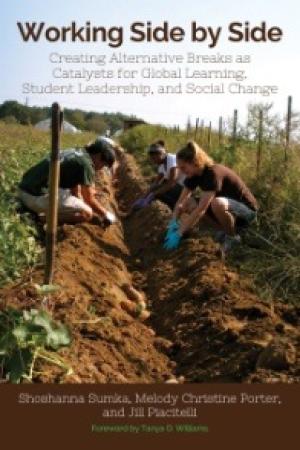
Sumka, Porter, and Piacitelli offer both the history and strategy of an emerging educational model that crosses borders between disciplines to develop competencies and leadership characteristics for social change. The authors document “short-term, student-run immersion service trips” designed to sharpen critical thinking and deepen commitment to future action for social justice (8). In this study their primary example of the alternative break movement is an organization called Break Away that grew out of Vanderbilt University. This and other new programs like the Alternative Break Citizenship school (ABCs) are rooted in efforts from the 1960s that experimented in transformational learning experiences combining travel, intercultural dialogue, collective action, and critical theorizing. A common denominator of these programs is the goal of social justice education. One theoretical framework undergirding these programs is an “active citizen continuum” pointing the way toward authentic relationships for life-long reflection, action, and community enrichment (10). The integration of critical theory and practice moves participants beyond charity and critical theorizing to active citizenship and intercultural competence. A key component of these programs is student leadership. By practicing the actual implementation of the model from the planning and training stages, students gain confidence and facility with each step of the work. In addition to providing the history and theory behind the programs, this book offers practical details contributing to the success of the learning. Readers find pointers on working relationships between staff and students as organizers and leaders of the trips, the alcohol and drug free policy, clarification of the roles of staff versus student leaders, as well as ideas about training, assessing, and fund-raising. The study would be strengthened by further development of the concept of justice. Despite the significance of social justice to this work, little attention is given to making explicit what is meant by justice. Similarly, the concept of global learning could be explored in relationship to literature on intercultural dialogue, collective action, and transcending political borders. Although this book provides an introductory discussion of what community means, contrasting communities of affinity versus communities of geography, the extensive body of work in philosophical and critical theory developing that distinction is not acknowledged (351). In other words, the academic and intellectual strands contributing to this model are not noted with as much care as the recent history of the particular program. This is a compelling read for anyone interested in learning that fosters authentic relationships rooted in “values of social justice, dignity, empowerment, and capacity building” (33). Although religious and theological frameworks are not discussed directly, schools or educators who offer immersion or intercultural learning experiences will benefit from reading this research. The authors’ caution about the tendency to slip toward do-gooder tourism, poverty tourism, and forms of educational travel where privileged students unwittingly perpetuate legacies of colonialism is timely and relevant.The conclusion of this book includes observations about the “need for inspiration and collective action” (359). If faith communities hope to be known as sources of inspiration and collective action in the future, this book offers potential for fertile common ground.
Digital Didactical Design is neither a step-by-step guide for developing educational curriculum, nor a compendium of creative teaching methodologies tweaked by the latest digital technologies. It is, however, a thought-provoking treatise aimed at educational institutions, teachers, and decision-makers in need of a better understanding of learning in a digital world. Readers are reminded that “instead of focusing too much on new technology-driven designs or content design” (13) attention should be placed on developing Digital Didactical Design that facilitates meaningful and deep learning. Equipped with research gathered in varied cultural and educational settings, Jahnke challenges educators to develop teaching methods that appeal to a variety of learning preferences that fall “outside-the-lines.” The author claims that many educational institutions remain fixated on a hierarchical, trickle down, teacher-student relationship that does not take into full consideration the varieties of learners in any classroom context. She also believes there has been an over reliance on the written text as a means of disseminating information. To facilitate greater surface and deep learning, Jahnke calls for a transformation of the language and mindset shaping didactical design and teaching at all levels – from early primary to tertiary. The book proposes certain key concepts as departure points for shaping a pro-active educational design that merges digital media and learning into new communication spaces called “CrossActionSpaces.” These space are seen as “dynamic, overlayered, expanded… where the boundaries of physical buildings and walls are somewhat irrelevant” (18). Learning communities, Jahnke believes, exist as much in cyber space as within the classroom, taking place across several boundaries to thousands of humans who are online, in different settings. In such a milieu, human communication becomes a catalyst for shrinking the distance between people, culture, and knowledge, and acts as a new form of social action (73). Another key concept put forward by Jahnke is the idea of “learning expeditions rather than that of learning experiences which are seen as more open ended” (99). In such an environment, formal structures and processes for teaching and learning combine to create communities where students and teacher are co-collaborators and sojourners of learning content. Additionally, readers are asked to consider learning as a social process constructed within an inclusive offline and online community. Instead of arranging learning around lectures and workshops, Jahnke contends that learning should be more open ended, student centric, and should emphasize social action and active learning, rather than information consumption (186). Digital Didactical Design is a reminder that the traditional teaching space is no longer the central metaphor (197). In its place has come a greater need for peer reflective learning, group activities, and collaborative unbounded reflection.This book affirms that in a digital world interactive technology and didactical design are to be wedded and used in proactive and progressive ways so as to advance student learning. Since new forms of learning are evolving, Jahnke has effectively placed her energies on helping readers better understand digital didactical design, rather than on supplying packaged solutions in all situations. She makes no claim to have all the answers, but she does provide countless opportunities for reflecting on the best way forward in shaping effective digital didactical design and learning strategies for today’s hyper-connected world.
Stephen Downes, cofounder of the first Massively Open Online Course, or MOOC, once asked how many ways society actually needs to teach trigonometry (2001). Each instructor who teaches the subject must teach it anew every time. But what if there is an optimal way to teach the subject? Shouldn’t that be developed as a pedagogical artifact and made available to everyone? The MOOC promises the possibility that anyone with an internet connection can access quality instruction. Rhoads’ book, MOOCs: High Technology and Higher Learning is a critical examination of the MOOC movement. The first half of the book outlines the history of MOOCs as growing out of the Open Educational Resource movement, as well as the institutions which stepped in to take advantage of MOOCs to expand educational brands and even make open courses profitable. It also outlines the split between the Connectivist-MOOC (cMOOC), which relies on individual motivation for self-study, and the xMOOC, which represents the scalable online arm of institutions of higher education and which often offers certificates of completion. The book really shines in its critique of the current state of the MOOC movement. Rhoads argues that rather than being a democratizing force delivering free education to all, MOOCs have largely replicated inequalities in society. The MOOC movement has the ideals of democratization of education, but it has been dominated by a hegemony of elite schools such as “Columbia, Harvard, MIT, Penn, Yale, and Stanford” (104). He illustrates this problem using the example of a popular political philosophy course called “Justice” offered by Harvard’s Michael Sandel. When San Jose State University proposed offering a MOOC version of this course with Sandel delivering his lectures via video, the SJSU Philosophy Department objected. Their concern was that this created a two-tiered system in which students at elite universities interact with “rock star” (105) instructors, while students at public institutions watch canned lectures and whose work was supervised by faculty who were reduced to “glorified teaching assistants” (106). The scalability of MOOCs means that faculty may never interact with students, or at best may just serve as graders. Uncritical adoption of MOOCs also exacerbates problems of diversity in higher education, especially when one recognizes that the institutions creating MOOCs are less diverse than the presumptive adopting institutions. And finally, there is a false epistemological assumption that there is one right, best way to teach a subject, rather than allowing that there may be many different ways to teach a subject, each responsive to a particular social and cultural context. Rhoads’ goal is not to suggest that higher education should abandon MOOCs entirely. He is aware of the potential in MOOCs for making quality education more broadly available. But he recommends a number of reforms in the way MOOCs are developed and implemented. Digital online learning may benefit from a combination of recorded lectures and publicly accessible online documents as well as intensive faculty support embedded within particular institutional contexts. This approach to MOOCs yields a hybrid model he dubs an “xsMOOC,” a “MOOC with extra support” (130). Contrary to the view that online learning should be pedagogically efficient, Rhoads argues that the best educational resource is one that is grounded in the context of the learners who will use it. In this way can MOOCs best fulfill their promise.

Jon Krakauer’s book on the epidemic of sexual assaults on American college campuses is hard to put down, both because it is incredibly well-written and engaging, but also because it is so alarming. For the faculty member who is already aware of the problem (either from a statistical vantage point or from hearing the experiences of survivors on her or his own campus), some of the information presented is not surprising. The scope of the issue is quite shocking, however: Missoula, home of the University of Montana, is the focus of Krakauer’s case study and one gets the sense that this college town is especially unsafe. Towards the end of the book, however, Krakauer demonstrate that Missoula’s rape statistics are actually typical – perhaps even lower than the national average. Even though the problem presented is horrifying, Missoula is not even the worse case scenario. Through interviews and legal testimony, Krakauer narrates the stories of several college-aged women who were sexually assaulted while they were students. Most of the accused rapists were members of the football team, so part of the story concerns the untouchable status of campus athletic teams (or, at least, certain high-profile athletic teams). But sports are not the only unjust system implicated here: Krakauer looks unflinchingly at the ways that administrators protect colleges from litigation, often at the expense of victims. He similarly criticizes the legal system for re-traumatizing victims and for consistently doubting women’s testimony when they come forward. Krakauer’s accessible explanations of technical matters are very helpful: for example, he explains the different burdens of proof that apply on- and off-campus. A college or university is required by the U.S. Department of Education to use a “preponderance of evidence” standard as its burden of proof when adjudicating sexual assault accusations, while the criminal justice system uses the “beyond a reasonable doubt” standard (179). Thus, a rapist may be found guilty in an on-campus case and expelled, even while the same evidence might not have resulted in a guilty verdict or prison time in the state’s criminal justice system. As another example, Krakauer uses psychiatrist Judith Herman’s foundational work to explain that traumatized people often act in bewildering ways that do not make sense to the outside world (perhaps by contacting the perpetrator or by continuing to attend class after experiencing violent trauma; moreover, the memories of a traumatic experience can be confusing and non-linear). Although these behaviors seem to indicate to others that “nothing happened” or “the experience must not have been that bad,” Krakauer (via Herman) shows that these are utterly typical behaviors of a traumatized person. Trauma so reorients a person that the behaviors a person displays in the aftermath can be counterintuitive to what non-traumatized people expect. This book should be required reading for faculty and especially for administrators who adjudicate sexual assault cases on college campuses; it would probably be useful for those in law enforcement, too. Missoula would also be excellent for campuses that have required first-year or campus-wide reading programs, as it forces us to consider the realities that victims face on campus and to realize that judicial systems, both on- and off-campus, can and must do better.
Norman Denzin and Michael Giardina have edited an amazing collection of cutting-edge articles on qualitative research methodologies and methods in their new volume, Qualitative Inquiry Past, Present, and Future: A Critical Reader. The editors selected twenty-four chapters for this volume from nine years of the Congress of Qualitative Inquiry proceedings.The authors represent a variety of disciplines including sport studies, education, psychology, sociology, communications, and gender studies. In the opening chapter, Denzin and Giardina provide an overview of the developments and arguments in qualitative research methodologies since the Congress published its first volume in 2005. They argue that qualitative research is “at a pivotal crossroads: We live in a historical present that cries out for emancipatory visions, for visions that inspire transformative inquiries, and for inquiries that can provide a moral authority to move people to struggle and resist oppression” (12). They explore the paradigm wars since the 1980s and create the space for this volume in the works of C. Wright Mills, Paulo Freire, bell hooks, and Cornel West. After this introduction, the book is divided into four sections, a coda, and an epilogue. Section I contains four chapters that explore the Philosophy of Inquiry. These chapters engage important concepts including disciplines sharing language using Bakhtin’s concept of chronotopes, the turn towards praxis, the role of institutional review boards, power, research ethics, as well as subjects and agency. The six chapters in Section II (Politics of Evidence / Politics of Research) explore the struggle between qualitative research and the privileged position of scientifically based research.The authors then highlight a variety of factors that threaten the legitimacy of qualitative research including pressures from pro-profit universities, the diminished role of faculty in university governance, and the rise of the national security state. Henry Giroux writes that “these may be dark times… but they don’t have to be, and that raises questions about what educators are going to do within the current historical climate to make sure that they do not succumb…. Resistance is no longer an option, it is a necessity” (216). Section III, Methodological Imperatives, contains some of the most provocative and practical articles for active researchers. These articles engage an array of methodological techniques including empathetic interviewing, ethnography, performative writing, art-based methods, and autobiographical methods. Halley’s article on the production of death and Dillard’s work on memory and spirituality in particular push the frontier of methodological discussions. Section IV, Indigenous and Decolonizing Interviews, provides four articles that advance the role of social justice in the research agenda. These authors engage multiple levels of struggle and as Puebla argues, “our knowledge about the social world has been tremendously useless when dealing with the urgency of social justice, social change, and democracy” (387). In the Coda, Ellingson stresses the passion and pleasure of paying attention. The Epilogue contains an engaging dialogue on the future of qualitative inquiry. The dialogue itself was the result of e-mail exchanges between the two editors and five additional authors. Denzin and Guardina conclude: “qualitative inquiry is being pulled in multiple directions at once: pushing the boundaries of both traditional social science and interpretive research; engaging in struggle against oppressive institutional and political machinations, balancing the need for deep theoretical engagement with a praxical approach to the research act; and striving to engage with (if not change) the landscape on which qualitative inquiry currently sits… we have a job to do; let’s get to it” (462). This is a powerful and inspirational volume. It is global in scope with articles from the United States, Europe, Africa, and New Zealand. The individual articles contain excellent bibliographies and insightful conclusions. They are well written and easily accessible to graduate readers. This volume is an important addition for theological libraries that serve schools with degrees in practical theology, emphasis in social justice, chaplaincy programs, and doctor of ministry degrees. Professors who teach theological methodological approaches and methods should consider adding selected articles from this volume to their required reading.
Wabash Center Staff Contact
Rachelle Green, Ph.D.
Associate Director
Wabash Center
greenr@wabash.edu