Resources
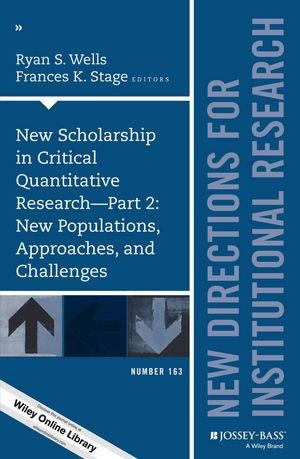
The New Scholarship in Critical Quantitative Research – Part Two: New Populations, Approaches, and Challenges provides readers with a timely and much needed expansion of the emerging paradigmatic approach of blending critical theories with quantitative methods. This volume substantially supplements the two prior New Direction for Institutional Research volumes that serve as the only other major publications on the employment of critical quantitative inquiry within higher education. Editors Wells and Stage garnered a multifarious group of authors to present diverse perspectives and methodological nuances within critical quantitative inquiry. The authors examine underserved and minoritized subpopulations of students, under-researched institutional types, and paradigmatic conflict within methodological techniques. The way Wells and Stage combine these chapters allows readers to preview the utility of employing critical quantitative inquiry by considering areas that are missing within the existing literature (minoritized student populations and community colleges). In Chapter One, Faircloth, Alcantar, and Stage provide a blueprint for researchers to examine the experiences of American Indian and Alaska Native students who frequently are represented on national surveys in very small sample sizes. These authors not only provided tangible ways to use large-scale datasets to study minoritized groups, but also illustrated multiple ways to conceptualize how researchers operationalize identity variables as quantitative data. Chapter Two examines another minoritized group, students with disabilities. In this chapter, Vaccaro, Kimball, Wells, and Ostiguy propose the idea of critically analyzing samples of students with disabilities to develop “policies and practices that liberate rather than exclude” (38). Chapter Three examines an under-researched institution type, the community college. Rios-Aguilar beautifully delivers a set of tangible possibilities for community college leaders and institutional researchers to collect, analyze, and utilize “big” data for commuter students at two-year institutions. In Chapter Four, Malcom-Piqueux details a study using latent class analysis to discover inequities in college financial aid. Canché and Rios-Aguilar again use the context of the community college, in Chapter Five, to highlight social network analysis. Through a completed research project, they outline basic concepts of critical social network analysis and implications for institutional researchers at community colleges. Hernández, in Chapter Six, diverges from empirical examples to examine the theoretical and paradigmatic tensions of critical quantitative inquiry. Finally, Wells and Stage provide Chapter Seven as an overview of the historical uses of critical quantitative inquiry and implications for the future. This publication is well-organized and provides readers with a variety of perspectives and empirical examples. While there are several overlaps between the chapters, particularly as it relates to the implications (for example, need to oversample minoritized populations), this overlap in each chapter still diverges slightly from the other chapters. This publication is a bold counter-argument to using strictly positivist and postpositivist methods, which will allow researchers to highlight inequities and better study the experiences of minoritized students in higher education. This publication is worth purchasing if you research or assess the needs, experiences, and outcomes associated with the collegiate experience.
The Slow Professor takes its cue from the slow food movement (http://www.slowfoodusa.org). Borrowing the words of Carlo Petrini, author of Slow Food Nation, Maggie Berg and Barbara K. Seeber define slowness as “not so much a question of duration as of an ability to distinguish and evaluate, with the propensity to cultivate pleasure, knowledge, and quality” (89-90). Slowness, in their thinking, is less about speed than it is about intentionality. They raise this point in a number of contexts. On the slim volume’s opening page, Berg and Seeber identify the popular and academic discourses they engage in their exploration of time management and timelessness; pedagogy and pleasure; research and understanding; and collegiality and community. They intersperse expert opinions from a variety of fields, including other research on teaching and learning, to support their stance that slowness is a productive stance for academics. Each chapter builds a case for slowness that culminates in practical suggestions, many of which seem like the kind of advice a reader with this book in hand may have considered already. I found value, however, in Berg, Seeber, and their chorus of sources confirming my suspicion that in the face of pressure to work constantly, I have a right to health, a life with my family, and enjoyable hobbies (16). Still, their advice tends to focus on what individual readers can do on a daily basis rather than on how institutional change might occur. For example, the first chapter, “Time Management and Timeliness,” ends with elaborations on these recommendations: “We need to get off line;” “We need to do less;” “We need regular sessions of timeless time;” “We need time to do nothing;” and “We need to change the way we talk about time all the time” (29-32). I am all for these, and I wholeheartedly agree that “if you want an event to be joyless, make it mandatory,” a takeaway from the end of “Collegiality and Community” (83). Still, the pressure of knowing that I have five years to publish another book, mere months to submit my next article, or a few weeks to finish a book review (ahem) gives me pause when I weigh walking the dog against writing. Institutional pressures directly affect individuals, but change in an individual’s perspective on time – especially that of a junior or contingent faculty member, for instance – does not lead directly to institutional change. Berg and Seeber acknowledge that “academic culture celebrates overwork” but, they argue, “it is imperative that we question the value of busyness” (21). Herein lies their contribution: in questioning busyness, they advocate learning from slowness so that the work we do is planned, thoughtful, deliberate, and energizing rather than scattered, scatter-brained, hurried, and draining. The latter leads to diminishing returns hidden behind the familiar, “I’d love to, but I’m busy.” The former can yield Csikszentmihalyian flow in reading, writing, and teaching.
In The Grace of Playing, Courtney Goto offers a project in practical theology for Christian religious education that uses the notion of playing to better understand teaching and learning. Goto distinguishes her project from a formal practical theology of play, where play could be explored as a universal category of human existence. Instead, she works in the line of Paulo Freire’s search to move beyond a traditional schooling model of education towards learning that is more integrated, experiential, and creative. Specifically, Goto reflects critically on the notion of revelatory experiencing through the language and pedagogies of playing. Her focus is on playing as it relates to adult learning, and her investigation demonstrates – both conceptually and through case studies – how playing cultivates faith formation. Goto is an Assistant Professor of Religious Education at the Boston University School of Theology and a co-Director of the Center for Practical Theology. She writes as a third generation Japanese American United Methodist primarily for an audience of theorists, students, and practitioners who are liberal mainline Protestants. She invites Roman Catholic, Orthodox, and Charismatic Christians into the conversation as well, but notes that her advocacy of revelatory experiencing is to be understood in terms of the contextualized perspectives encountered in mainline Protestant churches. This is an important caveat. Theologically conservative readers will take issue with her concept of revelatory experiencing, whereby revelation happens in between persons as they relate to one another (as opposed to approaching Christian revelation as a totalizing meta-narrative). That Goto makes her theological liberalism so clear and defined, particularly in terms of her understanding of revelation, is a great service to readers. The Grace of Playing investigates playing from social scientific, theological, and historical perspectives and offers two case studies for application. After a preface and introduction, Chapter 2 explores psychoanalytical and psychological concepts of playing, relying particularly on D. W. Winnicott to articulate sociologically what occurs in revelatory experiencing. In Chapter 3, Goto turns to theology to build a theory and constructive proposal of play by appropriating insights from Jürgen Moltmann’s Theology of Play. Chapter 4 is a historical accounting of medieval practices of play, including the use of devotional dolls by fourteenth century nuns in the Rheinland, Germany and the practice of holy foolery by those in both Western and Eastern Church traditions. The final two chapters contain case studies of grace-filled play. The first describes the creation of a pretend garden at a Japanese American church for the purpose of congregational reconciliation, and the second briefly recounts a practice of playing with inmates in a juvenile detention center.To conclude, Goto demonstrates that the grace of playing leads a world in need towards God’s new creation. The Grace of Playing skillfully navigates insights from sociology, theology, and history to make a compelling case for the theological practice of play as a mediating, revelatory experience within Christian religious education. The book is readily accessible for students and practitioners, without neglecting the more technical needs of theorists. For the case studies, Goto deliberately refrains from providing much, if any, direct data; this effectively condenses the reading, but also leaves a sense of wanting to know more about how the grace of playing works itself into and through these unique settings. Overall, the book is a warm invitation for all to play in the fullness of God’s grace.

Reading The Lost Jewels of Nabooti, a “Choose Your Own Adventure” book by R.A. Montgomery as an eight year old in 1979, I never could have imagined relating that adventure to the book of Revelation in scripture. Now, after reading Robby Waddell’s essay “Choose Your Own Adventure: Teaching, Participatory Hermeneutics, and the Book of Revelation” in Teaching the Bible in the Liberal Arts Classroom: Volume 2, the possibility of a scholarly conversation between the two makes me eager to teach Revelation again. Teaching the Bible includes four parts: tactics, strategies, principles, and reflections on Biblical Studies in the liberal arts classroom. Waddell’s essay is just one of several essays sharing tactics for teaching the Bible. Each of these tactical essays highlight creative and compelling possibilities for teaching: Twitter as a tool for conversation and connecting, Wikipedia as an example of Pentateuchal formation, and digital storytelling to illumine Biblical character studies are just a few examples. Certainly it would be easy to view these tactics as mere activities for class discussion. However conceptualized, within this framework these tactics reveal deeper truths: the changing role of teachers in a twenty-first century globalized classroom, the ongoing fight for humanities’ role as a vital component of a post-modern education, and facilitating effective learning when it is all too easy for a student to surf the Internet while taking notes on their computer. Editors Jane S. Webster and Glenn S. Holland, along with their cohorts in the “Teaching Biblical Studies in the Undergraduate Liberal Arts Context” within the Society for Biblical Literature, care about this deeper conversation. Tactics for teaching become activities when separated from guiding strategies and overarching principles. Tactics become a particular art form when guided by essays like those included in Parts II and III of this book. Consider the strategy suggested by Sonya Shetty Cronin in her essay, “Fantasy: The ‘Renewed’ Genre Making Necessary a Biblical Education for Understanding Our Contemporary World.” Cronin’s argument suggests scholars of Biblical studies should be just as versed in modern fantasy novels as they are in Philo. Doing so allows scholars to continue to present the modern relevance of Biblical themes as well as their undergirding of so much of popular culture. If strategies are the goals that guide tactics, principles are the greater themes that illumine those strategies. In this volume, themes of ecology, supersessionism, and violence are explored as principles that call for a deeper conversation within the Biblical narrative and contemporary culture. The final three essays, exploring Biblical studies in the liberal arts curriculum, are valuable conversation partners. For example, Steven Dunn highlights a syllabus and course objectives drawn into conversation with the ability-based curriculum at Alverno College. Katy E. Valentine probes the problems and possibilities for teaching students from non-religious backgrounds. Certainly The Lost Jewels of Nabooti drew me into the scholarly conversation unfolding within these pages. To be clear, this excellent book is not unlike a “Choose Your Own Adventure” book where the reader chooses the adventure most needed within their classroom setting.

This collection of fourteen essays, most of which originated from a faculty workshop on Pedagogies for Civic Engagement sponsored by the Wabash Center for Teaching and Learning in Theology and Religion, is divided into three sections. The collection represents a variety of perspectives and the authors engage that diversity through a distinct set of questions. “What is the civic relevance of the academic study of religion, considered on its own terms and in its increased diversity? What unique contributions does religious studies offer the public sphere, especially when seen as separate from the work of religious communities who concentrate on religious belonging? How might the disciplines dedicated to such study offer a distinctive shape and response to the civic mission of the contemporary university?” (xiv-xv). Further uniting the individual contributors’ perspectives are their insights offered towards the development of a model of civic engagement that answers these questions. Section I describes the CLEA model of civic engagement. The employed acronym is drawn from the terms complexity, location, empathy, and action. The terms refer to dimensions, better still, capacities essential for civic participation emerging from the “virtues of civility, reasoned deliberation, and commitment to the common good” (xiii). The intellectual capacity needed for democratic society is evident when persons achieve awareness of the complexity of the world, especially a view of the world beyond the way the powerful control the interpretation of social reality (8-10, 14, 25). As democracy blossoms into pluralism, the person who would be a responsible citizen must exhibit awareness of his or her social location and point of view relative to that of other persons (15, 27-28). Beyond awareness of difference, he or she must have empathy, namely a sense of connection to others as all are (or should be) in pursuit of the common good (15-16, 31). The responsible citizen must act on what he or she has come to know as true (16, 34). In Section II, various strategies for teaching civic engagement are described. Among the various methods used for teaching civic engagement is reflective writing which is summary and evaluation of different points of view relative to one’s own view (49, 50-53). In critical assessment of texts and media, students learn to interrogate symbols, internet (websites), newspaper and news programs, visual and performing arts, and various forms of entertainment (49, 53-54, 88-89, 95) but also learn how they may be used responsibly (100-102). Field trips are immensely helpful aids in teaching (49, 54-55, 77-80, 119-121). Another method of teaching civic engagement is community-based learning which involves teachers and students going into the community as well as representatives from the community visiting their classroom (49, 55-56, 66-71, 110, 112, 136-137). Engagement may also be taught through students’ involvement in community service projects designed to address a need or problem in a community (49, 57, 110, 112). Ascetic withdrawal, for example, in the form of abstinence from or limiting use of cell phones, smart phones, email and texting, impulse buying, consumption of fast-food, use of products made through exploited labor, may enable students to empathize with other persons adversely affected by American consumerism and to discern and cease the unhealthy habits they have formed through compulsive behaviors (93-94, 151, 155). Successful teaching requires creativity in the selection of instructional methods as well as discernment of the combination of methods, two or more, that will lead to achievement of specified learning objectives (58-59). Section III goes further into defining civic engagement and locating it within the curriculum. Civic engagement is defined as participation in political processes such as voting, development of relationships, and collaborations or partnerships that lead to policy that contributes to the common good (165, 167, 170, 175). Civic engagement is not only local and national but also global (184). It is connected to, inseparable from, the idea of social justice (185). Also, it is connected to advocacy, not taking a political position but rather “taking a side in a debate and arguing for it” (209-210). Disagreement about the relation of and distinction between religious studies and theology is resolved in the consensus that both function best as means for analysis and critique of societal and cultural traditions that result in privilege and inequality (236). Whether in religious studies or theology, the course offered in civic engagement is an opportunity for students and teachers to practice democracy (17, 188-190, 246-247). In spite of the charge that the described teaching methods are difficult to grade and are not academically rigorous (37-39, 218-220), this volume of essays merits consideration. It is a rich resource on instructional methods. The combined essays offer a substantive definition of civic engagement. Most importantly, the collection correlates teaching method to the cultivation of capacities needed for life in democratic society.
In a valuable and demanding text, Sara Ahmed’s On Being Included looks at the role of diversity in higher education institutions in order to examine the many difficulties and paradoxes that diversity practitioners face. Most centrally, Ahmed argues that the people who work in diversity offices are expected to fix the “blockages” that come with various racial, ethnic, gender, and sexuality tensions, yet these same persons are themselves viewed as the blockage when they raise such issues. Similarly, many institutions use the existence of a diversity office as sufficient evidence of the school’s health rather than as a locus for productive work. The book’s argument relies on a series of interviews that Ahmed did with diversity practitioners at schools in the United Kingdom and Australia. The results she obtained are shaped largely by a series of acts passed in the UK, beginning with 2000’s Race Relations Amendment Act (RRAA) and concluding with 2010’s Equality Act. These acts led to the creation and assessment of diversity statements by UK colleges and universities. Over the course of five main chapters, she examines the experiences of her informants and analyzes their logic and rhetoric to disclose how institutional diversity work often functions to salve privileged consciences while concealing marginalized voices. In particular, Ahmed spends significant time looking at the policy documents that diversity offices were often tasked with developing. Because of the RRAA, many of the documents she examined were written in terms of legal compliance, and thus target safeguarding the school’s image more than improving its institutional life and structures. Moreover, she notes that after the policies created by various UK schools were evaluated and ranked, high marks on a well-written statement were translated into institutional strength at diversity work, which ultimately concealed the type of work that still needed to be done. Indeed, the text claims that an explicit, stated commitment to diversity by a school usually has no effect on the actual practices and habits of the school. Not only do policy commitments fail to lead to action, they often substitute for action. This leads to one of the concluding provocations of the text, where Ahmed pushes against the discourse around diversity “allies.” She notes that a focus on white anti-racism can often have the effect of simply re-centering whiteness. Diversity work is often supported by white persons or by predominantly white institutions precisely as a way of assuaging a bad conscience. Ahmed sees this as most evident when progressive whites react to challenges about race first by invoking their own bonafides rather than affirming the experiences of the marginalized. On Being Included is an insightful, challenging, and well-written text. Teachers and administrators who are interested in diversity should certainly take time with Ahmed’s work, as should anyone interested in assessing the larger role of institutional context in higher education. Although a careful reading will not leave the reader with any easy approaches or techniques, it will undoubtedly prompt helpful critical self-reflection that universities need.
The editors of Looking and Learning argue that institutions of higher education have required textual literacy for centuries, but now are facing a problem: they have not cultivated visual literacy in an age when visual input has risen exponentially in volume, pace, and cultural significance. Little, Felten, and Berry propose to address this problem pedagogically throughout academic curricula. Eight contributing authors bring disciplinary-based tools to the conversation, discussing pedagogical approaches and outcomes for students’ development of visual literacy as a means of depth-learning. One of the most valuable features of this volume is the introduction of the Association of Colleges and Research Libraries’ (ACRL) definition, promotion, and list of observable performance standards with outcomes for visual literacy (3, 8). Looking and Learning then details particular courses and pedagogical approaches by professors who claim that visual learning significantly enhances student perceptions of data and experience, deepens engagement with course material, and sharpens critical thinking skills – all important outcomes for effective education. Chapter one, for example, focuses on visually-based pedagogical approaches for learning astronomy. A pedagogical shift came to Anthony Crider when he began to emphasize visual and information literacy skills rather than content delivery in his courses (16). He found that as a result, his students learned to think through problems more deeply and effectively. Now, close observations of the objects and phenomena in space are required, followed by deductive thinking to frame arguments for hypotheses and proofs. Chapter two provides pedagogical tools that move students from subjective reactions to critical responses when encountering a visual input. In this chapter, like Crider, Michael Palmer focuses on developing the critical skills for visual literacy, rather than content-based learning. Likewise, chapter three shows how Katherine Hyde uses photography to cultivate sociological mindfulness and social identity (31). Cedar Riener teaches about visual perception in chapter four, using pictorial illusion to demonstrate that perception is not always accurate. Chapters five and six speak to “deep learning” through work with visual media including historical paintings (Steven S. Volk), and film-making (Alison J. Murray-Levine). The intent is to slow visual inputs so there is actual engagement and analysis of the subject matter as a visual story and language. Chapter seven introduces the process and structure of critique in the area of visual arts (Phillip Motley). The volume concludes in chapter eight with Deandra Little providing suggestions and strategies for teaching visual literacy throughout a curriculum (87). For those who are visually impaired or have difficulty interpreting visual cues and yet are able to hear, there is little aid in this volume. One exception occurs in chapter five where historian Steven S. Volk helpfully introduces students’ auditory input for a person who is not sighted, discovering that learning is enhanced for everyone. Perhaps auditive literacy is the next logical educational contribution for learning by senses. Data and experience come through many senses; pedagogical approaches are likely to have to address these different avenues of learning as attention to differing abilities expands both culturally and legally. Ultimately, the editors and contributors call for all teachers and students to “learn to look and look to learn” (5). Such a challenge seems obvious, achievable, and pedagogically meaningful (for the sighted) as an effective educational focus for literacy – literacy for a visual age.
Adult education is an area of study and application that has helped bridge the gap between immigrant populations and the bureaucratic systems regulating said populations. This has been accomplished by implementing formal and informal training as well as collaborating with settlement services and other programs. Sadly, the bent of much of this training (specifically within Canada, the U.S., and Australia, in which this volume’s featured studies are located), was geared historically toward assimilating immigrants rather than integrating them into their host countries. Even today, the underlying narrative of immigration policy in these countries is highly colonial and assimilationist. This volume attempts to elucidate the key conflicts at work between immigrants, host countries’ policies, and service workers. Using Nancy Fraser’s theoretical constructs of redistributive, recognitive, and representational justice, the authors present solutions and insights into how adult education as a field can assist immigrants in challenging exploitation and influence policy towards a more socially just outcome. Applying Fraser’s theory to adult education, Shibao Guo defines recognitive adult education as one that “affirms cultural difference and diversity as positive and desireable assets” (15). This collection addresses the conflicting interests at work within immigration and education and points to possible ways adult educators and others can mitigate the negative realities that immigrants face. The topic of immigration is dense and multifaceted so thankfully the chapters are concise and accessible. Given that “the United Nations now estimates that 232 million of the world’s population lives outside the country of their birth,” transnational migration can no longer be ignored (2). One takeaway from this collection of nine chapters is that there is a marked disconnect between immigrants’ experiences and the policies created to regulate them. Immigrants face a myriad of challenges: the devaluation of foreign credentials, possible exploitation, racism, discrimination, heightened security policies of receiving countries, and broken bureaucratic systems. The nature of immigration has also changed. Shibao Guo provides a helpful description of how transnational migration is different from other types of migration by defining it as “multiple and circular migration across spaces of migrants who maintain close contact with their countries of origin” (7). This type of migration is a far cry from migration patterns of the nineteenth and twentieth centuries when migration was often described as “one way” and immigrants were expected to completely assimilate into the receiving country’s culture, leaving all traces of “foreignness” behind. Each of the chapters echo Shibao Guo’s call for adult education to “continue its long-standing commitment to social inclusion by working toward a more inclusive adult education squarely focused on the benefit of marginalized adult learners (e.g., workers, farmers, women, racialized minorities)” (8). The statistics reported are simply staggering. Bonnie L. Slade cites the Longitudinal Survey of Immigrants to Canada (LSIC), which reports that “although 76% of new immigrants have at least one type of international credential, such as a university degree, 70% experienced barriers in gaining access to the Canadian labor market at an appropriate level” (67). As Slade and others note, the devaluation of foreign creditials often leads to underemployment or unemployment, especially for immigrant women. Critically studying the language used in immigration policy and the theoretical position taken by policy makers may also assist adult educators in unpacking some of the undercurrents of racism and colonialism still at work in policy creation. As Edward Joaquin and Juanita Johnson-Bailey point out, the “issue of immigration has generally been cloaked in the language of patriotism and nationalism” (79). While overt racism and bias may be shunned in modern discourses around immigration “predjuice has become coded and wrapped in new, less offensive language and discussion” (80). Joaquin and Johnson-Bailey also suggest that adult education programs “adapt their curriculum to educate learners about transmigrational immigrant education concerns” as well as “infuse strategies that address the needs of immigrant students” (83). Yan Gao’s chapter on ESL programs in Canada illustates how some language programs have become mechanisms to create and control workers. Yan Gao suggests that adult educators in Canada “help immigrants develop critical language awareness” which will allow them to contest unfair practices (48). Perhaps one of the most promising avenues for change comes from Tara Gibb who suggests “inviting policymakers and employers into literacy classrooms and language classrooms so that they might observe firsthand alternative forms of assessment, view holistic respresentations of language and literacy practices, and listen to immigrants’ experiences and expressions of knowledge” (60). In these instances, adult educators are being called on to actively educate themselves, their students – immigrant and nonimmigrant alike – and policy makers on these issues. This collection provides an intriguing foray into the brave new world of immigration. It lends itself not only to adult educators who work with immigrants but also to those who do not. College faculty, administrators, and staff in the Global North would benefit from reading this volume because if transnational migration continues on its current trajectory, it will vastly change our institutional as well as national demographics.
Research literature reveals that effective mentoring has significant and positive impact on student success and persistence for women and people of color. Mentoring as Transformative Practice consists of ten essays concerning effective traditional and nontraditional mentoring strategies for women and underrepresented minorities (URM). The essays presuppose the value of mentoring and also explore its impact on student outcomes and agency. The majority of essays in this volume are written by women and persons of color who have successfully mentored others or have been the beneficiaries of effective mentoring relationships. Many of the essays employ a nontraditional methodology for analyzing mentoring relationships and effective mentoring methods. For example, a critical reflective and subjective instrument called scholarly personal narrative is used both to analyze mentoring relationships and as a tool to mentor students. Scholarly personal narratives highlight the author’s voice and communicate their perceptions and interpretations of their lived experiences. Such narratives reveal insights and depth of experience in compelling ways. These are not normally found in research works. They also offer a unique method for constructing new knowledge. Chapter One uses personal narratives to examine significant aspects of mentoring that impact women and URMs in higher education arguing that they often need psychosocial versus academic mentoring. The authors – one with a national mentoring award – reflect on mentoring practices in their personal narratives. They conclude that students need mentors who offer authentic relationships, understand their experiences as minorities, listen without reprisal, and encourage and model vulnerability at all levels. In Chapter Two, an African American female and associate professor at a research university and six of her students analyze data from their scholarly personal narratives, revealing three consistent behaviors that contribute to the development of student agency: (1) perceived and actual approachability allowing for mutual trust and comfort leading to cultivation of student agency; (2) the balance of challenge and support; and (3) assistance and encouragement to develop a scholarly voice, passions, and vocation. In Chapter Four personal narratives are used as a critical pedagogical tool through which students trace and critically analyze their educational development, comparing their experiences with patterns highlighted by social science theories, quantitative data, and relevant social policies. The book offers several mentoring takeaways in the remaining chapters. One takeaway is that mentoring can become a racialized experience when it takes the form of protecting a traditional canon from nontraditional perspectives brought to the learning experience by women and minority students. Viewed within the context of social justice, mentoring involves conscientization, the valuing of lived experience, and advocating for students. Nontraditional alternatives to proximate mentoring relationships include “mentoring-at-a-distance” through emails, conferences calls, and so forth, and various unexpected “cheerleaders” who become sources of psychosocial encouragement. Online mentoring solutions provide psychosocial support for students in specific disciplines, like STEM. “Pedagogy for Equity” peer mentoring can focus on three levels – personal biography, collaborative sociocultural group context, and broader institution. Intergenerational and near-peer approaches positively impact retention and achievement from junior high through doctoral programs. I highly recommend this book as a resource for individual or institutional self-reflection about participation (or lack thereof) in mentoring relationships as mentor/mentee and for thinking about and developing effective mentoring strategies for women and URMs.

The title Listening to Teach caught my eye. When one imagines teaching, one might first think the student’s job is to listen, while the teacher’s job is to speak, or at least to organize activities geared toward a predetermined outcome. What does listening have to do with the role of teaching? Furthermore, for those teaching within the religious academy, what might a pedagogy of listening look like in the context of religious higher education? Although this book does not specifically target religion or higher education, undergraduate and seminary professors will find many ideas, which will inspire their classroom teaching. The various models of pedagogical listening presented in this text can also serve to challenge traditional teaching strategies that are still pervasive in many higher education classrooms: teacher-centered strategies that often rely on a banking model where content is transferred to passive students. Infusing religion classrooms with dialogical and student-centered approaches can create new forms of learning where students learn not only content, but also how to ask good questions and seek answers in ways that are personally and contextually relevant. For many teachers this requires a shift in one’s perceived role: rather than seeing the teacher as having all the information and students as receptacles for it, this approach recognizes that students enter the classroom with a wealth of experiences and perspectives the teacher may not share. Within listening pedagogy models, teachers serve as co-researchers, observers and documenters of classroom interactions, and interpreters who can help students grasp the meaning of the learning that has taken place. As teachers listen deeply to students and encourage them to learn the art of listening to one another, students are able to enter into the learning process in a way that holds their interest and results in learning that remains in place far beyond a content test. Part 1 sparks ideas for teaching strategies and discussion formats that, although predominantly geared toward children, would work at least as effectively in a classroom of college or seminary students. In these methodologies there are some strategies I have come to through trial and error, but like many teachers in higher education, I have no formal training in teaching. Therefore, learning educational theories and strategies others have found helpful provides a deeper level of intentionality in my teaching, and allows me to see how I might more holistically implement options other than didactic teaching. These brief chapters also provide lists of references that are useful for digging more deeply into any of the specific pedagogies outlined. Part 2 contains ideas of particular relevance for higher education religion classrooms. Chapter 8 focuses on a “pedagogy of discomfort,” which the author, Ashley Taylor, suggests as a way to approach teaching and learning about areas of injustice and oppression. Taylor draws together the cognitive and emotional aspects of learning, allowing learners to critically analyze their own emotional responses. A teacher’s role, then, is to listen intently to student responses and create a safe space in which to acknowledge and examine areas outside of our comfort zones. This approach could be quite helpful in facilitating conversations regarding the approach people of faith should take in the face of today’s many areas of social and economic inequity. Chapter 9 suggests a pedagogical model a religion teacher might find useful: curation as listening. Thinking of a religion teacher as a curator of a faith tradition, with particular emphasis on the Latin word curare, “to take care of,” what would it look like for religion professors to imagine our role as caring for the tradition and testimony of our spiritual forbears, closely listening to the voices (present and absent) in our tradition’s history, and the ways those voices speak to our present context? In content-based religion courses such as Bible, history, and some theology courses, how might the professor’s role shift by thinking of him or herself as a curator of the tradition rather than the all-knowing expert? How might the students’ experience change if they see themselves as co-curators, creating meaning alongside the tradition and their curator-professor? Other chapters also hold useful ideas, including the development of trust, the augmentation of uncertainty, and the ways that one transfers these listening pedagogies to an online format. Similar to the struggle experienced by many K-12 teachers regarding “teaching to the test,” many religion professors may wonder if students can learn an appropriate level of content based on these methodologies, and this is a valid critique. Engaging a pedagogy of listening invites academics to reimagine ways by which a discipline is passed on most effectively and meaningfully. For those recognizing the limitations of the banking model of education, pedagogies of listening offer alternative models to advance lifelong student learning.
Wabash Center Staff Contact
Rachelle Green, Ph.D.
Associate Director
Wabash Center
greenr@wabash.edu