Resources
From the Publishers Despite the intimidating reference to pedagogy in the title, the anthology is true to the encompassing notion of feminism as a foundation from which theories and disciplines can emanate in order to voice a variety of experience. The American, British, and Australian scholars provide compelling essays on identity, friendship, motherhood, hunger, the media, parenting, childcare, shame, and the silencing influences of legal systems and the academy. Unusual for this type of collection is a lone wolf contribution about learning to be a man--the "other half" viewpoint by which feminism marks its progress.
Are the new elitism and conservatism that are creeping into academia degrading undergraduate education? This volume seeks not to resolve the issues surrounding academia today but rather to mark the contested points in the debates on whether to incorporate cultural diversity in the curriculum, whether to compete for the research dollar, and how to evaluate faculty humanely in a changing atmosphere. As Eble urged, in the 1990s it is imperative that we find ways to foster good teaching and learning in an academy that must change to meet the needs of students from different demographic backgrounds and with different levels of preparedness, and academy that is facing continuing political and budgetary pressures. (From the Publisher)
This report relates to the concept of teaching portfolios. It discusses the importance of accounting for institutional culture when introducing the concept of teaching portfolios. Includes information on how the department chair can help to improve teaching. (From the Publisher)

This is an incredible, amusing, horrifying, yet true story, in which all names have been changed to protect the guilty. It tells how the author, a journalist turned college professor, came face to face with Generation X: jaded, un-achieving, highly demanding yet lacking any respect for standards or intelligence. These insouciant scholars wore bored looks, ample attitudes, and reversed baseball caps. They expected to earn top grades by just showing up in class, which they interrupted with their portable TVs, cellular phones, or personal pagers. For his own survival as a teacher, Sacks decided to play a bizarre, cynical game: The Sandbox Experiment, in which he catered to the whims of his students as though they were kindergartners. It worked: Sacks became a great success as a 'teacher', got tenure, and now continues to 'teach' at the strange, appalling institution he calls 'The College'. (From the Publisher)
Global developments directly or indirectly affect teaching and learning in higher education. In this new era of telecommunication revolution and growing international cooperation, it is time for university and college teachers to talk across national boundaries about teaching. In this volume of New Directions for Teaching and Learning, contributors from around the world describe issues they are currently facing in their teaching practice. National differences are put into the context of universal themes. Faculty are responding to demands for social development and to pressures from the world of work. They are influenced by government policies and financial constraints. Regardless of the context within which they practice, faculty still struggle with the familiar issues of how to learn about teaching, how to juggle teaching and research, and how to evaluate both teaching and learning. The international perspectives presented in this volume give readers a fresh outlook on everyday concerns and introduce new thoughts on teaching and learning. This is the 72nd issue of the quarterly journal New Directions for Teaching and Learning. (From the Publisher)
The seemingly subtle difference between asking "What should we teach?" and "How will students be different as a result?" can lead to changes that permeate all aspects of an institution. Decisions about classroom content and methods, as well as larger curricular issues, depend on a clear view of intended outcomes - what we want students to know and be able to do with what they know. It is ironic that college catalogues include assurances that graduates will be prepared to participate in society as contributing citizens, make informed decisions, and take on leadership roles, and yet the abilities necessary for these contributions are not explicitly taught. In contrast, the programs set forth in this volume assist students to integrate what they know with what they can do. (From the Publisher)
Assessment is most effective when it is conceived, discussed, and implemented by faculty and their classes. This sourcebook presents assessment strategies and information, based on recent research and practical experience, to provide new assessment ideas and approaches that emphasize student learning and effective teaching. (From the Publisher)
The author offers an in-depth examination of resource-based learning as an important new paradigm for higher education. This concept shifts the focus from teaching to learning by requiring students to select their own learning materials from a wide range of real world information resources. A resource-based approach helps students assume more responsibility for their own learning. It also creates a strong partnership between faculty members and campus librarians. Breivik highlights examples of colleges and universities that are already using this approach successfully and offers a framework to help educators create their own resource-based learning programs. This work will be of significant interest to academic leaders, faculty, and campus information providers. (From the Publisher)
The twenty essays and four responses ("cross-talks") in this volume, the fifth in the Research and Scholarship in Composition series, confront the challenges presented by the racial, ethnic, class, gender, religious, age, and physical-ability differences among today's writing students. The contributors, who teach in classrooms and writing centers at a variety of private and public institutions, discuss their immersion in students' discourses and cultures and balance descriptions of their teaching experiences with careful and critical reflection. The volume begins and ends with sections examining the tensions and conflicts in the classroom; the two sections in between focus more specifically on texts and curricula and on teaching English as a second language. The cross-talks that conclude each section synthesize and critique the essays. Writing in Multicultural Settings is essential, thought-provoking reading for college administrators, writing teachers, and scholars and students in composition studies. (From the Publisher)
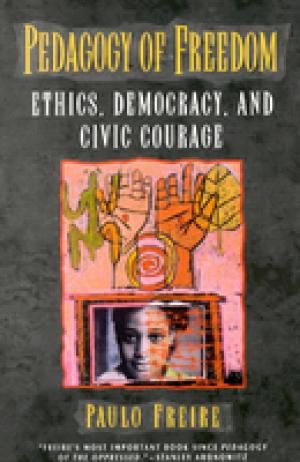
In "Pedagogy of Freedom" Paulo Freire travels ever more deeply into the territory where learning and activism are the essence of human life. This profound new book shows why an engaged way of learning and teaching is central to the creation of the individual, culture, and history. Freire finds in today's emerging global society a new context in which education cannot be indifferent to the reproduction of dominant ideologies and the interrogation of them. He argues against "progressive" liberalism and its passive acceptance of a world where unemployment and hunger must inevitably co-exist with opulence. In so doing, he shows why an acceptance of fatalism leads to loss of personal and societal freedom-and how those individuals who think without optimism have lost their place in history. This book displays the striking creativity and profound insight that characterized Freire's work to the very end of his life-an uplifting and provocative exploration not only for educators, but for all who learn and live." (From the Publisher)
Wabash Center Staff Contact
Rachelle Green, Ph.D.
Associate Director
Wabash Center
greenr@wabash.edu