Resources
Success Strategies for Adjunct Faculty provides adjunct instructors with a multi-faceted toolkit for increasing both effectiveness and efficiency in today's college courses and enhances their opportunities for success. Building upon the research and strategies recommended in The Adjunct Professor's Guide to Success, Dr. Lyons leverages his subsequent workshop experiences throughout North America as well as focused research. The book adds new self-analysis tools that enable the instructor to integrate personal strengths into course planning and delivery, provides additional course management tools, such as a model mentoring agreement and an exam development exercise. Brand new features include testimonials from 28 successful adjunct professors throughout North America, which open and close each of the book's 14 chapters, as well as a new chapter focused on infusing technology into the adjunct professor's instruction. The book includes a rich array of online support resources. (From the Publisher)
* Do students gain when they are taught by active researchers? * Should all faculty be involved in research? * What are the benefits students (and their parents) should get from studying at an elite research university – and paying higher fees for the privilege? In Scholarship Re-Considered, Ernest Boyer challenged US universities to "break out of the tired old teaching versus research debate." This book provides an international perspective on how universities, departments and individual faculty have successfully sought to connect their research to the benefit of student learning and institutional mission. It directly addresses the ways teaching-research links can be developed. Building on research, the literature and wide practical experience, the authors show how academic research activity can be connected to academic teaching activity in such a way as to ensure that neither operates in a vacuum and, most importantly, that each can be enhanced by the other. The book addresses the issues at the individual, course and institutional levels, as well as at the level of public policy. An important work for faculty, faculty developers and administrators. (From the Publisher)
Key Benefits: Faculty of Color in Academe focuses on inequities based on racial and ethnic differences within the professional workplace in higher education. This book draws on a comprehensive study of African American, Asian, Pacific American, American Indian, and Latino faculty in eight mid-western states. By using both narrative and statistical data, this book provides an in-depth view of the issues surrounding the successful recruitment, retention, and development of faculty of color. Key Topics: The authors attempt to capture and describe some of the similarities and differences experienced by faculty among each of the above mentioned racial/ethnic groups. Includes a comprehensive discussion of what needs to be done in order to achieve diversity in the teaching profession. (From the Publisher)
Our schools and colleges often make the intellectual life seem more impenetrable, narrowly specialized, and inaccessible than it is or needs to be, argues the eminent scholar and educator Gerald Graff, whose provocative book offers a wealth of practical suggestions for making the culture of ideas and arguments more readily understandable. (From the Publisher)
Graduate Theological Education and the Human Experience of Disability examines graduate schools of theology and their limited familiarity with the study of disability -- and the presence of people with disabilities in particular -- on their campuses. Dubbed a "missing note" by one theologian, this text offers critical research and illuminates new pathways for theologia and practice in the community of faith. Reviews of previous literature, theology, and practices illuminate how people with disabilities have historically been marginalized by the religious community. Theologians, people with disabilities and researchers offer suggestions for incorporating disability studies into theological education and religious life. (From the Publisher)
With Pedagogy of Hope, Freire explores his best-known analytical themes - with even deeper understanding and a greater wisdom. Certainly, all of these themes have to be analyzed as elements of a body of critical, liberationist pedagogy. In the present book, we come to understand the author's pedagogical thinking even better, through the critical seriousness, humanistic objectivity, and engaged subjectivity which, in all of Freire's books, are always wedded to a unique creative innovativeness. (From the Publisher)
Inquiry and Reflection shows how stories of schooling can elucidate difficult, and unexamined problems facing teachers. While professional texts tend to raise issues of power and its distribution and questions of culture and ideology, often the manner of presentation is abstract, and pre-service teachers have difficulty making connections. Yet literary, film, and video materials illuminate problems and suggest ideas to which teachers can actively respond. This book offers teacher educators a variety of resources for articulating a critical pedagogy and suggests an alternative to the technical, job training approach to teacher education by providing a unique educational curricula that illuminates issues of power, ideology, and culture. (From the Publisher)
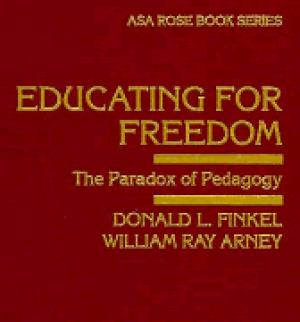
The very notion of teaching freedom suggests a paradox. Ever since Rousseau, the project of liberal education has been situated in the matrix of the teacher-student relationship. Some theorists have even seen this relationship as erotic. Part one of this book explores the educational philosophies of Rousseau, Freud, Paolo Freire, Ivan Illich, and Michel Foucault. All these thinkers wrestle with the paradox, How can such a mutually dependent relationship foster independence? The primary vehicle necessary to a liberating education, the personal relationship, is also the fundamental obstacle to the achievement of genuine liberation. After reaching this conclusion, the authors turn away from the student-teacher relationship and the paradox of pedagogy to examine another type of teaching and learning--where two teachers who differ in fundamental ways engage in collegial teaching with students they have in common. Collegial teaching is described in its particularity, based on the authors' experiences at an unusual liberal arts college, The Evergreen State College. They find that the changed dynamics of equality and the altered structure of authority created by collegial teaching is rewarding for both teachers and students, and may be a way out of the paradox of pedagogy to intellectual freedom. (From the Publisher)
Explores the issue of institutional productivity and student learning outside the classroom. Reviews the conditions that can foster a climate where out-of-classroom experiences can contribute to greater educational productivity. (From the Publisher)
Wabash Center Staff Contact
Rachelle Green, Ph.D.
Associate Director
Wabash Center
greenr@wabash.edu