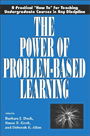
- Author
- Duch, Barbara J., Susan E. Groh and Deborah Allen, eds.
- Publisher
- Stylus, Sterling, VA
- ISBN
- 1579220371
- Table of Contents
-
Preface
ch. 1 Why Problem-Based Learning? A Case Study of Institutional Change in Undergraduate Education (Barbara J. Duch, Susan E. Groh and Deborah E. Allen)
ch. 2 Faculty Mentoring Faculty: The Institute for Transforming Undergraduate Education (George H. Watson, Susan E. Groh)
ch. 3 Make it So: Administrative Support for Problem-Based Learning (John C. Cavanaugh)
ch. 4 Models for Problem-Based Instruction in Undergraduate Courses (Barbara J. Duch)
ch. 5 Writing Problems for Deeper Understanding (Barbara J. Duch)
ch. 6 Strategies for Using Groups (Deborah E. Allen, Barbara J. Duch and Susan E. Groh)
ch. 7 Getting Started in Problem-Based Learning (Harold B. White III)
ch. 8 Undergraduate Group Facilitators to Meet the Challenges of Multiple Classroom Groups (Deborah E. Allen and Harold B. Wright III)
ch. 9 Assessment Strategies in a Problem-Based Learning Course (Barbara J. Duch and Susan E. Groh)
ch. 10 Problem-Based Learning and the Three Cs of Technology (George H. Watson)
ch. 11 The Evolution of Problem-Based Learning in a Biotechnology Course (Sherry L. Kitto and Lesa G. Griffiths)
ch. 12 A PBL Course that Uses Research Articles as Problems (Harold B. White III)
ch. 13 Integrating Active Learning and the Use of Technology in Legal Studies Courses (Valerie P. Hans)
ch. 14 Problem-Based Learning in Large and Very Large Classes (Harry L. Shipman and Barbara J. Duch)
ch. 15 Problem-Based Learning: Preparing Nurses for Practice (Christine A. Cannon and Kathleen A. Schell)
ch. 16 The Large and the Small of It: A Case Study of Introductory Biology Courses (Richard S. Donham, Florence I. Schmieg and Deborah E. Allen)
ch. 17 PBL, Politics, and Democracy (Kurt Burch)
ch. 18 Using Problem-Based Learning in General Chemistry (Susan E. Groh)
ch. 19 A Skeptic's Look at PBL (Elizabeth M. Lieux
ch. 20 PBL in Preservice Teacher Education (Eugene Matusov, John St. Julien and James A. Whitson)
ch. 21 Introductory Physics: A Problem-Based Model (Barbara A. Williams)
Index
Problem-based learning is a powerful classroom process, which uses real world problems to motivate students to identify and apply research concepts and information, work collaboratively and communicate effectively. It is a strategy that promotes life-long habits of learning.
The University of Delaware is recognized internationally as a center of excellence in the use and development of PBL. This book presents the cumulative knowledge and practical experience acquired over nearly a decade of integrating PBL in courses in a wide range of disciplines.
This "how to" book for college and university faculty. It focuses on the practical questions which anyone wishing to embark on PBL will want to know: "Where do I start?" – "How do you find problems?" – "What do I need to know about managing groups?" – "How do you grade in a PBL course?"
The book opens by outlining how the PBL program was developed at the University of Delaware -- covering such issues as faculty mentoring and institutional support -- to offer a model for implementation for other institutions.
The authors then address the practical questions involved in course transformation and planning for effective problem-based instruction, including writing problems, using the Internet, strategies for using groups, the use of peer tutors and assessment. They conclude with case studies from a variety of disciplines, including biochemistry, pre-law, physics, nursing, chemistry, political science and teacher education.
This introduction for faculty, department chairs and faculty developers will assist them to successfully harness this powerful process to improve learning outcomes. (From the Publisher)
The University of Delaware is recognized internationally as a center of excellence in the use and development of PBL. This book presents the cumulative knowledge and practical experience acquired over nearly a decade of integrating PBL in courses in a wide range of disciplines.
This "how to" book for college and university faculty. It focuses on the practical questions which anyone wishing to embark on PBL will want to know: "Where do I start?" – "How do you find problems?" – "What do I need to know about managing groups?" – "How do you grade in a PBL course?"
The book opens by outlining how the PBL program was developed at the University of Delaware -- covering such issues as faculty mentoring and institutional support -- to offer a model for implementation for other institutions.
The authors then address the practical questions involved in course transformation and planning for effective problem-based instruction, including writing problems, using the Internet, strategies for using groups, the use of peer tutors and assessment. They conclude with case studies from a variety of disciplines, including biochemistry, pre-law, physics, nursing, chemistry, political science and teacher education.
This introduction for faculty, department chairs and faculty developers will assist them to successfully harness this powerful process to improve learning outcomes. (From the Publisher)