Resources
Click Here for Book Review Abstract: How world-class research makes its way into lecture halls and seminar rooms Major research universities expect faculty to conduct significant research but also to excel as teachers. Too often those outside the classroom assume that these two functions have little in common when in fact the best teachers conduct exciting and innovative research that provides students the opportunity to learn by doing. An Illinois Sampler presents personal accounts from faculty members at the University of Illinois at Urbana-Champaign and other contributors, about their research and how it enriches and energizes their teaching. Contributors from the humanities, engineering, social and natural sciences, and other disciplines explore how ideas, methods, and materials merge to lead their students down life-changing paths to creativity, discovery, and solutions. As faculty introduce their classes to work conducted from the Illinois prairie to the farms of Africa, from densely populated cities to dense computer coding, they generate an atmosphere where research, teaching, and learning thrive inside a feedback loop of education across disciplines. Aimed at alumni and prospective students interested in the university's ongoing mission, as well as current faculty and students wishing to stay up to date on the diverse work being done around them, An Illinois Sampler offers a rare glimpse into the impact of cutting-edge research on undergraduate education in a rapidly changing world. The book also showcases the best, the most ambitious, and the most effective teaching practices developed and nurtured at one of the world's premier research universities. "The late Ernie Boyer inspired his readers when he wrote about the 'scholarship' of teaching. Years later, the engagement of faculty in the scholarly assessment of what students know and can do and in the exploration of ways in which these outcomes might be improved remains a formidable challenge. This is especially the case in complex research universities. In this timely volume and in fields as diverse as dance, geology, music, medicine, kinesiology, mathematics, engineering, and microbiology we have firsthand accounts of what faculty members are doing to make a better tomorrow. The narratives are as inspiring as they are practical and deserve to be shared and read by those who care about the quality of American universities."--Stanley Ikenberry, President Emeritus of the University of Illinois "The land-grant model is discovery of new knowledge, teaching students, and engaging the broader community. Something is lost when you try to separate the three concepts because they are mutually enriching--discovery comes in part by engaging the community, discovery by faculty and students strengthens education, etcetera. In this time of accountability and scarce resources, the academy must better explain this integration of effort, particularly in connection with the allocation of faculty time and compensation to research and engagement. The stories of scholar-educators from the University of Illinois, one of the great land-grant universities of the country, wonderfully illustrate how this all works."--Peter McPherson, President Emeritus of Michigan State University and President of the Association of Public and Land-grant Universities (From the Publisher)
As the chief academic officer, the provost plays the central role in the contemporary university or college. He or she leads the faculty and serves as their key representative to the administration while simultaneously acting as the administration’s spokesperson to the academic faculty. How has this essential leadership position evolved over the past few decades, and what are the best practices to adopt for succeeding in specific operational areas? In seventeen essays written by some of the most successful chief academic officers in the United States, The Provost’s Handbook outlines key topics related to the changing environment of higher education while explaining what constitutes effective leadership at the college and university level. How, for example, does the provost lead in a time of disruption and shifting needs? What skills should he or she nurture in new faculty? What role should data and institutional research play in decision making? How can a provost navigate the often stormy situations of shared governance? These questions—and many more challenges presented by this role—are addressed in this essential volume. Assembled by James Martin and James E. Samels, accomplished authors and scholars of leadership in higher education, The Provost’s Handbook is destined to become the go-to resource for deans, presidents, trustees, and chief academic officers everywhere. (From the Publisher)
With this report, Barbara G. Wheeler ends a long and distinguished era as a lead researcher and author for the Auburn Studies series, the signature line of publications from the Center for the Study of Theological Education (CSTE). Beginning with Reaching Out (1993) which set a focused and extraordinarily generative vision for the CSTE, Wheeler went on to author or co-author fourteen of the twenty studies in this series. These studies engaged many of the issues central to theological schools and their stakeholders: studies of enrollment and student debt, student recruitment and alumni success, and the status of faculties and senior leadership—both presidents and governing boards. With these and many other publications, lectures, and consulting projects, Wheeler established Auburn as a respected source for those wanting to understand the dynamics of this very particular set of institutions of higher education which prepare faith leaders for their vocations. Governance That Works: Effective Leadership for Theological Schools exhibits Barbara Wheeler’s characteristically clear prose and keen insight readers of past Auburn Studies have come to expect. At a time when many theological schools are experiencing significant challenges, the report helpfully exegetes several schools as notable cases of effective governance. In general, the story is one of gradual change towards better governance policy and practice. Yet many boards struggle with improving board composition—including minority and gender inclusion but also people with the right skills and a capacity to be substantial donors to the school. Among a number of notable trends, the increasing power of chief executives—with generally strong support from their faculty and boards—greatly heightens the salience of interpersonal skills on the part of those executive leaders. In a related insight, the report shows how such an interpersonally wise senior executive develops stronger leadership within the faculty and board, and a more vital partnerships between the two. (Christian Scharen)
Click Here for Book Review Abstract: Dynamic changes are underway in American higher education. New providers, emerging technologies, cost concerns, student debt, and nagging doubts about quality all call out the need for institutions to show evidence of student learning. From scholars at the National Institute for Learning Outcomes Assessment (NILOA), Using Evidence of Student Learning to Improve Higher Education presents a reframed conception and approach to student learning outcomes assessment. The authors explain why it is counterproductive to view collecting and using evidence of student accomplishment as primarily a compliance activity. Today's circumstances demand a fresh and more strategic approach to the processes by which evidence about student learning is obtained and used to inform efforts to improve teaching, learning, and decision-making. Whether you're in the classroom, an administrative office, or on an assessment committee, data about what students know and are able to do are critical for guiding changes that are needed in institutional policies and practices to improve student learning and success. Use this book to: • Understand how and why student learning outcomes assessment can enhance student accomplishment and increase institutional effectiveness • Shift the view of assessment from being externally driven to internally motivated • Learn how assessment results can help inform decision-making • Use assessment data to manage change and improve student success Gauging student learning is necessary if institutions are to prepare students to meet the 21st century needs of employers and live an economically independent, civically responsible life. For assessment professionals and educational leaders, Using Evidence of Student Learning to Improve Higher Education offers both a compelling rationale and practical advice for making student learning outcomes assessment more effective and efficient. (From the Publisher)
An early demonstration of the value to teachers (and students) of writing the scholarship of teaching (SoTL) by defining a challenge to classroom learning, a “problem” to be investigated (much as we define a problem for our guild research to address) – in this case: learning goals and student pre-knowledge.
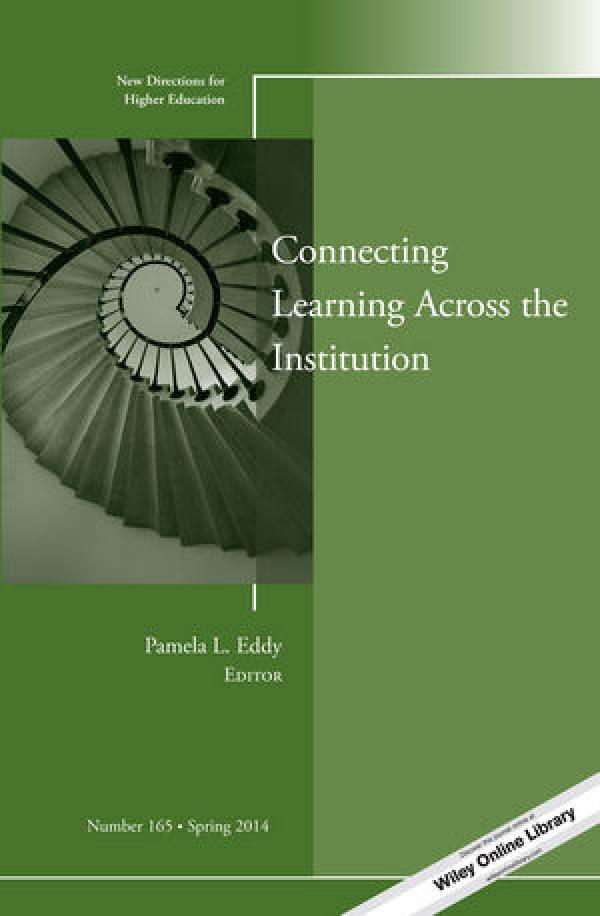
Click Here for Book Review Abstract: Most research on learning tends to occur in silos based on stakeholder perspective. This volume seeks to break down these silos and draw together scholars who research learning from different perspectives to highlight commonalities in learning for students, faculty, and institutions. When we understand how learning is experienced across the institution, we can develop strategies that help support, enhance, and reinforce learning for all. Exploring what it means to bridge learning across the institution, this volume provides a roadmap to improve learning for all. Both scholarly and practical, it advances the knowledge about the ways we investigate and study learning across and for various groups of learners. 

It also: • Collects thinking about learning in its various formats in one location • Provides a platform for synthesis • Outlines key questions for thinking more deeply about learning on campus. Instead of thinking of learning as discrete depending on the stakeholder group, this  volume highlights the commonalities across all types of learners. (From the Publisher)
An Auburn Studies report on a study of 24 “top supplier” doctoral programs in theology and religion—those that send the most graduates to teach in seminaries and divinity schools. The report raises questions about the practices of programs and the employment prospects of graduates.
Having attended her first "unconference," the writer shares five ideas she brought to the event about "Teaching teachers technology," and five ideas she returned with. Also includes reflection on the "unconference" as a model for better faculty pedagogy workshops.
Cornell University resources for mentoring new faculty, including links for: Best Practices in Mentoring of New Faculty, The Mentoring Relationship, The Successful Mentee, Ideas for Mentors, Questions you might ask peers/senior faculty, Mentoring Guidelines, and Suggestions for Supporting New Faculty