Resources
Click Here for Book Review Abstract: Online distance education continues to grow at a fast pace, even outpacing the overall growth of U.S. higher education. Demands for quality are coming from all shareholders involved. As if caught by surprise, a patchwork response to quality is often the typical organizational response. The result can be inconsistent and uncoordinated levels of value to those invested in online learning. This often promotes negative images of the educational experience and institution. Comprised of highly regarded experts in the field, this edited volume provides a comprehensive overview of quality assurance, a snapshot of current practices and proven recommendations for raising standards of quality in online education. Topics discussed include: * Improving practices for teaching online * Using educational analytics for quality assurance and improvement * Accessibility: An important dimension of quality assurance * Assuring quality in online course design * Assuring quality in learner support, academic resources, advising and counseling * The role and realities of accreditation This text clearly answers the call for addressing quality from a broad, deep and coordinated understanding. It addresses the complexities of quality assurance in higher education and offers professionals top-shelf advice and support. *This text is also appropriate for students enrolled in Educational Technology and Higher Education Administration Masters and PhD programs (From the Publisher)
Pedagogies for the Future illustrates a unique and exciting endeavor whereby a group of academics across one university developed a professional learning community for the purposes of investigating, articulating and developing their scholarship of practice. Through their collaborative efforts, these educator-researchers sit at the forefront of calls to take teaching seriously in higher education and to recognize the powerful potential of interdisciplinary collaboration. The book provides a model for establishing learning communities in higher education and demonstrates that such work is not only possible but also successful. From vision to reality, Pedagogies for the Future offers important insights into the complex nature of researching teaching and learning in higher education from the perspectives of those directly engaged in it. This book will be of great interest and value to both scholars and administrators. (From the Publisher)
Click Here for Book Review Abstract: In order to make appropriate changes to improve your teaching and your students’ learning, first you need to know how you’re teaching now. Figure it out for yourself and invigorate your teaching on your own terms! This practical evidence-based guide promotes excellence in teaching and improved student learning through self-reflection and self-assessment of one’s teaching. Phyllis Blumberg starts by reviewing the current approaches to instructor evaluation and describes their inadequacies. She then presents a new model of assessing teaching that builds upon a broader base of evidence and sources of support. This new model leads to self-assessment rubrics, which are available for download, and the book will guide you in how to use them. The book includes case studies of completed critical reflection rubrics from a variety of disciplines, including the performing and visual arts and the hard sciences, to show how they can be used in different ways and how to explore the richness of the data you’ll uncover. (From the Publisher)
If you're willing to move outside your familiar and comfortable way of teaching and try team teaching, you'll find many challenges but also many rewards.
More and more, graduate students are seeking quality training in leadership skills as well as in teaching and research.
Peer review provides informed considerations of a candidate’s teaching that student ratings cannot address: breadth, depth, and rigor of course objectives and materials; patterns of and procedures for course management; and a contextualized sense of the interactions between teacher and students as a whole.
This book is designed to help nonprofit organizations craft proposals for grants from foundations, companies, and government agencies. Ellen Karsh, a writer and former director of the Mayor's Office of Grants Administration, in New York, and Arlen Sue Fox, associate executive director for development at Sunnyside Community Services, also in New York, significantly update this edition from 2005 by including interviews with grant makers about how the current economic crisis is affecting their giving and how grant seekers can improve their chances of garnering support. The book includes a proposal checklist, a glossary of terms, sample grant forms, and a list of Web sites that provide information on grants offered by foundations, corporations, and the government. —from the Chronicle of Philanthropy (From the Publisher)
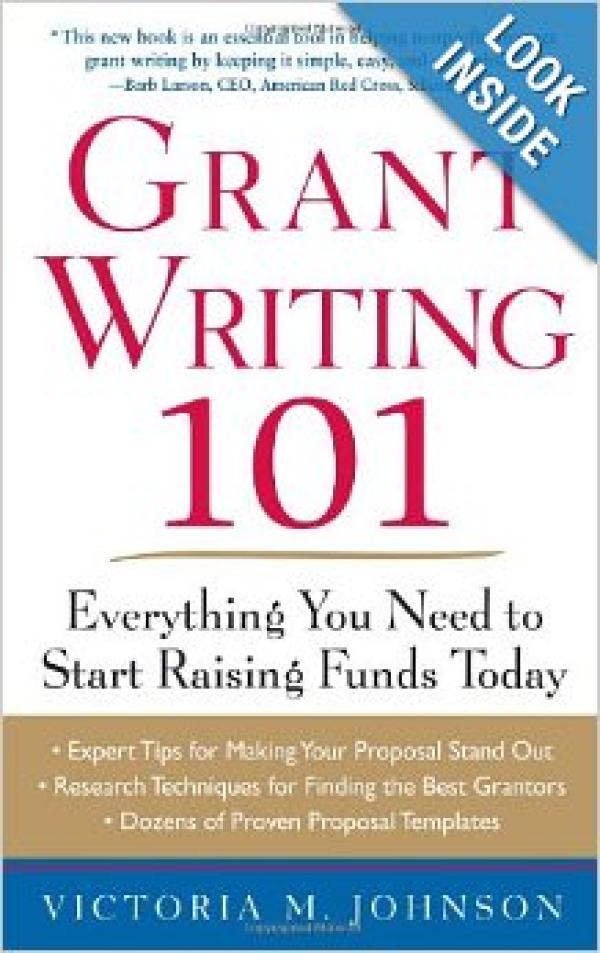
This book offers you no-frills essentials and down-and-dirty tricks for producing great grant-writing results. (From the Publisher)
If leaders are made, not born, what is the best way to teach the skills they need to be effective? Today's complex times require a new kind of leadership--one that encompasses a mind-set and capabilities that can't necessarily be taught by conventional methods. In this unique leadership book, Sharon Daloz Parks invites readers to step into the classroom of Harvard leadership virtuoso Ronald Heifetz and his colleagues to understand this dynamic type of leadership and experience a corresponding mode of learning called "case in point." Unlike traditional teaching approaches that analyze the experiences of past leaders, case in point uses individuals' own experiences--and the classroom environment itself--as a crucible for learning. This bold approach enables emerging leaders to work actively through the complex demands of today's workplace and build their skills as they discover theory in practice. Through an engaging, you-are-there writing style, Parks outlines essential features of this approach that can be applied across a range of settings. In the process, Leadership Can Be Taught reveals how we can learn, practice, and teach the art of leadership in more skilled, effective, and inspired forms. Sharon Daloz Parks is director of leadership for the New Commons--an initiative of the Whidbey Institute in Clinton, WA. She has held faculty and research positions at the Harvard Divinity School, Harvard Business School, and the Kennedy School of Government at Harvard University. (From the Publisher)
Click Here for Book Review Abstract: Research indicates that of the pedagogies recognized as “high impact”, learning communities – one approach to which, the linked course, is the subject of this book – lead to an increased level of student engagement in the freshman year that persists through the senior year, and improve retention. This book focuses on the learning community model that is the most flexible to implement in terms of scheduling, teacher collaboration, and design: the linked course. The faculty may teach independently or together, coordinating syllabi and assignments so that the classes complement each other, and often these courses are linked around a particular interdisciplinary theme. Creating a cohort that works together for two paired courses motivates students, while the course structure promotes integrative learning as students make connections between disciplines. This volume covers both “linked courses” in which faculty may work to coordinate syllabi and assignments, but teach most of their courses separately, as well as well as “paired courses” in which two or more courses are team taught in an integrated program in which faculty participate as learners as well as teachers. Part One, Linked Course Pedagogies, includes several case studies of specific linked courses, including a study skills course paired with a worldview course; a community college course that challenges students’ compartmentalized thinking; and a paired course whose outcomes can be directly compared to parallel stand-alone courses. Part Two, Linked Course Programs, includes a description of several institutional programs representing a variety of linked course program models. Each chapter includes information about program implementation, staffing logistics and concerns, curriculum development, pedagogical strategies, and faculty development. Part Three, Assessing Linked Courses, highlights the role of assessment in supporting, maintaining, and improving linked course programs by sharing assessment models and describing how faculty and administrators have used particular assessment practices in order to improve their linked course programs. (From the Publisher)