Home » Resources » Scholarship on Teaching » Linked Courses for General Education and Integrative Learning: A Guide for Faculty and Administrators
Scholarship
March 29, 2017
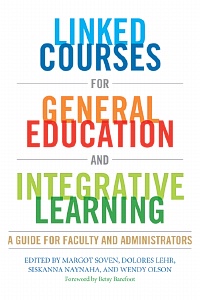
Linked Courses for General Education and Integrative Learning: A Guide for Faculty and Administrators
- Author
- Soven, Margot; Lehr, Dolores; Naynaha, Siskanna; and Olson, Wendy, eds.
- Publisher
- Stylus Publishing, LLC, Sterling, VA
- ISBN
- 9781579224868
- Table of Contents
-
Foreword
Introduction: Why the Need for Learning Communities Now
Part One: Linked Course Pedagogies
ch. 1 Pairing Courses to Benefit Student Learning (Scott E. Gaier)
ch. 2 Linked Content Courses: A World Civilizations–World Religions Case Study (Jeffrey LaMonica)
ch. 3 Double Entry: Linking Introductory Financial Accounting and English Composition (Bruce A. Leauby and Mary C. Robertson)
ch. 4 Multiple Majors, One Writing Class: Discovering Commonalities Through Problematization (Irene Clark)
Part Two: Linked Course Programs
ch. 5 The Science of First-Year Learning Communities (Brandi Kutil)
ch. 6 Implementing a Linked Course Requirement in the Core Curriculum (Margot Soven)
ch. 7 Academic Partnerships with Residential Learning Communities (Maggie C. Parker and Alex Kappus)
ch. 8 Learning Communities in the New University (Siskanna Naynaha and Wendy Olson)
Part Three: Assessing Linked Courses
ch. 9 The Nuts and Bolts of Evaluating Linked Courses (Michael Roszkowski)
ch. 10 Using Program Assessments and Faculty Development to Deepen Student Learning (Lynn Dunlap and Maureen Pettitt)
ch. 11 Linked Course Assessment: The Problem With Quantitative Data (Bethany Blankenship)
ch. 12 Constant Reconnaissance: Assessment for Validation and Change (Greg Smith and Geoffrey Mamerow)
Editors and Contributors
Index
Click Here for Book Review
Abstract: Research indicates that of the pedagogies recognized as “high impact”, learning communities – one approach to which, the linked course, is the subject of this book – lead to an increased level of student engagement in the freshman year that persists through the senior year, and improve retention.
This book focuses on the learning community model that is the most flexible to implement in terms of scheduling, teacher collaboration, and design: the linked course. The faculty may teach independently or together, coordinating syllabi and assignments so that the classes complement each other, and often these courses are linked around a particular interdisciplinary theme. Creating a cohort that works together for two paired courses motivates students, while the course structure promotes integrative learning as students make connections between disciplines.
This volume covers both “linked courses” in which faculty may work to coordinate syllabi and assignments, but teach most of their courses separately, as well as well as “paired courses” in which two or more courses are team taught in an integrated program in which faculty participate as learners as well as teachers.
Part One, Linked Course Pedagogies, includes several case studies of specific linked courses, including a study skills course paired with a worldview course; a community college course that challenges students’ compartmentalized thinking; and a paired course whose outcomes can be directly compared to parallel stand-alone courses.
Part Two, Linked Course Programs, includes a description of several institutional programs representing a variety of linked course program models. Each chapter includes information about program implementation, staffing logistics and concerns, curriculum development, pedagogical strategies, and faculty development.
Part Three, Assessing Linked Courses, highlights the role of assessment in supporting, maintaining, and improving linked course programs by sharing assessment models and describing how faculty and administrators have used particular assessment practices in order to improve their linked course programs. (From the Publisher)
Abstract: Research indicates that of the pedagogies recognized as “high impact”, learning communities – one approach to which, the linked course, is the subject of this book – lead to an increased level of student engagement in the freshman year that persists through the senior year, and improve retention.
This book focuses on the learning community model that is the most flexible to implement in terms of scheduling, teacher collaboration, and design: the linked course. The faculty may teach independently or together, coordinating syllabi and assignments so that the classes complement each other, and often these courses are linked around a particular interdisciplinary theme. Creating a cohort that works together for two paired courses motivates students, while the course structure promotes integrative learning as students make connections between disciplines.
This volume covers both “linked courses” in which faculty may work to coordinate syllabi and assignments, but teach most of their courses separately, as well as well as “paired courses” in which two or more courses are team taught in an integrated program in which faculty participate as learners as well as teachers.
Part One, Linked Course Pedagogies, includes several case studies of specific linked courses, including a study skills course paired with a worldview course; a community college course that challenges students’ compartmentalized thinking; and a paired course whose outcomes can be directly compared to parallel stand-alone courses.
Part Two, Linked Course Programs, includes a description of several institutional programs representing a variety of linked course program models. Each chapter includes information about program implementation, staffing logistics and concerns, curriculum development, pedagogical strategies, and faculty development.
Part Three, Assessing Linked Courses, highlights the role of assessment in supporting, maintaining, and improving linked course programs by sharing assessment models and describing how faculty and administrators have used particular assessment practices in order to improve their linked course programs. (From the Publisher)