Home » Resources » Scholarship on Teaching » The Provost's Handbook: The Role of the Chief Academic Officer
Scholarship
March 29, 2017
The Provost’s Handbook: The Role of the Chief Academic Officer
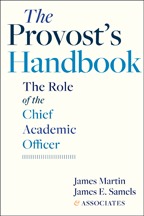
- Author
- Martin, James; and Samels & Associates, James E.
- Publisher
- Johns Hopkins University Press, Baltimore, MD
- ISBN
- 9781421416267
- Table of Contents
-
Preface
I The Academic Agenda
ch. 1 New Skills, Old Skills, and Leading the Academic Community (James Martin and James E. Samels)
ch. 2 New Realities and Lingering Stereotypes: Key Trends for the National CAO Census (Bryan J. Cook, Christopher J. Nellum, and Meredith S. Billings)
ch. 3 Professional Development Programs for Chief Academic Officers: A Key to Effective Leadership (Richard Ekman)
ch. 4 The Scope of Academic Leadership at the Top: CAOs, Presidents, and Trustees (R. Michael Tanner)
ch. 5 Ground Level: How to Lead the Faulty as the First among Equals (Linda A. McMillin)
ch. 6 The CAO as Planner: Strategic Planning and the Office of Institutional Research (John D. Simon)
ch. 7 Difficult Change int he Provost’s Doman in Curriculum, Faculty Appointments, and Teaching Strategies (Robert M. Groves)
ch. 8 The CAO and the Curriculum: Developing and Implementing Effective Programs for a Contemporary Student Population (Lon S. Kaufman and Saul J. Weiner)
ch. 9 Technology and the Changing Classroom Experience: Best Practices for Curriculum, Resources, and Personnel (John G. Flores)
ch. 10 Academic Governance: The Art of Working with People (James R. Stellar and Michael A. Baer)
II Essential Partners
ch. 11 The CAO and the Chief Financial Officer: Managing a Critical Connection (James Gandre and Miroslava Mejia Krug)
ch. 12 The Academic Ask: Partnering Academic Affairs and Institutional Advancement (Bradley W. Bateman, Wesley R. Fugate, and Julia Beyer Houpt)
ch. 13 Working Effectively with the Senior Student Affairs Officer (Penny Rue and Suresh Subramani)
ch. 14 What Provosts Need to Know About Enrollment Management (Robin Mamlet, David Pershing, and Sheila Murphy)
ch. 15 Increasing Accountabilities: The Provost’s Role in Intercollegiate Athletics (George H. VanderZwaag and William Scott Green
ch. 16 Keep Your Friends Close and College Counsel Closer: New Developments in Higher Education Law (James E. Samels and James Martin
ch. 17 Building Bridges beyond the Quadrangle: The CAO and the External Community (Mark B. Lapping)
Bibliography
List of Contributors
Index
As the chief academic officer, the provost plays the central role in the contemporary university or college. He or she leads the faculty and serves as their key representative to the administration while simultaneously acting as the administration’s spokesperson to the academic faculty. How has this essential leadership position evolved over the past few decades, and what are the best practices to adopt for succeeding in specific operational areas?
In seventeen essays written by some of the most successful chief academic officers in the United States, The Provost’s Handbook outlines key topics related to the changing environment of higher education while explaining what constitutes effective leadership at the college and university level. How, for example, does the provost lead in a time of disruption and shifting needs? What skills should he or she nurture in new faculty? What role should data and institutional research play in decision making? How can a provost navigate the often stormy situations of shared governance? These questions—and many more challenges presented by this role—are addressed in this essential volume.
Assembled by James Martin and James E. Samels, accomplished authors and scholars of leadership in higher education, The Provost’s Handbook is destined to become the go-to resource for deans, presidents, trustees, and chief academic officers everywhere. (From the Publisher)
In seventeen essays written by some of the most successful chief academic officers in the United States, The Provost’s Handbook outlines key topics related to the changing environment of higher education while explaining what constitutes effective leadership at the college and university level. How, for example, does the provost lead in a time of disruption and shifting needs? What skills should he or she nurture in new faculty? What role should data and institutional research play in decision making? How can a provost navigate the often stormy situations of shared governance? These questions—and many more challenges presented by this role—are addressed in this essential volume.
Assembled by James Martin and James E. Samels, accomplished authors and scholars of leadership in higher education, The Provost’s Handbook is destined to become the go-to resource for deans, presidents, trustees, and chief academic officers everywhere. (From the Publisher)