Resources
Student assignments and assessment – is there life beyond the ten-page essay? Drawing on the theory of multiple intelligences and experience with an assignment in which students were asked to address course content in anything but an essay, the author considers the challenges and virtues of a creative format that does not rely exclusively on linguistic intelligence. The process, presentations, and evaluative approach employed in an assignment that called upon student creativity in a "Women and the Bible" course are described, and pedagogical and practical considerations explored. The analysis of a particularly memorable student submission reveals layers of complexity seldom achieved in a conventional essay format.
Aimed primarily at higher education professionals, this book is a comprehensive guide to assessment issues, particularly for those professionals who are coming to terms with the range of new pressures on their traditional teaching practices. Agents of change such as increased use of IT, flexible assessment methods and quality assurance all converge on the area of assessment, making new demands of assessors. Outlining how traditional assessment practices can be updated and diversified to suit these contemporary teaching and learning methods, this book is a practical resource, with reflection boxes and diagnostic tools that encourage the reader to apply the principles to their own practice. Other areas covered include: Assessing large groups, Authentication of student work, Maintaining assessment standards, Assessing generic skills and Quality assurance. (From the Publisher)
Although new forms of learning call for new forms of assessment, many faculty struggle to find different ways of testing their students' achievements. This issue introduces readers to both theory and practical examples of innovations in assessment in the college classroom. Examples include authentic testing, testing with multimedia, portfolios, visual synthesis, and performance-based testing, among others. Contributors also argue that student performance on exams can be improved by techniques that can be implemented both before and after the exam to make the students better learners. (From the Publisher)
For over thirty years, portfolios have been used to help adult learners gain recognition for their prior learning and take greater control of their educational experiences. The portfolio has become a distinctive means of assessing such learning, serving as a meaningful alternative to conventional papers and standardized testing. Portfolio Development and the Assessment of Prior Learning: Perspectives, Models, and Practices provides a primer of flexible approaches to shaping and conducting portfolio-development courses. It offers practitioners in the field an extensive range of model assignments, readings, and classroom activities, each organized around a specific theme: Academic Orientation, The Meaning of Education, Personal Exploration, Learning from the Outsider Within, The World of Work and Careers, and Dimensions of Expertise. Twelve case studies by practitioners in the field then show how academics in the US and around the English-speaking world have adapted the portfolio to changing circumstances in order to deliver academically rich educational services for adults. These case studies highlight portfolio development in the context of web-based instruction, changing institutional imperatives, service to historically disenfranchised groups, partnerships with industry, and cross-institutional cooperation. In addition to serving as a valuable hands-on resource for practitioners, Portfolio Development and the Assessment of Prior Learning locates portfolios and assessment in a broad social and intellectual context. Thus, the authors also offer an historical overview of the usefulness of portfolios in the assessment of prior learning and then consider their use inthe future, given current trends in higher education for adults. The book explores the implications of a changing educational landscape, in which new student populations, budgetary pressures, and understandings of knowledge both enrich and challenge student-centered approaches such as portfolios. The approaches and case studies are not only valuable to adult educators but, equally, to faculty in higher education concerned with the development of competency- and outcomes-based assessment. (From the Publisher)
Changes in instructional paradigms are leading to changes in the way student achievement is tested, including group testing, online testing and authentic testing. This issue discusses the theory and practice of these new forms of testing and offers practical suggestions for instructors considering their use. (From the Publisher)
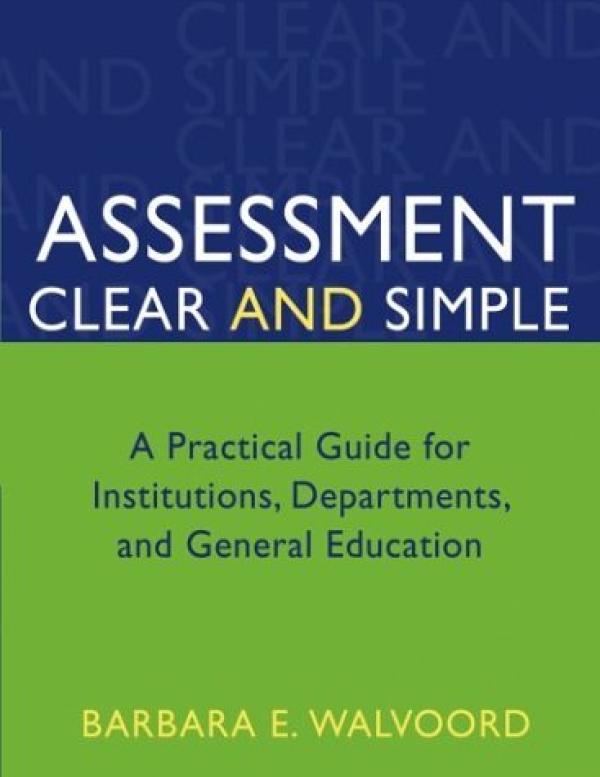
Assessment Clear and Simple is "Assessment 101" in a book -- a concise, step-by-step guide written for everyone who participates in the assessment process. This practical book helps to make assessment simple, cost-efficient, and useful to the institution, while at the same time meeting the requirements of accreditation agencies, legislatures, review boards, and others. Assessment Clear and Simple can help your institution employ assessment as a powerful instrument for improvement and provide a basis for wiser planning, budgeting, and change in curriculum, pedagogy, staffing, programming, and student support. (From the Publisher)
At its most basic a rubric is a scoring tool that divides an assignment into its component parts and objectives, and provides a detailed description of what constitutes acceptable and unacceptable levels of performance for each part. Rubrics can be used to grade any assignment or task: research papers, book reviews, participation in discussions, laboratory work, portfolios, oral presentations, group work, and more. This book defines what rubrics are, and how to construct and use them. It provides a complete introduction for anyone starting out to integrate rubrics in their teaching. (From the Publisher)

Assessment is most effective when it is conceived, discussed, and implemented by faculty and their classes. This sourcebook presents assessment strategies and information, based on recent research and practical experience, to provide new assessment ideas and approaches that emphasize student learning and effective teaching. (From the Publisher)
Returning tests following an examination is often a difficult task for the instructor, particularly in courses that are perceived by students as anxiety producing. The purpose of this article is to offer suggestions for designing this class session so that students view it as a positive part of the learning process. the four phases suggested for this feedback session are (a) preparing the students for receiving test feedback, (b) implementing a strategy for returning tests, (c) selecting an approach for reviewing test items, and (d) bringing closure to the class a positive way. young professionals lacking the experiences to anticipate problems when returning examinations to students may especially benefit from these suggestions.