Resources
This book is based on the argument that detailed and developmental formative feedback is the single most useful thing teachers can do for students. It helps to clarify the expectations of higher education and assist all students to achieve their potential. This book promotes student learning through formative assessment and feedback, which: * enables self-assessment and reflection in learning * encourages teacher-student dialogue * helps clarify what is good performance * provides students with quality information to help improve their learning * encourages motivation and self-confidence in students * aids the teacher in shaping teaching Underpinned by the relevant theory, the practical advice and examples in this book directly address the issues of how to motivate students to engage in formative assessment effectively and shows teachers how they can provide further useful formative feedback. (From the Publisher)
Because the drive toward external assessment speaks almost exclusively in terms of standardized testing, we need to be reminded of the internal purposes of assessment: measuring learning for both student and teacher so that instruction can be adjusted and improved. This book is written for college instructors who are striving to creatively change assessment practice to better reflect learner-centered teaching. It is intended to consider not only the multiple ways in which individuals learn content, but also the multiple avenues to assessment the variety of learning styles demands. Creative assessment is defined here as assessments that spin, twist, and reform what might be a standard kind of assessment in an ordinary classroom. Instructors should use these examples of creative assessment as starting points, and as the beginnings of an internal discussion on what matters most in the courses they teach: What components of each course count the most for solving a range of problems in the discipline? If facts are important, and they usually are, how can they be used to support a flexible approach to thinking, solving, considering options, and gathering and interpreting evidence? What are the facts not telling us? (From the Publisher)
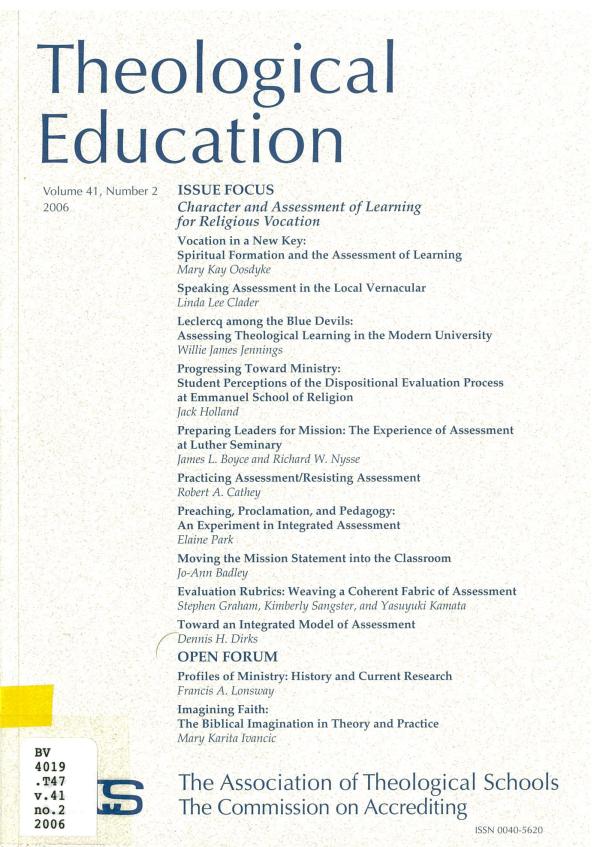
Journal Issue. Full text is available online.
Journal Issue.
Journal Issue.
Journal Issue.
This paper explores the relationship between assessment and ethical value. It starts by reflecting on the traditional assessment convention that distinguishes strongly between process (the ways in which a student constructs a piece of work) and conclusion. The paper then examines three case studies from Holocaust studies, feminist theology, and Providence. The argument of the paper is that these three case studies illustrate that imparting certain values is part of the teaching process, and therefore it should not be excluded from assessment.
After laying a theoretical basis for an active learning orientation in the classroom, the co-authors describe methods they developed to evaluate active learning in two different settings of introductory courses in biblical studies. They argue that honoring diverse learning and communication styles among students does not need to compromise academic rigor. The authors show how portfolio-based assessment of student learning allows students a range of ways to demonstrate their mastery of the material. Examples are provided of components of student portfolios from their undergraduate classes.
Classroom Assessment Techniques (CATs) offer immediate, relevant feedback to professors on the teaching process as well as feedback to students on the learning process. While Classroom Assessment Techniques have been introduced, studied and analyzed in undergraduate education, application to graduate theological education has not been advanced. The author describes a recent research project that discerned faculty attitudes toward the implementation of Classroom Assessment Techniques in a seminary setting in hopes that more effective faculty development programs can be designed by implementing CATs.