Search Results
9339 results found using the following search criteria: .
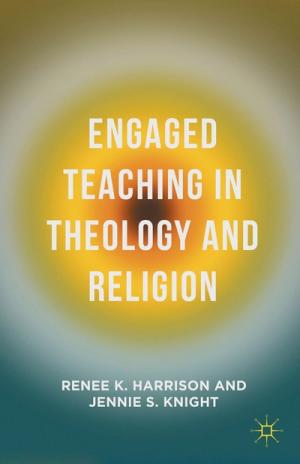
There is wide agreement that student-centered pedagogies yield deeper student engagement and stronger learning outcomes than more traditional “sage-on-the-stage” teaching does. Learning shines when students are invited and equipped to integrate course content with their own experiences, insights, and prior knowledge. In this volume Renee K. Harrison and Jennie S. Knight reflect on personal experiences in the classroom, explore pedagogical theory, and provide examples of applied practices to create a map of the key elements of engaged pedagogy. The map, divided into four sections, moves from the selfhood of the teacher to teaching methods and course content to community context and engagement. Harrison and Knight begin with a premise: that the enterprise of teaching involves the very personhood of the teacher. Either we can acknowledge this and cultivate an awareness of our strengths, blind spots, and biases, or we can ignore it. That deep learning involves the very personhood of students is another key premise. Nurturing this two-pronged awareness – that teachers and students do not leave their wider selves at the door of the classroom – is the necessary ground of engaged teaching. Whole persons are welcomed into the classroom and empowered to reflectively integrate course content with who they are. Sections two and three explore how form and content can either undermine or buttress one another and how, even when teachers aim for the latter, they may unwittingly miss the mark. For example, in classrooms in which more democratic teaching practices are employed, course content may still hew closely to a traditional textual canon, with marginalized voices tacked on at the end. Or content may offer a wide range of perspectives while teaching methods minimize student voices. Ideally, democratic pedagogies and a widened canon reiterate one another. If the goal of learning is not just knowledge acquisition but transformation and if we are inviting students’ whole lives into the process, attending to communal context is likewise crucial. The authors thus cap the volume with strong advocacy for community-based learning (CBL). They discuss the logistical and pedagogical challenges of incorporating community work into courses and illustrate why it is well worth the effort. They offer tools for implementing such work, while acknowledging that sustained success in CBL requires significant institutional buy-in that some teachers may not enjoy. In fact, a particular strength of this volume is its honesty about engaged teaching practices, which while considered innovative in pedagogical circles, are still perceived in many academic circles as less rigorous and less respectable than more classic methods. Harrison and Knight lament that this should be so especially in theological-religious education, where the integration of curricular and worldly knowledge is paramount. Should engaged teaching not be the norm? Recognizing that teachers will need to calculate risks depending on institutional context, they counsel courage for the sake of students’ whole-person integrity – and of the credibility of theological-religious education. The wisdom conveyed in these pages is clearly hard won, over the course of many years across varied institutions. In distilling their experiences, Harrison and Knight offer their readers a real gift. However, while teachers can benefit from the ideas, strategies, and examples laid out in the book, they should not expect to change their own teaching methods and courses overnight. Rather, this volume invites teachers to an ongoing practice of engaged pedagogy that requires continual self-reflection, awareness of institutional and classroom contexts, a willingness to take creative risks, and a commitment to engaging one’s students as whole persons. It is a compelling invitation indeed. For those who prize transformative pedagogy, this volume weaves the best of theory and practice in teaching theology and religion – accessibly, comprehensively, and indeed engagingly. Highly recommended for undergraduate, seminary, and graduate teachers alike.

The up-tick of media covered violence in the USA, as well as the reports of violence from around the world, causes me to pause. While I believe that experiencing the pain, suffering, and uncertainty of the world is calling us to become a nation of compassion, forgiveness, respect and equity, I am also afraid. The Golden Rule or the rule of reciprocity is pursuing us with gusto and I am fatigued. The survival of the planet depends on our willingness to examine ourselves and change. It is mid-summer, and my attentions have turned toward preparing for fall and spring courses. Given the backdrop of terrorism and violence in the world – I feel tentative and uprooted. It is easy to slip into the narrative of “an eye for an eye.” Or fall down the slippery slope of thinking that the suffering of some “expendable” populations is acceptable if others can live well as a result- just collateral damage for the greater cause of democratized capitalism. The anxiety in the nation is palpable. The media identifies the acts of violence and hatred by their geographic locations; Nice, France; Orlando; Charlotte; Ferguson (to name a scant few). We are reeling from news coverage which includes cell phone videos of neighbors and family members who are shot, mauled, assaulted, maimed and murdered. Conversations are polarized about police corruption and arrogance. Colleagues, friends, and politicians are writing public letters in response; public manifestos in protest; public statements of dismay and clarion calls for change. I am appreciative that each literary piece is like a musical note in the score for a new symphony of resistance. In the straining for meaning – comparisons are drawn. Grasping for perspective, people are comparing this 2016 era of violence to the civil rights movement. People are harkening back to the days of blatant assassinations: JFK – 1963, Malcolm X – 1965, King – 1968, Bobby Kennedy – 1968. Others are saying that the flagrant violence dappling the nation is a-day-in-the-life for our brothers and sisters in Israel – or is the everydayness for our brothers and sisters in Beirut and Iraq and Afghanistan. Some people liken the current national violence of 2016 to nights in Watts or Camden or Chicago or Detroit – where nightly gun violence and murder is normal, routine, customary - terrorizing. They use the words of Malcolm X, “… the chickens have come home to roost,” as prophetic finger wagging. The mainstream news routinely including a person who is professing that terrorist attacks cannot change our (U.S.) way of life! The person, usually a white, middle aged, man, proclaims that we must live our lives, keep our habits, and not “let the terrorists win!” I suspect my definition of “terrorists” is more expansive than his. My 88-year-old father now refuses to attend the Saturday matinee for fear of being shot. The most piercing uproar and outcry is for - what to do. Thankfully, the counter-narrative is coming on strong. Organizations like #blacklivesmatter and the Samuel Proctor Conference, led by Dr. Iva Carruthers, are diligently, systemically, and effectively working on the issues of violence, corruption and white supremacy in thoughtful, strategic and transformative ways. These organizations are calling us to empathy, compassion, and justice so we all might live and our babies yet-to-be-born might know safety. As a Drew faculty person, I am thankful for Drew graduates who are on the front lines of the 2016 fight, the 2016 journey toward compassion. An exemplar from Drew is the Rev. Dr. William Barber, II, the President of the North Carolina State Conference of the NAACP and the National NAACP Chair of the Legislative Political Action Committee. When I think of Bill and his tireless work I know I do not teach in vain. Bill’s activism and public theology is shaped, not in spite of his theological education, but by his theological education. With discipline and faith, I tell myself to gather myself – I have to, with intention, keep myself grounded. I force myself to stretch beyond myself. My impulse, like so many of us, given the events of violence across the world, is TO DO SOMETHING! When I quiet myself and take a breath I re-purpose myself to commit to teach as a service of justice. I am convinced we must marshal our smartnesses/our best minds, our most creative spirits, our best innovators to solve the problems of violence, racism, militarism – which, if unchecked, will kill us. My fears are allayed when I think of gathering with my students in the fall semester. Embedded in my course content (explicitly or implicitly) is my yearning for them to be change agents. I believe to teach well is to instill in students the ability to discern work which is meaningful, work which is transformative, work which yields compassion and empathy for the stranger. I am looking forward to challenging my students to exercise and hone their abilities to think deeply, to think imaginatively, and to think with their hearts about new ways of being in the world. The world will become more compassionate when we teach and learn that we all are God’s children – no exceptions. Obscure classrooms in seminaries are full of people who will partner with and collaborate with Bill Barber and the others. My job is to train folks in such a way that they are not seduced nor intoxicated by the trivial, and who can engage the deeper issues of alienation, xenophobia, and hatred which are our plague. The old moorings are gone and the new ones are wrenching and cricking into existence. My job is to assist my students in doing work that is worth doing – the work of justice and compassion.

Theological school deans are not just theological leaders for their institution, they must be EDUCATIONAL leaders. That is, they must implement sound educational practices related to curriculum, instruction, supervision, assessment, and administration. There is a variety of ways to assess the effectiveness of the curriculum, and there are several levels of assessment (program-level, course-level, student testing, student projects, etc.). While faculty members can focus on course-level and individual student learning assessment, academic deans need to focus on program-level assessment in order to evaluate the effectiveness of the school's curricular course of study. Here are ten basic curriculum assessment tools every academic dean needs, nine are covered in previous posts: Outcomes alignment worksheet Syllabus assessment worksheet Curriculum maps Program-level rubrics Alumni survey Grade Distribution report Program retention and completion rate worksheets Entering student profile Graduating class profile Student course evaluations In this final entry of the series we review: 10. Student course evaluations that are worth the trouble Student course evaluations, a form of indirect assessment, can be a meaningful component of a school's formative assessment of its curriculum. Unfortunately, most course evaluation tools do not provide sufficiently meaningful data to be helpful. One evidence may be how difficult it is for most schools to collect meaningful data from the evaluations. Another is how students tend to see them as a chore, resulting in cursory responses and a low rate of return. Further, in most cases, the data collected rarely is analyzed at depth or used to prompt pedagogical actions for improvement in teaching and learning. Two approaches can help make course evaluations worth the trouble for students and for deans. First, a better-designed course evaluation tool, and second, a procedure that helps ensure a higher response rate. 1. A well-designed student course evaluation tool An effective student course evaluation tool will provide data and feedback that is meaningful. That is, the information from student feedback should address issues of pedagogy that are relevant, measurable, and actionable. For example, the mythical Central Generic Theological Seminary gathers the following clusters of information on its student course evaluations: (1) Student profile information (2) Feedback on program-level goals (3) Feedback on instruction and pedagogy (4) Feedback on instructor effectiveness (5) Feedback on the relevance of the course to the practice of ministry (6) Feedback on program and learning integration. In order to make these clusters meaningful, the instrument focuses on instructional effectiveness and curricular program goals, not on what students "like" or "enjoyed." Additionally, the clusters of items are co-factored to yield meaningful interpretation. See the attached "Anatomy of a Student Course Evaluation Tool" which shows how the instrument is structured by clusters and for co-factor analysis. Download Anatomy of student evaluation Once the student evaluations are collected (CGTS uses its learning management system (LMS) for its course evaluations) the dean prepares an aggregate report for the Faculty. The aggregate report includes a comparison of selected items over the course of several semesters. The comparison focuses on areas targeted for improvement based on the student evaluations. Here are some examples: In Example 1 the dean compares student responses to degree program goal 1.A across two semesters. Additionally, the report compares two related items by gender. In Example 2 the dean highlights three instructional items related to coursework (knowledge, principles, skills) and compares the responses over three semesters. This report item shows improvement in the most recent semester indicating that the interventions faculty members applied in their courses to address these issues are having a positive effect. In Example 3 the dean compares a cluster of items related to instruction over three semesters. This feedback becomes important for the Faculty of CGTS in helping it realize the need to be more overt in applying pedagogical strategies that help students be more aware of the course learning objectives and to create learning experiences that yield a higher response from students about achieving the course outcomes. As a result of this feedback, the dean led the Faculty in applying teaching and learning practices to increase the effectiveness of these items. You can download a copy of the student course assessment questionnaire here 2. A rigorous procedure for assessment The second strategy employed by CGTS is the implementation of policies and procedures that help ensure a high rate of return on student course evaluations. The school's policy makes completion of the student course evaluation part of the course completion requirements. Students who do not complete the course evaluation do not receive a grade for the course. Additionally, the school has put in place the procedures to help ensure this indirect assessment data set is part of the formative assessment plan. A Student Course Evaluation Sample Here is a sample of student course evaluation questions with questions that cover the various clusters for co-factor analysis. Download Student Course Evaluation sample
Cláudio Carvalhaes Associate Professor McCormick Theological Seminary In Brazil We who believe in freedom cannot rest We who believe in freedom cannot rest until it comes. (1) We have had a month of intense events in the US. The killings of Black precious people, this time, Philando Castile and Alton...

Joshua Canzona Georgetown University When I was teaching public high school, a colleague in the history department approached me to express his concern about our world religions curriculum. “I am scared to touch it,” he said. What he meant, first of all, was that he felt unprepared to teach about..

Tat-siong Benny Liew Class of 1956 Professor in New Testament Studies College of the Holy Cross At the Annual Meeting of the Society of Biblical Literature last year, the Student Advisory Board organized an interesting session titled, “What I’m Telling My Students.” I find this a wonderful question for every
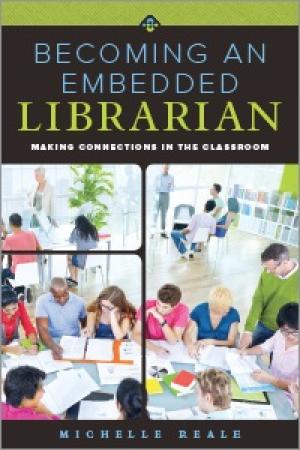
It would be easy to become intimidated while reading Michelle Reale’s book. It isn’t just her wealth of practical knowledge and hard won experience that may intimidate the reader, it is the daunting nature of embedded librarianship (EL) itself. Reale writes that “embedded librarianship necessitates the stepping out of an old, comfortable role and embarking on a new way of being, without the safety net of known results” (79). Even so, setting the intimidation factor aside, there are excellent reasons to add this book to your reading list. The author makes the most of this slim volume, a mere 104 pages, by combining both her personal journey through and scholarly support for her flavor of EL. Tucked in the middle of Reale’s twelve chapters are two chapters discussing educational theory in-depth as it applies to EL. The author’s theoretical foundation is based on Jean Lave and Etienne Wenger’s “community of practice” model of learning. This community work constructs learning through the art of conversation. In addressing the group work that establishes a community of learning Reale writes “learning begins to take shape in community as students are encouraged to think out loud” (37). Her focus is on the librarian encouraging and mediating student communities within the classroom. This approach explains her dedication to in-person EL. While Reale’s scholarship on the application of educational theory to EL is helpful, it is her personal journey that makes this book special. Reale brings the reader along the path, mitigating neither failure nor success, allowing the individual to decide whether this journey is also for them. The book reads a bit like a suspense novel with the reader wondering whether the hero will survive the next faculty encounter or student misunderstanding. The journey is filled with practical advice including concept mapping – hand out sheets of paper with just circles in them to allow the students to fill in; marketing – quoting Ulla de Stricker “Marketing isn’t our issue. Relationships are” (73); and personal goal setting that helps librarians visualize success. Reale’s chapters “Relationship Building,” “Clarifying Your Role,” “Establishing a Teaching Style,” “Setting Personal Goals,” and “Personal Branding” are as effective for standard librarianship as they are for EL. Consequently, even if the reader decides the EL journey is not for them the read is still worthwhile. There was one small negative. It is not evident from the cover that the book discusses only in-class embedding. There is no discussion about online embedding which is becoming more and more relevant with the rapid growth of online education. That in itself is not negative. But this comment juxtaposing online and actual classroom embedding, “I am primarily interested in actual classroom embedding and believe it to be true embedding” (xviii), may lead some to believe Reale is a bit too chauvinistic in her approach. Her comment on one-shot instruction, “The days of one-shot instruction just don’t work anymore,” (8) may add weight to this opinion for those who strive to excel in online embedding or creatively moving forward with one-shot instruction. But considering the value of the rest of the work these are minor concerns.
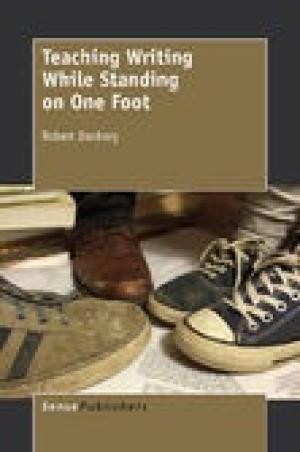
This book is an invitation, and is itself a somewhat circuitous reflection on teaching and learning. Directed at writing teachers, much of Danberg’s advice applies to teaching in general, and not just because faculty teach forms of writing in class. The title borrows an image from a famous rabbinic story in which Rabbi Hillel was asked by a nonbeliever to teach the whole of Torah in the time the nonbeliever could stand on one foot. “That which is hateful to you do not do to others,” Hillel instructed, “The rest is commentary; go and learn it” (13). Danberg reminds us that standing on one foot is a posture of instability, the position of both teachers and learners. He encourages teachers to remember their own difficulties in learning. Following Rosenzweig, Danberg suggests that Hillel did not mean “the rest is only commentary… To know Torah is to know the lesson, but also to participate in an ongoing conversation… into the lesson’s value” (14). Students often seek facts, principles, or methods that they can then apply, but good teachers are able to set them on a path of lifelong inquiry. A series of autobiographical vignettes in prose and poetry, the book is punctuated by reflection prompts, or “commentary.” The author employs several metaphors, but cooking images dominate. A good cook has learned not just to follow a recipe but knows how to see the possibility of a meal in the ingredients on hand; a good cook knows what a dish needs and when it is done. The implied parallel perhaps works best with the craft of writing but the larger point is about what Danberg calls “enfolded knowledge.” Teaching involves confronting the tension “between what we must tell students and what they can only know for themselves” (71). He offers a compelling description of his own learning disability – his struggles, the strategies he developed, and how teachers reacted to him along the way (47). Danberg laments that schools often define gifts narrowly and he suggests the following exercise: “Spend a couple of days observing the people around you and see how many gifts you can identify… Think of yourself as a zoologist whose great pleasure it is to wait for a butterfly they’ve never seen before” (58). Later, he describes class as “an invitation to inhabit forms of attention and attunement, patterns of caution and regard… If all goes well, it is no more mysterious than the heart and mind, that tangle we are always entangled in” (73). Danberg invokes the kabbalistic concept of tzimtzum, the contraction of the divine making space for creation. (This comes in a piece entitled “Four Principles and a Fifth” – but I counted six!). A good teacher knows when to get out of the way in order to make space for learning: “You can shape the problems and anticipate the obstacles. You can decide what a student encounters and the time it takes. But in the end, you simply must get out of the way, and leave them to do the work of learning” (98-99). Reading this book is a bit like ruminating on a Zen koan. Danberg contradicts himself and revels in paradox. The bizarre organization and genre shifts can be frustrating. This is a quirky book, but one with many moments of glittering insight into the difficult joys of learning and teaching.
This short, easy-to-read book may inspire academic administrators to set up one-on-one relationships between teachers with the goal of increasing effective technology use within classroom settings. The book may not translate directly to those teaching in theological education because it is drawn from the authors’ experiences in K-12 teacher education graduate programs. Its focus is on technology integration in elementary, and secondary contexts and teacher education, even though marketing copy on the back cover might indicate otherwise. Frequent clichés and repetitive text are also distracting. A major conceptual problem in this book is the use of the idea of “digital immigrants.” In the first chapter, Alaniz and Wilson describe current students who have grown up with the Internet as “digital natives.” Their parents’ generation, who did not grow up with the Internet, is one of “digital immigrants.” This generational understanding of technology adoption does not advance the aims of the book. Technology integration in the classroom requires skill in both technology and pedagogy. Generational age is not a good indicator for teachers’ capabilities in these areas. In the last chapter, the authors attempt to nuance the generational understanding, but it is too little, too late. Despite these problems, the book presents an appealing method of collegial coaching for improved technology integration in teaching. Alaniz and Wilson ground their methodology in education research on the value of collaboration and conclude the book with testimonial evidence of the effectiveness of collegial coaching. The heart of the book is a recipe for setting up a coaching program, supplemented by brief examples from graduate students who implemented programs in primary and secondary contexts. The steps for setting up this sort of program seem well-considered and backed by practical experience. While Alaniz and Wilson might have devoted more attention to intercultural issues in coaching relationships, they offer many helpful suggestions for considerations in selecting participants and structuring relationships. Shifting from one-size-fits-all workshop sessions on technology to more focused coaching on technology integration is a strategy that may benefit all levels of education, not just the primary and secondary levels. Theological educators could have ongoing structured peer relationships that focus on integrating technology and educational resources into a classroom setting. Educational technologists and librarians in theological settings might utilize principles of coaching to help faculty utilize their resources in the classroom. It would be interesting to see this recipe for collegial coaching adapted to a theological education context, with greater sensitivity to intercultural dynamics in the academy and more nuance about generational facility with technology. With noted cautions, this book is recommended for educators, particularly educational technologists, librarians, and deans, who might use insights from a peer coaching model to help faculty better use technology. 072016
Open-Space Learning (OSL), a “transdisciplinary pedagogy” as practiced at the University of Warwick, challenges assumptions about the boundaries of disciplinary knowledge, the organization of teaching spaces and resources, and the power arrangements that order the roles of teachers and students. This book bears witness to the efficacy of learning in spaces that assume students are engaged in embodied risk-taking, problem-based play, personal responsibility, group collaboration, and open-ended exploration within boundaries and expectations that yield demonstrated competence. The essential prefix for this learning space is “trans-”; it is asserted to be transgressive, transcendent, transitional, trans-rational, transactional, transdisciplinary, and transcultural. OSL draws from the learning theories of Boal, Freire, Vygotsky, Gardner, and Kolb and from the work of Clark and Damasio in neuroscience. In 2005 the University of Warwick received a grant from the Higher Education Funding Counsel of England to create its center for Creativity and Performance in Teaching and Learning (CAPITAL) in partnership with the Royal Shakespeare Company. Principles of theater pedagogy and performance studies opened new learning possibilities for disciplines not normally associated with embodied performance. The OSL website at the university notes collaborations between CAPITAL and students in business, chemistry, cultural studies, theater studies, philosophy, math, and psychiatry programs. The authors indicate that hundreds of students have been exposed to their learning pedagogies between 2007 and 2011. Four case studies create the backbone for the book. (1) An undergraduate module “without chairs” for literature majors brought twelve of Shakespeare’s plays to life and assessed student learning in comparison with students in the “with chairs” version of the module. (2) Law students argued cases found in four plays and analyzed their legal implications. (3) The learning gained by participants in the Certificate in Teaching Shakespeare program and the Postgraduate Award in Teaching Shakespeare for Actors is assessed using several measures. (4) Three “practice as research” projects focused on theatrical productions, practical workshops, and performance process for undergraduate students or post-graduates who were teaching Shakespeare. These studies provide descriptions and interpretations of the projects, but they do not offer much detail about the pedagogy’s methods for those without a theater background. The book publisher provides videos and outlines for specific OSL activities on its website. (I was not successful in getting a number of the links to work.) The OSL site at the University of Warwick provides similar links as well as some others. (This website has not been updated since fall 2013, which also raises questions about the current state of OSL at Warwick.) This book was published as a paperback in 2015. Open Space Learning reads like a report for university or funding organization officials. The authors give significant attention to student assessment of their learning and their performance on various required assignments. Classroom lectures and seminars, characterized negatively as contexts of “knowledge download,” were the dominant forms of teaching when CAPITAL began. OSL intentionally changes, at least in theory, the relationship between teachers and students, “dethroning” or “uncrowning” the power of the teacher that is reinforced by physical classroom spaces and presentation formats. I am not satisfied that the authors grappled with the power dynamics that remain present in OSL environments. While a teacher’s authority and expertise are expressed differently in the OSL context, teachers are still structuring the environment in which learning occurs. They are evaluating student work. They determine who passes or fails the modules. While teachers may have been “dethroned” from the traditionally hierarchical ways of exercising authority, they still have power, and perhaps disguised power, in the exploratory OSL context. The expressions of open space learning reported in this book depend heavily on the plays of Shakespeare. These applications of OSL for religious or theological educators are not immediately obvious, but imaginative teachers, especially those with a performing arts background, will draw inspiration from Open Space Learning and develop possibilities for performing the narrative-based texts from their disciplines in their teaching.