Resources
That continuing education (CE) was only recently added to many traditional programs makes it understandable that it has still to gain the respect of some departments in many colleges and universities. Certain trends – well-outlined in this book – have brought CE to the fore in the academy, and readers who have not recognized these trends will have to account for their institutions’ tardiness in catching up. Ten essays chart these developments, each exploring some facet of the CE phenomena. The essays are more practical than speculative; they orient the reader to relevant knowledge about current trends and how best to implement a state-of-the-art CE program. The economy and the technological boom are the major incentives for CE development, and the implications each has for such programs are well-covered in the essays. While disposable income has made CE attractive for the self-enrichment of a healthily aging population, retooling the present workforce to adapt to a changing economy indicates a significant need and opportunity for business and academia, respectively. Hence, CE’s profitability must be considered more closely, advantageous as it is for revenue-conscious higher education. Lisa Braverman’s essay explains why educators do well to note business practices (sometimes a loathed subject in academia), demographics, marketing, and innovation when designing CE programs. Nontraditional students will only increase in the near future, and effective marketing of CE will require innovation and nuance since marketing to nontraditional learners in the workforce differs significantly from traditional recruitment. To this end, some schools have enhanced their CE marketing departments, realizing that sophisticated use of social media and a better understanding of adult learners’ needs are more effective than the former “one size fits all” modes of recruitment based on criteria geared toward traditional students. Rebecca Nichols’s article addresses the role of the community college as a partner in economic development. Not only do these schools meet needs in retooling the workforce, but they also play a role in creating jobs. To this end, Nichols offers seven examples of innovative community college programs around the country. The essays acknowledge online education as the greatest recent innovation affecting CE. While nontraditional students continue to prefer brick-and-mortar campuses, they are opting for online education (38 percent by one survey) for its efficiency, a trend productive of increased revenue streams but one yet to gain more widespread acceptance and improvement of delivery. MOOC impact is considerable and is discussed in several of the essays. Another specific factor for CE is “Prior Learning Assessment” (PLA), or the acceptance of work and life experience (such as military service) in addition to or in lieu of “seat time” credit hours. While this practice is not new, Rebecca Klein-Collins and Judith B. Wertherin argue that it is fueled by adult learners’ need to complete a degree quickly and to attract older workers. Left unanswered are questions about the merit of “life experiences” that cannot be readily measured in any way equivalent to classroom assignments. Successful CE programs require the cooperation and understanding of their sponsoring institutions even as these programs keep in line with institutional missions. They also build lasting relationships with regional business, industry, and other entities requiring employees to keep updated certification. Such are the challenges and opportunities before CE programs everywhere.
Speaking about her identity as a Muslim woman, spoken-word poet Sofia Baig said, “At a certain point, you have to raise your voice and fight to take it back” (275). In that spirit, this volume unites reflection and action for transformational pedagogy. By teaching readers to recognize negative stereotypes about Muslim women and exposing complicity with imperialism in some uncritical forms of multiculturalism, these essays make a significant contribution to social justice education. Collectively these authors model the transnational feminist praxis they propose. The volume offers a treasury of references to Muslim women artists as well as caution about the ways that some authentic voices have been commodified and co-opted. Interviews with artists expand and enrich the scholarly examination of pedagogical questions regarding authority, agency, representation, and identity. Contributors present an impressive array of arguments that problematize pervasive errors in “liberal” or “Western” feminism because it has contributed to simplistic and oppressive images of Muslim women in ways that feed the justification for violence, war, and imperialism. For example, Megan MacDonald effectively demonstrates how glib ideals of the “universality of global sisterhood” can be co-opted to justify “the occupation’s military industrial agenda” if Muslim women are reduced to oppressed victims in need of rescue (39). Similarly, Catherine Burwell warns about exploitive trends in marketing and uncritical reading of fiction featured by North American women’s book clubs that sometimes perpetuate those negative images. Over and over, these writers examine the dangers of depoliticizing and disconnecting women’s voices from historical context. At the same time, these scholars call for art and critical education in both public and academic settings that broadens and deepens antiracist, anticolonial, transnational feminist cultural production. For instance, the creation of the “Hijabi Monologues,” by Sahar Ishtiaque Ullah actively counters the “conflation of Middle East and Arab and Muslim” (286). Readers get a glimpse of what Mehre Gomez Fonseca calls “pedagogical means to unlearn Arabphobia and Islamaphobia” (198). These artists, scholars, and educators warn readers against unethical use of some literature written by Muslim women that is quite well known. At the same time, they introduce readers to new artists whose work may be less familiar. Full transcripts of interviews with Muslim women artists include: conversations with novelist Mohja Kahf, documentary filmmaker and writer Zarqa Nawaz, curator and writer Rasha Salti, editor and publisher Tayyibah Taylor, spoken-word poet Sofia Baig, theater director and writer Sahar Ullah, and visual artist Jamelie Hassan. Social justice educators committed to antiracism, anticolonialism, and transnational feminism will appreciate this corrective to mistakes that many of us have unwittingly made. Readers find suggestions for anticolonial praxis such as “ethical practices for reading across difference” examining privilege and power, and opening up “space of dialogue, debate, and dissent” (195). The book will be of particular interest to those who teach religious studies, feminist studies, and multicultural literature.

This volume engages current debates on establishing or maintaining quality online education, instructional practices, and educational innovation. The book is divided into four parts: (1) five essays on “overview and implications of practices and processes for assuring quality,” (2) six essays on “quality assurance and continuous improvement at the course design and teaching levels,” (3) six essays on “processes for assuring quality at resource and program levels,” and (4) two essays of “final thoughts.” Thirty-nine education practitioners wrote either single-authored or multi-authored essays for this collection of nineteen articles. Some of them direct online education, quality control, or program assessment. A few others serve in K-12 online learning programs. A couple of contributors hold communications or marketing appointments. Nearly all hold administrative educational leadership or are academic researchers or professors. Many of the authors work at institutions of higher learning located in Pennsylvania. Others teach at institutions located in Colorado, Illinois, Maryland, Pittsburgh, Virginia, West Virginia, Washington DC, and British Columbia. On the book’s coverage of topics, I expected to find and found, pieces about improving course design, determining effectiveness and faculty development, and reviewing culturally diverse student populations. Significant online education concerns are addressed in stand-alone essays: ethics, academic advising, learning analytics, knowledge management, contact hours in online education, and accreditation. The volume also includes a helpful essay on concerns about online accessibility (including reaching disabled persons), affordability, and accountability. Interesting contributions include “The Sloan Consortium Pillars and Quality Scorecard,” that is used to benchmark effectiveness, efficiencies, and innovation, and “The Power of a Collaborative, Collegial Approach to Improving Online Teaching and Learning.” Of notable mention is the careful attempt throughout to focus on issues related to: government – federal, state, and district levels, accrediting agencies, professional bodies, faculty, managers/administrators, controllers, assessors, and learners. Teaching Theology & Religion readers may find a number of relevant essays. The volume does not engage theological education or religious studies in the liberal arts. Still, discussions and principles raised are transposable to online religious education. Online religion studies and theology programs continue to become more popular. A 2012 study of online education in the United States shows that 70 percent of higher education institutions surveyed have recognized the critical importance of online education; 6.7 million students enrolled in at least one online course (I. Elaine Allen and Jeff Seaman, Changing Course, Babson Survey Research Group, Pearson Education, and Sloan Consortium, 2013). An August 2014 web search at www.GradSchools.com lists more than 150 accredited online religious programs: 51 doctorates, 138 masters, 22 certificates, and 7 hybrid programs. Religious community online has been empirically investigated (Heidi Campbell, Exploring Religious Community Online, Peter Lang, 2005). In time, religious educators will also study this phenomenon. Until then, religious educational administrators and leaders can contextualize insights from this volume with classical areas of program creation and evaluation in curriculum, instruction, institution, faculty, and student components, to provide innovative online educational program.
Assessing and Improving Your Teaching by Phyllis Blumberg describes a comprehensive plan for teacher development and offers creative strategies for teachers at all stages of their professional career. Blumberg identifies many ways by which faculty can gain insights and improve the quality of their teaching to foster better student learning. This book is an excellent resource for both beginning instructors and more experienced ones especially in terms of recommended methods and tools for assessing faculty growth and learning outcomes. The book goes beyond well-documented analysis of individual strategies and contributes to the relatively few studies that integrate strategies from a hierarchical approach to improve teaching. For Blumberg, “a hierarchical approach” is one “that places the locus of control with the instructor who wants to improve, rather than with others who need to judge teaching performance,” and “provides a robust teaching enhancement process” (4). The first part of the book describes Blumberg’s hierarchical approach by initially establishing criteria that define teaching standards. Borrowing a commonly used, learning-centered approach to teaching, Blumberg focuses primarily on what the instructor does to promote student learning and discusses misconceptions about teaching. She then recommends alternative ideas and essential aspects of teaching for “deep and intentional learning.” The second and third parts of the book build on each other by describing a constructive self-assessment model which uses self-assessment rubrics for purposes of improving and assessing teacher effectiveness. Blumberg believes that teaching is composed of many different skills that can be learned. However, she encourages “systematic growth” which results from periodic, critical reflection on one’s teaching along with on-going critical review and the incorporation and documentation of both. In addition to discussing ways to improve teaching, Blumberg proposes three types of principles for assessing teaching, namely: (1) the context for assessment or what to assess; (2) the assessment methods or how to assess; and (3) the results of this assessment process. She notes that many professors who serve on promotion and tenure committees regularly comment on how little is actually analyzed or documented about the teaching process or teacher effectiveness. Using multiple sources of data about teaching effectiveness, Blumberg shows there is a need throughout the academy to supplement student course evaluation data with other appropriate procedures and tools” (116). Opposed to the older instructor-centered models in which assessment focuses on teaching performance or lecturing skills, she emphasizes other roles and skills such as course alignment, organization of educational experiences, and reflection on instruction. The tools for self-reflection and analysis include rating scales and descriptive rubrics; Blumberg also describes five cases from very different contexts of teaching and faculty members with different levels of experience. This book is a valuable contribution to literature on the evaluation of teaching in higher education because it contains both assessment forms that others can use to assess teachers as well as tools that instructors can use for self-reflection and analysis.
The first online course I ever viewed appeared to be a simple transfer of teaching materials from the in-person format to the online environment. There were scans of handwritten lecture notes, a few documentary links, and a couple of ungraded discussion forums. This haphazard planning was a reminder that the virtual classroom is a distinctly different environment from the traditional classroom and must be planned for and constructed in a very different way. This is where Stavredes and Herder’s An Online Guide to Course Design would have been useful, to navigate the opportunities an online course affords and to mitigate the problems of student retention and persistence sometimes seen with distance education. Stavredes and Herder advocate an outcomes-based design in order to plan an online course fully before it even begins. One starts by first asking what students should learn from the course, then asking how to assess what they have learned, and finally asking how they will learn this content. To this end the authors break course creation down into a four-part arc of (1) Analysis, (2) Design, (3) Development, and (4) Implementation and Evaluation. In the first step, “Analysis,” the instructor assesses the characteristics of the expected learners and articulates his or her goals for the course. The authors invoke Bloom’s Taxonomy to structure the goals of the course and they use this framework again in choosing course activities. The second phase, “Design,” takes up the bulk of the book. The authors helpfully recommend strategies for choosing and sequencing course activities. Of particular note is the role of the asynchronous classroom discussion, as discussions are one of the ways an instructor creates a social presence in the virtual classroom. Here we see that the online environment is fundamentally different from the face-to-face classroom. “If learners don’t feel a connection with you and their peers, it is difficult for them to persist online” (80). An instructor must deliberately foster a social presence to engage students in the online classroom. The authors recommend a problem-based approach to content-related discussions: present students with a real-world issue and let them draw inferences from the subject matter to solve the problem. In the “Development” phase the authors describe further how lecture notes, videos, and introductions can help enhance the sense of the online classroom as a social and collaborative community. The authors also offer advice for developing rubrics and how to write instructions for students accustomed to scanning information on the Internet rather than actively reading it. Finally, in the “Implementation and Evaluation” phase the authors recommend reflecting on the course to improve it according to specific standards. The authors develop a rubric for evaluating a course and they recommend eliciting feedback from students as well as from colleagues after each term, to discover areas for improvement. A real strength of this book is that the authors do not just explain what makes for good course design. They give examples of how to design well with a high degree of precision. For example, they offer clear guidelines for articulating course outcomes. In chapter 10 there is a chart quantifying the amount of time different activities in a course take, from assigned reading, to writing, to taking quizzes, in order to meet accreditation expectations. It is this concern with ensuring that all aspects of course design are planned and deliberate that makes this book an asset to anyone serious about developing an effective online course.

This book stretches a reader’s view of online learning. The contribution made by these twelve chapters, written individually and jointly, does not come in the form of new theories of learning or innovative models for administering educational institutions in a digital era. Rather, they stretch the reader’s view beyond a few courses to address a complete institutional whole. Rarely does the tone become boosterish, despite the word “transformation” in the title. The writers have done the hard work of leading distance education into the mainstream of the institutions they serve. They map the work they have done and the work that still needs to be done. The resulting map is detailed, complex, and extensive. Reading the chapters should scare away anyone who thinks online education is a quick fix for any of the issues confronting higher education. The depth of work chronicled removes naivety. The seven writers have worked at large institutions, such as Penn State. At first glance teachers and administrators at seminaries with sixty to two hundred students might be inclined to bypass the narratives and guidance offered. That would be a mistake. Schools both large and small need to make policy and procedural decisions, secure technical support, provide pedagogical support for learners and teachers, deploy student services, market programs, and so forth. The list is long. It is as long as the to-do list of any residential program. The business office, the library, campus pastor, the registrar – all of these and more – require attention. What is assumed and hence nearly invisible in residential programs becomes visible and needs to be deliberately addressed in distance education. Once the proximity of teacher and learner in time and/or distance is no longer a given the entire institution is rearranged. Reconceptualization needs to occur institutionally. Despite the difference in scale, the obligations to learners are very similar. Where there is a significant difference between the experience of the writers and many readers of this journal is the background of the writers prior to the experiences that are at the center of these chapters; they worked in distance education prior to the web. They worked in programs employing audio and video satellite connections or distributing tapes and CDs to individual distance learners. Spatial and temporal distance between teachers and learners was not unimaginable and the challenges of design and support had been faced. They had already worked in a world not exclusively shaped by residential models. In this respect, the move to online learning was not as abrupt or disorienting, but the change was nevertheless extensive and required continual new learning. The web brought distance learning from the margin to the mainstream of their institutions. In the past, residential students did not need to worry about satellite linkages, but now they do bring their computers into the classroom and social media connects their lives. Temporal and spatial barriers may not be entirely overcome but they clearly are not what they were prior to the mid-1990s. These writers have come to grips with the changes; they have lived them. The book has a high degree of integration; the writers have worked together in several settings, the most prominent being the Sloan Consortium (Sloan-C, now named the Online Learning Consortium). The book is divided into three parts and works with the “Five Pillars of Quality Online Education” developed by the consortium. In four chapters, Part One addresses the first pillar: “access, which relates to the role of online distance education in an institution’s fundamental mission and institutional strategy” (xii). Gary Miller, who is one of the authors for three chapters in this section, repeatedly offers wise counsel and sounds cautionary notes. The following typifies his contributions: “[M]ission is mission critical. No institution that has online learning as a significant part of its current or emerging strategy will be successful if the mission of the institution does not clearly recognize it. Too often the online program strategy is not driven by mission” (35). Miller’s individually authored chapter (“Leading Change in the Mainstream: A Strategic Approach”) is an exemplary model for clear-headed thinking in these highly disruptive times. The past institutional culture has to be understood and respected, not in a perfunctory manner, but as an asset for engaging the unavoidable changes occurring in the environment in which that culture now exists. External forces cannot be scolded away but neither should the future of our institutions merely capitulate to them; rather, they need to be understood and deliberated within our inherited institutional cultures in order to faithfully and effectively serve the stakeholders to which faculty are responsible. The learners are at the center of those responsibilities. Part Two, in five chapters, addresses “enduring operational excellence.” It is not written in the tone of a how-to manual. None of the five authors use their own institutional experience as a template for others. Learning effectiveness, faculty satisfaction, and student satisfaction are the pillars addressed. Reading these pages, one is impressed by how these leaders have worked within an emerging field; stability is not assumed or sought. There is a clear recognition of the fluidity of the present context, but at the same time there is an emphasis on understanding the current institutional contexts and working institutionally. Leading is not understood in heroically individual terms. Part Three addresses cost effectiveness and institutional commitment. The goal is to sustain the innovation. Perhaps some readers will be surprised to find a chapter on leading beyond the institution. However, the authors view participation in professional organizations as a constitutive dimension of institutional sustainability. Institutions develop local leadership by supporting faculty and administrative participation in broad networks. Networks generate flexibility for addressing specific actions within an institution’s responsibility to its mission and stakeholders. In fact, this entire book is marked by sharing experiences and expertise to enhance effectiveness; it is decidedly not proprietary in tone or content. The closing chapter is a roundtable discussion responding to over a dozen questions that take up the future of online education. The writers stress an “actionable” future. Here, and throughout the book, these leaders dream with their feet on the ground. Coupling pragmatic effort with openness to emergent possibilities, the writers have provided a reflective narrative that should inform the work of boards, faculty, administrators, staff, and other stakeholders. Online learning is not merely an add-on; it signals a shift in institutional culture. This book underscores the extent of the cultural shift while being grounded in the day-to-day realities of institutional work.
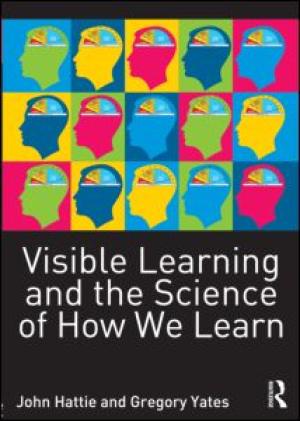
Visible Learning and the Science of How We Learn is an accessible volume that reinforces the concept of “visible learning” previously presented in Hattie’s 2009 Visible Learning (VLT) with supporting research and interpretations from the fields of education, sociology, and neuroscience. While some of the supporting research is new, the authors also harken to longstanding, now standard, studies on various topics. The writing is concise (most of the 31 chapters are about six pages) and the organization of the book allows it to be used as a compendium on topics related to learning and teaching. The book is organized using nine overarching principles that connect learning theory and teaching under three main sections: (1) learning within classrooms, (2) selected topics in learning theory, and (3) a theme of “know thyself” (self-esteem, competence, self-knowledge, and metacognition). Along the way Hattie and Yates address trendy but dubious ideas in education, such as learning styles, multitasking, and uncritical ideas about instructional technology and the Internet. This volume is among those that make the shift from a focus on the teacher and on the act of teaching, to the learner, the processes whereby learning actually happens, and impediments to learning. The working assumption is “achievement in schools is maximized when teachers see learning through the eyes of students, and when students see learning through the eyes of themselves as teachers” (xi). The value in this perspective is helping teachers understand the experience of learning on the part of the learner. Understanding and appreciating what goes on “inside the head of the learner,” can help instructors make learning “visible.” This means that teachers can design learning experiences to match how students actually learn, not how they may assume their students learn. The goal is to help teachers act with informed intention. While there is not much new in terms of learning theory, the book has value to theological educators in several regards. First, it is a good primer on pedagogy and current research on learning for instructors who do not have a background in learning theory. Second, the book provides motivational reinforcement for the importance of making the switch from teacher-focused instruction to student-centered learning. The book does so in a balanced manner, citing supportive research for both the importance of the teacher’s role and behavior in the classroom (effective use of direct instruction, the role of feedback, and so forth) and the necessity of focusing on student attention and engagement in the process of learning (cognitive load, attention, memory, motivation, and how knowledge and skills are acquired by learners). Third, several chapters touch on issues of concern particularly important to the theological and religious studies contexts. For example, Chapter 4 deals with the personality of the teacher and trust; Chapter 21 explores research and myths about students as “digital natives” and the impact of instructional technology and the Internet (Chapter 22 is titled, “Is the Internet turning us into shallow thinkers?”). Part 3, Know Thyself, focuses on the affective dynamics of teaching and learning, an issue which is consistently undervalued but is critical to matters of belief, faith, and self-understanding (formation). This is a worthwhile and useful volume. It covers the field of what makes teachers effective in the classroom. Its strength is in (1) making often complex concepts accessible in both writing and the format of the book; (2) providing balanced, research-informed coverage of concepts related to the complex acts of teaching and learning, and (3) helping teachers and instructors make the shift from over-focusing on the teaching act to appreciation and understanding of the process of learning as experienced by students.
The central questions of this study are how religious education (RE), as a part of public secondary school curricula, differs between England and Norway, and what accounts for these differences. To answer these questions the author analyzed documents reflecting national debates about RE in public schools, examined policy statements produced by the British and Norwegian governments, cited studies conducted by the European Union, and carried out limited ethnography at six secondary schools (three in Norway and three in England). This study bears the marks of having been a dissertation, and is deeply self-conscious of its methodology. Bråten cites a broad range of theoretical and methodological orientations put forth for the study of RE in Europe, settling on two frameworks that offer the greatest utility for answering her questions. The first framework, which provides the structure for the book, is that of “levels of the curriculum.” After an extensive, if somewhat dry, literature review, Bråten compares differences between England and Norway in increasingly narrow fields. These are the societal, institutional, instructional (teachers), and experiential (pupils) levels. Bråten thus first gives a broad overview of the forces at work at higher levels of organization in the planning and execution of RE curricula before describing how it is taught and received in actual practice. In each chapter she applies the second of her two main methodological frameworks: an assessment of the supranational, national, and subnational forces that have impacted developments at each curricular level. For example, primary among the supranational forces she identifies are globalization and pluralism, and among the national forces are the differing historical relationships between state, religion, and schools within the two countries. Bråten found that the teaching of RE as a multi-faith, non-confessional subject began earlier in England than in Norway, likely as a result of England’s history of relatively greater religious plurality. Apart from the formative influence of scholars within the secular field of religious studies, curricular developments in England tended to happen “from the bottom up,” and tend to be more diverse owing to the greater diversity of public schooling options. Norwegian RE, on the other hand, has tended to develop “from the top down,” and places greater emphasis on Christianity than English RE. Curricular developments in Norway were also most influenced by departments of theology, unlike in England. All of this has led to differences in how RE curriculum is executed in the two countries, but not to as many differences in how it is received by pupils. Given that most of the readers of this journal are involved with higher, not secondary, education in North America, I would suggest this study might be useful for faculty in the following ways. First, Bråten poses interesting questions about the importance of RE (mostly having to do with preparing pupils to be tolerant citizens in pluralistic societies) that are important for faculty and administrators to consider at institutions that require the study of religion as part of general education or liberal arts requirements. Why is RE considered necessary? How do students receive not only the content of what is taught, but the messages about why such courses are important? This book would also be of use for thinking about the supranational, national, and subnational forces that have impacted how and why we teach what we teach. Bråten raises many questions along these lines, and provides one multi-disciplinary model for how to answer them.
This volume follows up on the authors’ 2009 book, Going Beyond Google: The Invisible Web in Learning and Teaching (New York: Neal-Schuman, 2009). It is a welcome addition, given the rapid pace at which information technology is transforming higher education. “Invisible Web” is the term for the huge amount of Internet information that is not accessible via Google, Bing, Yahoo, and so forth. It includes proprietary databases, institutional collections, corporate and government data banks, privately secured web sites, and increasingly, social media. Of the trillions of webpages in the World Wide Web, Google only comprehends perhaps 10 percent. The rest is “invisible” to search engines. Devine and Egger-Sider present a picture in which: (1) print reference materials are tacitly deemed obsolete, (2) most students in U.S. higher education have institutional access to high quality digital research materials, but (3) they are often unaware of these resources or make little use of them. A major OCLC study in 2010, for example, found “a decline in use of library Web sites, electronic journals, and online databases since 2005,” a trend that has not yet reversed (31). The authors’ analysis of dozens of studies on student research identifies three major traits: “over-reliance on Google and other major search engines, a tendency to favor time over content, and an overwhelming preference for convenience” (38). The over-reliance on Google is especially troubling because of the rapid growth in automatically “personalized” searches, often unbeknownst to the user. Search engines filter the results of searches based on users’ previous queries. Over time, the search utility constructs dense profiles of users’ interests, generating results that are most likely to be “preferred.” This works well for advertising, but it is disastrous for critical inquiry. Personalized searches are liable simply to reinforce researchers’ biases. Devine and Egger-Sider make a strong case for teaching students about the Invisible Web, beginning as early as high school. They include a chapter describing approaches for introducing students to the Invisible Web, including a two-stage sample curriculum: (1) Web-Searching Basics, and (2) Presenting the Invisible Web, plus advice about teaching the Invisible Web with graphics and social media. The final sections of the book provide a working orientation to the Invisible Web, numerous examples of good resources, and some thoughts about the future of the Invisible Web. This book is valuable in its own right as a reference work and resource guide. Every chapter comes with extensive reference lists; there is also a collection of selected additional readings. Chapter 6, “Looking Inside the Invisible Web: A Sampler,” sets out the web addresses and some commentary for a basic research tool kit, recommended tools for specialized research, and an illustrative list of resources for highly advanced research.

This collection of essays by seventeen Generation X faculty members serving in various types of institutions and representing a range of disciplines, ranks, and roles aims to “demonstrate the personal issues, conflicts, and triumphs that are definitive of this generation” as they pertain to their academic careers. While some contributions are stronger than others, as a whole the book achieves its purpose through the insightful and honest author self-reflections. The first sentences of the opening chapter offer, “The truth is unbelieveable, not because it is untrue, but because no one wants to believe it. I am living proof.” The readers’ fear the whole book may sound like the all-too-familiar voice of a Gen Xer is quickly affirmed. The self-analysis of the first story flows into the next three installments and the reader may begin to wonder if the whole book is going to simply be a series of texts from a group of faculty who managed to gain a formal education but think life as a teacher ought to be different somehow. However, Andria J. Woodell’s recollection from a female white southern social psychologist’s perspective changes the tone of the book and is followed by primarily thoughtful reflections and analysis of personal choices and responsibility, within the realities of various institutional contexts. Most authors adeptly identify key factors in their personal journey, including educational background and aspirations, family dynamics, sexual orientation, or race, which impacted their experiences in academia. Following these observations they share information about specific institutional obstacles and supports they encountered along their respective journeys and how each responded to the interplay of these factors. David Prescott-Steed’s chapter, explaining how his PhD research project on “the abyss” metaphor became an intentional factor in his post-doctoral decisions personally and professionally, was entertaining, well-written, and an appropriate summary of a Gen Xer’s values encountering the challenges and triumphs of everyday life. Likewise, Kathleen and George Mollock’s perceptive essay on an academic couples’ journey in the higher education milieu, first as students and then as faculty, describes the choices they made and consequences of those choices, some anticipated, others unexpected. For most Gen X academics, this would be a beneficial read, even if they cannot identify with every individual story or institutional context. Likewise, for the late baby-boomer or early-Gen X administrator, it may provide helpful examples of understanding how the realities of academia are seen from different points of view. For either a faculty member or administrator in a faith-related institution, the narratives of individuals in these contexts also describe the unique challenges and approaches to these extra dimensions of academic life. As a whole, the book presents an appropriate and necessary diversity of experiences (race, gender, sexual orientation, discipline). While some chapters were stronger than others, it was a worthwhile book to read and would be a valuable addition to a post-secondary library.