Resources
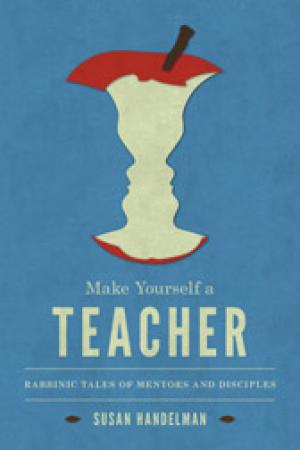
National Jewish Book Award finalist in Contemporary Jewish Life and Practice category Make Yourself a Teacher is a teaching book and a book about teaching. It discusses three dramatic, well-known stories about the student and teacher Rabbi Eliezer ben Hyrcanus from the Oral Torah. The stories of R. Eliezer serve as teaching texts and models for reflection on the teacher/student relationship in the Jewish tradition and in contemporary culture, with special emphasis on the hevruta mode of Jewish learning, a collaborative process that invites the reader into a dialogue with teachers past and present. Susan Handelman considers how teacher/student relations sustain and renew the Jewish tradition, especially during troubled times. As a commentary on historical and contemporary educational practices, she asks a range of questions about teaching and learning: What is it that teachers do when they teach? How do knowledge, spirituality, and education relate? What might Jewish models of study and commentary say about how we teach and learn today? Handelman not only presents pedagogical issues that remain controversial in today's debates on education but she also brings the stories themselves to life. Through her readings, the stories beckon us to sit among the sages and be their students. Susan Handelman is professor of English at Bar-Ilan University, Israel. (From the Publisher)
In The Learning Paradigm College, John Tagg builds on the ground-breaking Change magazine article he coauthored with Robert Barr in 1995, “From Teaching to Learning; A New Paradigm for Undergraduate Education.” That piece defined a paradigm shift happening in American higher education, placing more importance on learning outcomes and less on the quantity of instruction. As Tagg defines it, “Where the Instruction Paradigm highlights formal processes, the Learning Paradigm emphasizes results or outcomes. Where the Instruction Paradigm attends to classes, the Learning Paradigm attends to students.” (From the Publisher)
Journal Issue.
One page Teaching Tactic: students work collaboratively and in role play, to understand historical agents.
One page Teaching Tactic: weekly schedule designed to encourage students to bring their questions and concerns to the subject matter.
The course “Empowering Youth for Global Citizenship” seeks to equip students to teach global citizenship by engaging them in practices of ascetic withdrawal from consumer habits and active engagement in the public sphere. These goals underlie the design of the assignments, but should have also shaped the relationship between the assignments themselves. This article addresses the issue of course design in the service of empowering students for engagement in the public sphere by reflecting upon the course assignments, with emphasis on a project that worked well, and the implications this has for its relationship to the other course assignments, including one that missed the mark. The exploration of this misalignment between the learning goals and actual outcomes of the different assignments brings to light the unique role of learning communities of accountability and acceptance in deepening the impact of assignments aimed at personal transformation, as well as the rich dynamic that can come from coordinating course assignments to bring “head, heart, and hands” together.
Undergraduate students today often enroll in introductory religious studies or theology classes because they want the time and space to reflect on their personal spiritual questions. Such a motivation can clash with the faculty’s desire to introduce students to rigorous academic study of their field. Barbara Walvoord has proposed four “voices” that students may develop that will assist both student and faculty to cross this “great divide.” This essay explores the ways in which a course based in engaged pedagogical theory and practice -- in this case, problem-based learning -- can provide an effective space for students to “find their voices,” take control of their own learning, and fulfill both their own and their professor’s expectations.
Increasing numbers of college students enrolling in religion courses in recent years are looking to develop their religious faith or spirituality, while professors of religion want students to use and appreciate scholarly tools to study religion from an academic perspective. Some scholars argue that it is not possible to satisfy both goals in the classroom, while authors in this journal have given suggestions on how to bridge the gap between faith and scholarship. I argue that such authors are correct and that, in my experience, historical-critical methods can help devout students understand the original texts in their own religion better, comprehend why changes in interpretation have occurred over time, and appreciate the values in religions other than their own. Not all devout students are comfortable with an academic study of religion, but many can attain a more mature faith by such an approach.
This article argues that there is an identifiable scholarship of teaching and learning in theology and religion that, though varied in its entry points and forms, exhibits standards of excellence recognizable in other forms of scholarship. Engaging in this scholarship enhances a professor’s possession of practice and often reveals insights into student learning and the contours of a field that can advance both educational and disciplinary projects. Through conversation with a form of the scholarship of teaching and learning that emerged most clearly in work associated with the Carnegie Foundation for the Advancement of Teaching, we describe starting points and generative assumptions that have been employed in the discourse of the scholarship of teaching and learning in theology and religion as they have emerged in submissions to Teaching Theology and Religion over the past decade and a half and point to its benefits.