Home » Resources » Scholarship on Teaching » Academic Motherhood: How Faculty Manage Work and Family
Scholarship
March 29, 2017
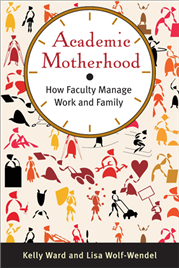
Academic Motherhood: How Faculty Manage Work and Family
- Author
- Ward, Kelly; and Wolf-Wendel, Lisa
- Publisher
- Rutgers University Press, New Brunswick, NJ
- ISBN
- 9780813553856
- Table of Contents
-
Acknowledgments
ch. 1 Motherhood and an Academic Career: A Negotiable Road
ch. 2 Origins of the Study
ch. 3 Understanding the Existing Narratives and Counternarratives
ch. 4 Managing Work and Family in the Early Career
ch. 5 Mid-Career Perspectives on Work and Family
ch. 6 The Role of Disciplinary and Departmental Contexts
ch. 7 Institutional Type Differences
ch. 8 Social Capital and Dual Careers
ch. 9 Leaving the Tenure Track
ch. 10 Policy Perspectives
ch. 11 Conclusions, Recommendations, and Parting Thoughts
References
Index
Academic Motherhood tells the story of over one hundred women who are both professors and mothers and examines how they navigated their professional lives at different career stages. Kelly Ward and Lisa Wolf-Wendel base their findings on a longitudinal study that asks how women faculty on the tenure track manage work and family in their early careers (pre-tenure) when their children are young (under the age of five), and then again in mid-career (post-tenure) when their children are older. The women studied work in a range of institutional settings—research universities, comprehensive universities, liberal arts colleges, and community colleges—and in a variety of disciplines, including the sciences, the humanities, and the social sciences.
Much of the existing literature on balancing work and family presents a pessimistic view and offers cautionary tales of what to avoid and how to avoid it. In contrast, the goal of Academic Motherhood is to help tenure track faculty and the institutions at which they are employed “make it work.” Writing for administrators, prospective and current faculty as well as scholars, Ward and Wolf-Wendel bring an element of hope and optimism to the topic of work and family in academe. They provide insight and policy recommendations that support faculty with children and offer mechanisms for problem-solving at personal, departmental, institutional, and national levels. (From the Publisher)
Much of the existing literature on balancing work and family presents a pessimistic view and offers cautionary tales of what to avoid and how to avoid it. In contrast, the goal of Academic Motherhood is to help tenure track faculty and the institutions at which they are employed “make it work.” Writing for administrators, prospective and current faculty as well as scholars, Ward and Wolf-Wendel bring an element of hope and optimism to the topic of work and family in academe. They provide insight and policy recommendations that support faculty with children and offer mechanisms for problem-solving at personal, departmental, institutional, and national levels. (From the Publisher)