Resources
Journal Issue.
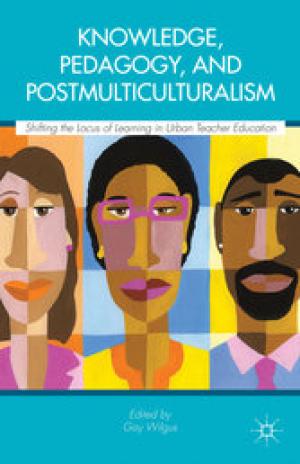
Knowledge, Pedagogy, and Postmulticulturalism opens for examination the research and experimental pedagogies of a teacher education faculty at a large, urban, public university, where teacher candidates from working-class and ethnic and linguistic minority backgrounds are prepared to work with learners from similar backgrounds. The pedagogies discussed have been expressly designed to elicit the funds of knowledge and community cultural wealth of these teacher education candidates. The research in this volume calls attention to the distinctive, complex perspectives that individuals from historically marginalized groups bring to the university classroom, and demonstrates how these valuable perspectives can be brought front and center in the university's teacher education curriculum. It counters contemporary trends of discouraging and preventing students and teachers from critically and intellectually engaging with issues of which knowledges are taught, and how. (From the Publisher)
This book is designed as a practical resource that reviews some of the most helpful approaches and exercises that teachers use when working with adult learners. Written in an accessible style, with numerous examples of practical applications scattered throughout the text, the book does not assume any prior experience with adult learning theory or adult educational history and philosophy on the reader's part. The book invites the reader into a conversation about some of the major challenges and problems involved in teaching adults, a conversation which draws on the author's long history of working with adult learners to describe how to understand and respond to these same challenges and problems. (From the Publisher)
Click Here for Book Review Abstract: Latinos’ postsecondary educational attainment has not kept pace with their growing representation in the U.S. population. How can Latino educational attainment be advanced? This monograph presents relevant contemporary research, focusing on the role of institutional contexts. Drawing particularly on research grounded in Latino students’ perspectives, it identifies key challenges Latino students face and discuss various approaches to address these challenges. Because so many Latino students are enrolled in federally designated Hispanic-Serving Institutions (HSIs), it also specifically explores HSIs’ role in promoting Latinos’ higher education access and equity. As a conclusion, it offers recommendations for institutional, state, and federal policies that can foster supportive contexts. This is Volume 39 Issue 1 of the Jossey-Bass publication ASHE Higher Education Report. Each monograph in the series is the definitive analysis of a tough higher education problem, based on thorough research of pertinent literature and institutional experiences. Topics are identified by a national survey. Noted practitioners and scholars are then commissioned to write the reports, with experts providing critical reviews of each manuscript before publication. (From the Publisher)
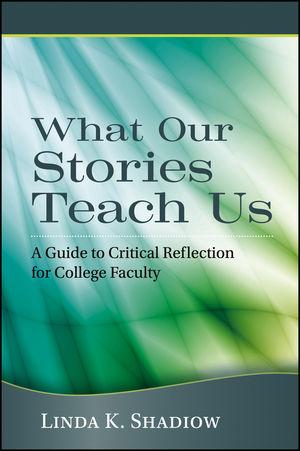
This book encourages and enables faculty to deeply examine their teaching experiences, stories, and choices so real insight results. The author invites faculty to recall stories from their own biographies, demonstrates how to view these stories as critical incidents instead of mere reminiscences, and introduces an approach faculty can undertake to analyze then interpret these stories for the benefit of professional growth in teaching. (From the Publisher)
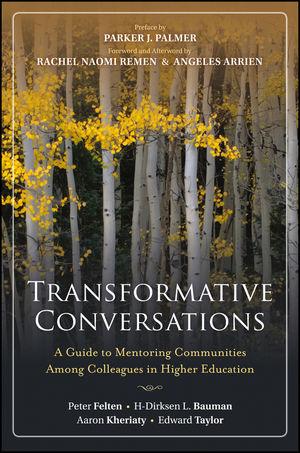
Click Here for Book Review Abstract: From the Inter-generational Mentoring Community project, which develops the next generation of academic leaders, comes formation mentoring, a process to enable faculty to recover, sustain, and further develop a sense of vocation, mission, and purpose. This book is a concise and practical guide to convening and sustaining these kinds of formation mentoring groups in higher education. It provides the necessary direction and structure to orient the process but is open-ended enough to apply across many settings and professional or educational disciplines. (From the Publisher)
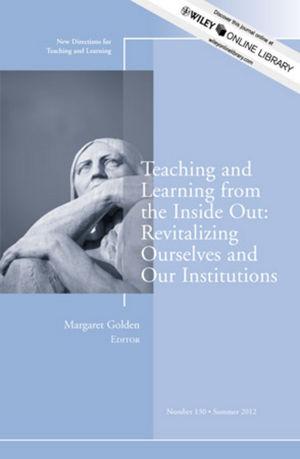
By reclaiming the passions of our hearts and exploring insights and ideas, we begin a remembering of ourselves. As we begin to reclaim our wholeness, we also have the capacity to renew and revitalize our institutions from within. After a long career of writing and speaking about how living in congruence—without division between inner and outer life—allows for being present with ourselves and those who journey with us, Parker Palmer and colleagues at the Center for Courage & Renewal developed a process of shared exploration. This Circle of Trust approach encourages people to live and work more authentically within their families, workplaces, and communities. This issue explores the transformative power of engaging in a Circle of Trust. The authors examine its direct applications to teaching and learning, and they explore and discuss the research being done by the facilitators of this work. This is the 130th volume of this Jossey-Bass higher education series. New Directions for Teaching and Learning offers a comprehensive range of ideas and techniques for improving college teaching based on the experience of seasoned instructors and the latest findings of educational and psychological researchers. (From the Publisher)
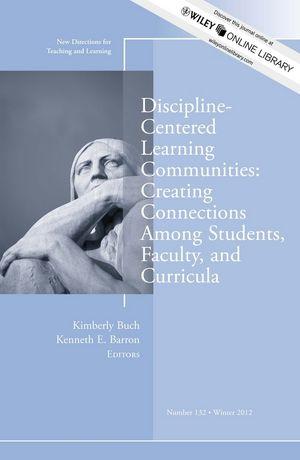
Take an in depth look at discipline-centered learning communities. Using psychology as an example, this issue provides prescriptive advice for those interested in developing a learning community in any academic discipline or program. Learning communities are a powerful vehicle for creating and sustaining connections among students, faculty, and the curriculum, but creating one can be a challenge. By providing resources, practical case studies, and theoretical grounding, this volume can both inspire and guide faculty, staff, and administrators in meeting their pedagogical and curricular goals. Learn how the five types of learning communities—based curricularly, residentially, in the classroom, on the students themselves, and even virtually—can be used to enhance student engagement and learning. Illustrating the versatility of the practice across a wide range of settings, student populations, and institutional types, this issue also contains an extensive listing of resources that go beyond disciplinary boundaries and open possibilities for all in higher education.  This is the 132nd volume of this Jossey-Bass higher education series. New Directions for Teaching and Learning offers a comprehensive range of ideas and techniques for improving college teaching based on the experience of seasoned instructors and the latest findings of educational and psychological researchers. (From the Publisher)
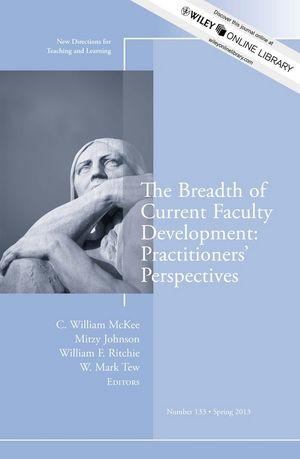
With pedagogical philosophy and practice changing significantly, faculty development has become much more important. Each chapter in this volume identifies particular areas of opportunity, and although the authors recognize that not every initiative suggested can be implemented by all institutions—circumstances such as institutional mission, available resources, and governance issues will dictate that—it is their hope that every reader will be able to glean details that might provide a spark or fan a flame on campus. As educators themselves, McKee, Johnson, Ritchie, and Tew invite you to consider the challenges, explore the possibilities, and join them on the journey. This is the 133rd volume of this Jossey-Bass higher education series. New Directions for Teaching and Learning offers a comprehensive range of ideas and techniques for improving college teaching based on the experience of seasoned instructors and the latest findings of educational and psychological researchers. (From the Publisher)
Journal Issue.