Resources
Journal Issue.
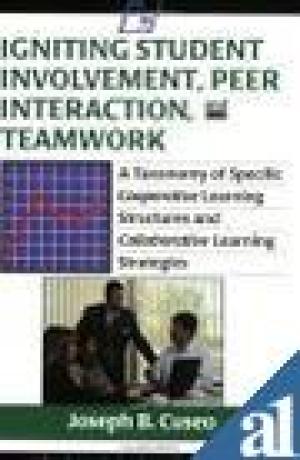
The student-centered pedagogical practices of cooperative learning, collaborative learning, and team learning can be united and defined inclusively as two or more learners who work interdependently toward a common goal, on a common task, that culminates with a consensual decision or creation of a common product. The purpose of this monograph is to provide a description and rationale for a taxonomy designed to delineate and categorize itself is included as a separate unit, with the intention that it may serve as a stand-alone "user’s manual" or "procedural index file" containing specific, step-by-step practices that can be accessed conveniently and implemented expeditiously. (From the Publisher)
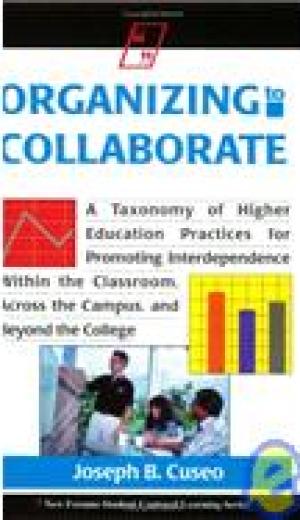
This book focuses on the terms "collaborative learning," "cooperative learning," and "learning community" in which they have been bandied about in American higher education with great frequency and enthusiasm. One primary purpose of this monograph is to provide a more precise delineation of postsecondary practices that are subsumed or assumed to be embraced by the umbrella terms, collaborative learning, cooperative learning, and learning community, and organize these practices into a coherent classification system or taxonomy. Other major objectives of the taxonomy are to: (a) create a common language for improving the clarity of communication and discourse about diverse forms of collaboration in higher education; (b) articulate a strong, research-based rationale for greater use of collaboration practices in postsecondary education, (c) provide a panoramic overview of, and a convenient catalogue for, the wide range of collaborative initiatives that have been imp! lemented at colleges and universities; and (d) serve as a stimulus for triggering wider use of collaborative practices in higher education. (From the Publisher)
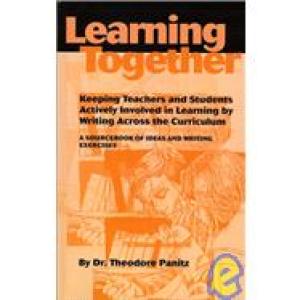
Keeping Teachers and Students Actively Involved by Writing Across the Curriculum -- Writing is an evolutionary process whereby the author revises his/her ideas, values and approaches, not just a mechanical act of placing words in a correct sequence with appropriate grammar. It is intensely personal and interactive with the subject matter, whether in the form of a brief One-Minute Paper at the end of class, a five-minute summary during class, an extended essay, or research paper. The purpose of this book is to provide a wide range of examples of writing across the curriculum (WAC) activities in order to encourage teachers to use writing in their classes regularly as a way of stimulating critical thinking in their students and providing variety in their teaching methods. (From the Publisher)

Examines how the higher education sector in Britain has responded to changes due to religious diversity. Takes particular account of the perspectives of chaplains in higher education, and also considers the perspectives of religious, student-run, and academic organizations concerned with religion in universities. Explores the role that religion plays in shaping a new generation of British Hindus, Muslims, and Sikhs, and examines issues such as the staffing of chaplaincies, religious dietary needs, and equal opportunity policies. (From the Publisher)
Journal Issue.
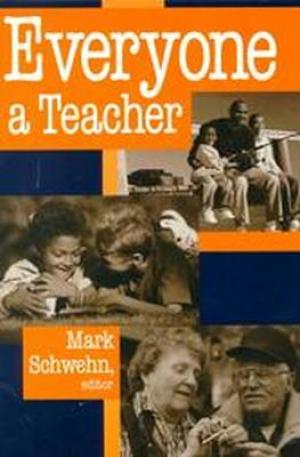
"All of us teach," begins Mark Schwehn's anthology of readings on teaching and learning. Teaching is woven into the fabric of our everyday lives. It includes training children, forming habits and characters, witnessing to a way of life, nurturing reflection and imagination, and imparting goals as well as facts and skills. Teachers are parents, grandparents, spouses, friends, neighbors, pastors, siblings, and co-workers, as well as professional educators. Most people know good teaching when they encounter it, Schwehn argues, and few would identify it with a list of techniques. Although good teaching often seems closer to an art than a skill, teaching is not an occult practice, but a public activity that can be improved by practice and questioning and demonstrated by good examples. Through Schwehn's choice of examples and deft introductions, Everyone a Teacher is an argument for a rich account of good teaching. It invites reflection yet avoids the abstractions of psychology and educational theory. From Socrates teaching a Greek slave boy geometry to Mark Twain's river-boat pilot on the Mississippi, from a real classroom of kindergarten children in Chicago to the parents who tenderly raise their child in Agee's A Death in the Family, the readings remind us of the historical and human importance of teaching and of the qualities of good teaching. These readings are intended to help us all think about the meaning of teaching and learning, for the sake of improving our teaching in everyday life. (From the Publisher)
In this much needed resource, Maryellen Weimer-one of the nation's most highly regarded authorities on effective college teaching-offers a comprehensive work on the topic of learner-centered teaching in the college and university classroom. As the author explains, learner-centered teaching focuses attention on what the student is learning, how the student is learning, the conditions under which the student is learning, whether the student is retaining and applying the learning, and how current learning positions the student for future learning. To help educators accomplish the goals of learner-centered teaching, this important book presents the meaning, practice, and ramifications of the learner-centered approach, and how this approach transforms the college classroom environment. Learner-Centered Teaching shows how to tie teaching and curriculum to the process and objectives of learning rather than to the content delivery alone. (From the Publisher)
Journal Issue.
Offering a conceptual framework and practical strategies for teacher preparation in schools with increasingly diverse racial and ethnic student populations, this book presents a coherent approach to educating culturally responsive teachers. The authors focus on the importance of recruiting and preparing a diverse teaching force, as they propose a vision for restructuring the teacher education curriculum, reconceiving the pedagogy used to prepare prospective teachers, and transforming the institutional context in order to support the curricular and pedagogical changes they recommend. (From the Publisher)
Wabash Center Staff Contact
Rachelle Green, Ph.D.
Associate Director
Wabash Center
greenr@wabash.edu