Resources
Teaching Learning, and Technology – a non-profit corporation that helps educational institutions make appropriate use of information technology through workshops, external evaluation, consulting, assessment tools, specialized tools and guides, institutional subscription programs, webcasts and online workshops, free resources and publications.
A library of practical ideas and suggestions for achieving the “Seven Principles of Good Practice in Undergraduate Education” through the online environment.
- includes a framework for the sustainability of new educational paradigms based on the combination of formal and informal learning processes supported by network and mobile technology (NMT)  - provides a series of recommendations on how to use attitudes towards NMT gained outside the school to integrate formal and informal learning  - gives a teacher training approach on how to use network and mobile technology-based informal learning to enhance formal learning pathways An ever-widening gap exists between how students and schools use communication technology. Using Network and Mobile Technology to Bridge Formal and Informal Learning introduces new methods (inspired by ‘pedagogy 2.0’) of harnessing the potential of communication technologies for teaching and learning. This book considers how attitudes towards network and mobile technology (NMT) gained outside the school can be shunted into new educational paradigms combining formal and informal learning processes. It begins with an overview of these paradigms, and their sustainability. It then considers the pedagogical dimension of formal/informal integration through NMT, moving on to teachers’ professional development. Next, the organizational development of schools in the context of formal and informal learning is detailed. Finally, the book covers the role of technologies supporting formal/informal integration into subject-oriented education. (From the Publisher)
There is a general notion that adult education literature generally supports the idea that teaching adults should be approached in a different way than teaching children. Adult learners include working adults with family responsibilities, older workers who may not feel confident about returning to school and people who are currently in the workforce and who need to upgrade skills and knowledge. The combination of synchronous and asynchronous transmission with face to face instruction allow for the implementation of a new Blended Collaborative Learning Environment, which is flexible in terms of location, time, and pace of adult learners. Blended Learning Environments for Adults: Evaluations and Frameworks demonstrates the view that Information and Communication Technologies should not be considered as a neutral teaching medium, but instead be implemented under pedagogical conditions; aiming at the development of critical thinking through their creative integration into the social and cultural context. This comprehensive collection brings a group of scholars in order to build up a pedagogical approach and analytical implementation steps and directions for designing and implementing Blended Learning Collaborative Environments for adults. (From the Publisher)

Teaching and Learning in the Digital Age is for all those interested in considering the impact of emerging digital technologies on teaching and learning. It explores the concept of a digital age and perspectives of knowledge, pedagogy and practice within a digital context. By examining teaching with digital technologies through new learning theories cognisant of the digital age, it aims to both advance thinking and offer strategies for teaching technology-savvy students that will enable meaningful learning experiences. Illustrated throughout with case studies from across the subjects and the age range, key issues considered include: • how young people create and share knowledge both in and beyond the classroom and how current and new pedagogies can support this level of achievement • the use of complexity theory as a framework to explore teaching in the digital age • the way learning occurs – one way exchanges, online and face-to-face interactions, learning within a framework of constructivism, and in communities • what we mean by critical thinking, why it is important in a digital age, and how this can occur in the context of learning • how students can create knowledge through a variety of teaching and learning activities, and how the knowledge being created can be shared, critiqued and evaluated. With an emphasis throughout on what it means for practice, this book aims to improve understanding of how learning theories currently work and can evolve in the future to promote truly effective learning in the digital age. It is essential reading for all teachers, student teachers, school leaders, those engaged in Masters’ Level work, as well as students on Education Studies courses. (From the Publisher)
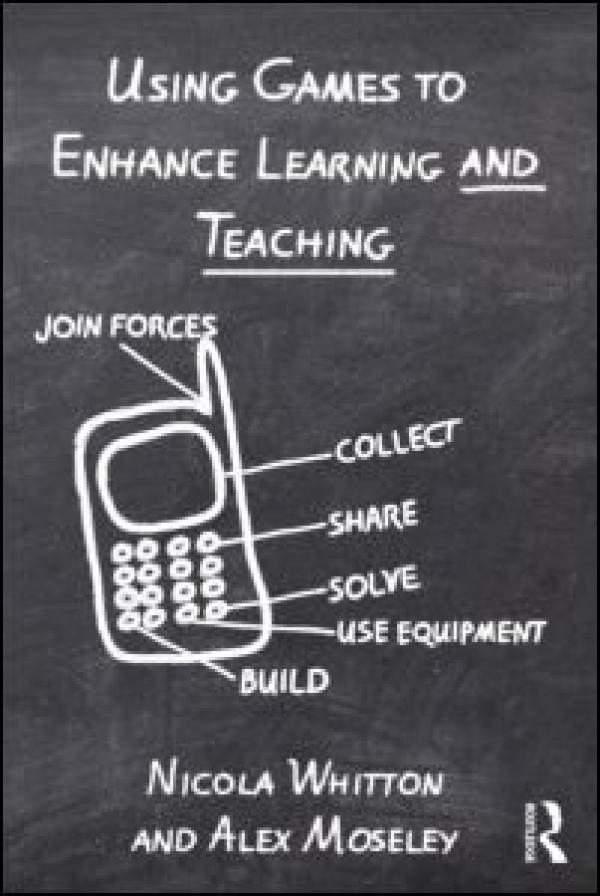
Click Here for Book Review Abstract: Using Games to Enhance Learning and Teaching provides educators with easy and practical ways of using games to support student engagement and learning. Despite growing interest in digital game-based learning and teaching, until now most teachers have lacked the resources or technical knowledge to create games that meet their needs. The only realistic option for many has been to use existing games which too often are out of step with curriculum goals, difficult to integrate, and require high-end technology. Using Games to Enhance Learning and Teaching offers a comprehensive solution, presenting five principles for games that can be embedded into traditional or online learning environments to enhance student engagement and interactivity. Extensive case studies explore specific academic perspectives, and featured insights from professional game designers show how educational games can be designed using readily accessible, low-end technologies, providing an explicit link between theory and practice. Practical in nature, the book has a sound theoretical base that draws from a range of international literature and research. (From the Publisher)
The rapid expansion of blogs, Twitter, wikis, and virtual worlds has dramatically transformed the landscape of education. Through highly accessible networks, these new media can integrate students into a learning community by enabling them to create, customize, and share content online. Using Social Media Effectively in the Classroom shows educators how to: • utilize social media to best support learners • resolve potential problems • create a powerful sense of community within user-centered Web 2.0 technologies. Moving beyond basic explanations of technologies and how to use them, this book provides research-based, jargon-free, practical examples of what works, what doesn’t, and why when it comes to social media. Organized according to the systematic process of instructional design, contributors describe innovative strategies for incorporating social media into educational settings as well as significant issues to be taken into consideration at each phase of planning, designing, teaching, and evaluation. (From the Publisher)

A large number of institutions are now providing online programs, requiring instructors to change the way they think about teaching and master a distinct set of workload management skills. The first book to discuss workload management for online instructors, Managing Online Instructor Workload offers practical strategies, advice, and examples for how to prioritize, balance, and manage an online teaching workload. Based on surveys and interviews, the timely and comprehensive insight in this book is essential for online instructors, instructional designers, faculty developers and others involved in online learning.

This book includes a definitive model for engaged learning that can be applied in a wide range of on-line learning environments and across age levels.  It also addresses current topics such as engaging in a blended learning environment, social networking, and using related technology tools. Continuing to Engage the Online Learner provides an introduction to the theory of engaged learning and its design, assessment, and management in online and blended learning environments. In addition, the book describes the types of activities that engage the online learner in each phase of engagement and provides 50 new examples of activities. (From the Publisher)
The popularity of entertainment gaming over the last decades has led to the use of games for non-entertainment purposes in areas such as training and business support. The emergence of the serious games movement has capitalized on this interest in leisure gaming, with an increase in leisure game approaches in schools, colleges, universities and in professional training and continuing professional development. The movement raises many significant issues and challenges for us. How can gaming and simulation technologies be used to engage learners? How can games be used to motivate, deepen and accelerate learning? How can they be used to greatest effect in learning and teaching? The contributors explore these and many other questions that are vital to our understanding of the paradigm shift from conventional learning environments to learning in games and simulations. (From the Publisher)