Home » Resources » Scholarship on Teaching » Using Games to Enhance Learning and Teaching: A Beginner's Guide
Scholarship
March 29, 2017
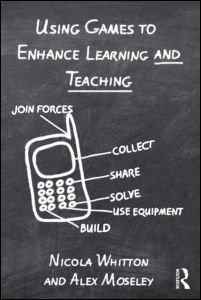
Using Games to Enhance Learning and Teaching: A Beginner’s Guide
- Author
- Whitton, Nicola, and Moseley, Alex, eds.
- Publisher
- Routledge, New York, NY
- ISBN
- 9780415897723
- Table of Contents
-
List of Figures
List of Tables
Notes on Contributors
Notes on Guest Expert Contributors
Acknowledgements
Part I - Background
ch. 1 Introduction (Alex Moseley and Nicola Whitton)
ch. 2 Good Game Design is Good Learning Design (Nicola Whitton)
Part II - Applying Game Principles to Education
ch. 3 Challenge: Levelling Up (Nicola Whitton)
ch. 4 Community: The Wisdom of Crowds (Michelle A. Hoyle and Alex Moseley)
ch. 5 Narrative: Let me tell you a story (Nicola Whitton and Dave White)
ch. 6 Competition: Playing to win? (Alex Moseley)
ch. 7 Multiple media: A picture is worth a thousand words (Peter Whitton)
Part III - Creating Games For Learning
ch. 8 Authentic contextual games for learning (Simon Brookes and Alex Moseley)
ch. 9 Mapping games to curricula (Alex Moseley and Rosie Jones)
ch. 10 Assessment and games (Alex Moseley)
ch. 11 Designing low-cost games for learning (Nicola Whitton and Alex Moseley)
Part IV - Games in Practice
ch. 12 Developing Alternate Reality Games for learning (Katie Piatt)
ch. 13 Evaluating Immersive Virtual Environments for learning (Sarah Smith-Robbins)
ch. 14 Alternate Reality Games and Literature (Danielle Barrios-O'Neill and Alan Hook)
Part V - Conclusions
ch. 15 Conclusions (Nicola Whitton and Alex Moseley)
References
Index
Click Here for Book Review
Abstract: Using Games to Enhance Learning and Teaching provides educators with easy and practical ways of using games to support student engagement and learning. Despite growing interest in digital game-based learning and teaching, until now most teachers have lacked the resources or technical knowledge to create games that meet their needs. The only realistic option for many has been to use existing games which too often are out of step with curriculum goals, difficult to integrate, and require high-end technology.
Using Games to Enhance Learning and Teaching offers a comprehensive solution, presenting five principles for games that can be embedded into traditional or online learning environments to enhance student engagement and interactivity. Extensive case studies explore specific academic perspectives, and featured insights from professional game designers show how educational games can be designed using readily accessible, low-end technologies, providing an explicit link between theory and practice. Practical in nature, the book has a sound theoretical base that draws from a range of international literature and research. (From the Publisher)
Abstract: Using Games to Enhance Learning and Teaching provides educators with easy and practical ways of using games to support student engagement and learning. Despite growing interest in digital game-based learning and teaching, until now most teachers have lacked the resources or technical knowledge to create games that meet their needs. The only realistic option for many has been to use existing games which too often are out of step with curriculum goals, difficult to integrate, and require high-end technology.
Using Games to Enhance Learning and Teaching offers a comprehensive solution, presenting five principles for games that can be embedded into traditional or online learning environments to enhance student engagement and interactivity. Extensive case studies explore specific academic perspectives, and featured insights from professional game designers show how educational games can be designed using readily accessible, low-end technologies, providing an explicit link between theory and practice. Practical in nature, the book has a sound theoretical base that draws from a range of international literature and research. (From the Publisher)