Home » Resources » Scholarship on Teaching » Using Network and Mobile Technology to Bridge Formal and Informal Learning
Scholarship
March 29, 2017
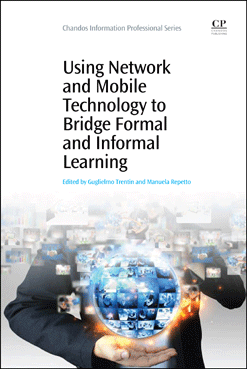
Using Network and Mobile Technology to Bridge Formal and Informal Learning
- Author
- Trentin, Guglielmo; and Repetto, Manuela, eds.
- Publisher
- Chandos Publishing, Oxford
- ISBN
- 9781843346999
- Table of Contents
-
List of figures and tables
List of abbreviations
Preface
About the contributors
ch. 1 Tapping the motivational potential of mobile handhelds: defining the research agenda (Cathy Tran, Mark Warschauer, and AnneMarie M. Conley)
 - Introduction
 - Educational technology and motivation: past, present and future
 - Proposed research strands for motivation and mobile handheld technology
 - Methodological considerations for research in mobile learning and motivation
 - Conclusion
 - Acknowledgments
 - References
ch. 2 Using social network sites and mobile technology to scaffold equity of access to cultural resources (John Cook, Norbert Pachler, and Ben Bachmair)
 - Introduction
 - Resources for learning: self-representation and writing in a school context
 - Key concepts
 - Using NMT for bridging social capital
 - Conclusions
 - Notes
 - Bibliography (John Cook, Norbert Pachler, Ben Bachmair)
ch. 3 A mobile Web 2.0 framework: reconceptualising teaching and learning (Thomas Cochrane, and Roger Bateman)
 - Introduction
 - Background
 - Mobile Web 2.0 design framework: some examples of use
 - Mobile Web 2.0 framework: key aspects
 - Discussion
 - Conclusion
 - Bibliography
ch. 4 Facing up to it: blending formal and informal learning opportunities in higher education contexts (Julie Willems, and Debra Bateman)
 - Introduction
 - The blurring of formal and informal learning
 - A new model for the knowledge economy
 - Methodology
 - Discussion
 - Conclusionv  - Bibliography
ch. 5 Networked lives for learning: digital media and young people across formal and informal contexts (Solveig Roth, and Ola Erstad)
 - Introduction
 - Networked lives
 - Learning lives
 - Methodology and research context
 - Three portraits
 - Interpretation of the portraits
 - Conclusion
 - Note
 - Bibliography
ch. 6 Network and mobile technologies in education: a call for e-teachers (Guglielmo Trentin)
 - Introduction
 - The key issues
 - From teacher to e-teacher
 - E-teacher education and professional development
 - Some conclusive reflections on e-teacher status
 - Note
 - Bibliography
ch. 7 Networked informal learning and continuing teacher education (Manuela Repetto)
 - Introduction
 - The Aladin project: general approach and activities
 - The Aladin project: results and attestations
 - Conclusion
 - Note
 - Bibliography
ch. 8 A conclusive thought: the opportunity to change education is, literally, at hand (Cathlee A. Norris, and Elliot Soloway)
 - Introduction
 - Technology = opportunity
 - The Age of Mobilism = opportunity for K-12 to finally change
 - Scaffolding the ‘demanded thinking’
 - Barriers to change
 - Stay tuned!
 - Acknowledgment
 - Notes
 - Bibliography
Index
- includes a framework for the sustainability of new educational paradigms based on the combination of formal and informal learning processes supported by network and mobile technology (NMT)
 - provides a series of recommendations on how to use attitudes towards NMT gained outside the school to integrate formal and informal learning
 - gives a teacher training approach on how to use network and mobile technology-based informal learning to enhance formal learning pathways
An ever-widening gap exists between how students and schools use communication technology. Using Network and Mobile Technology to Bridge Formal and Informal Learning introduces new methods (inspired by ‘pedagogy 2.0’) of harnessing the potential of communication technologies for teaching and learning. This book considers how attitudes towards network and mobile technology (NMT) gained outside the school can be shunted into new educational paradigms combining formal and informal learning processes. It begins with an overview of these paradigms, and their sustainability. It then considers the pedagogical dimension of formal/informal integration through NMT, moving on to teachers’ professional development. Next, the organizational development of schools in the context of formal and informal learning is detailed. Finally, the book covers the role of technologies supporting formal/informal integration into subject-oriented education. (From the Publisher)
 - provides a series of recommendations on how to use attitudes towards NMT gained outside the school to integrate formal and informal learning
 - gives a teacher training approach on how to use network and mobile technology-based informal learning to enhance formal learning pathways
An ever-widening gap exists between how students and schools use communication technology. Using Network and Mobile Technology to Bridge Formal and Informal Learning introduces new methods (inspired by ‘pedagogy 2.0’) of harnessing the potential of communication technologies for teaching and learning. This book considers how attitudes towards network and mobile technology (NMT) gained outside the school can be shunted into new educational paradigms combining formal and informal learning processes. It begins with an overview of these paradigms, and their sustainability. It then considers the pedagogical dimension of formal/informal integration through NMT, moving on to teachers’ professional development. Next, the organizational development of schools in the context of formal and informal learning is detailed. Finally, the book covers the role of technologies supporting formal/informal integration into subject-oriented education. (From the Publisher)