Resources
Eric D. Barreto Editor’s note: Today’s blog is Eric's final individual entry for this year of Stories from the Front (of the Classroom). Look for our final collaborative post on Tuesday May 19. One of the things I love most about teaching is the rhythm of the academic year: the...
Kate Blanchard This is a post about that time I taught a semester-long class on a topic about which I knew almost nothing… or perhaps I should say “the most recent time.” This was no one’s fault but my own. I work at a college that has no requirement for...

Eric D. Barreto When I was prepping my first online class, all I wanted was for someone to show me how to teach online. I wanted techniques. I wanted examples of best practices. I wanted a template upon which I could build. But I quickly learned that the hardest part..
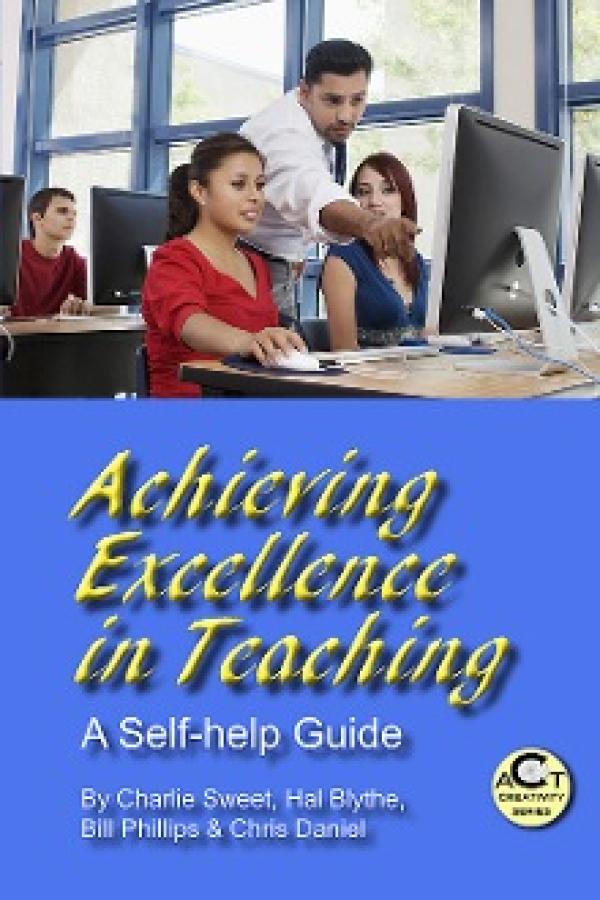
If you are looking for a book on teaching in higher education that does not scare you off with its heft, or frustrate you with its discipline-specific content, or confuse you with so many tips your head spins, then this little book might be just the thing for you! The authors combine their 110 years of faculty development and educational experience to offer their “Ten Top Traits for Terrific Teachers,” targeting the basic dispositions, skills, and strategies that have the greatest impact on deep student learning. Furthermore, they encourage teachers to reflect on their practice with a series of rubrics and action plans: “To improve by increments you must do something” (108). Throughout, they give snapshot summaries of the best research, all in a conversational tone. In an unusual turn, the first half of the book deals, not with mastery of content or course design, but with the internal drivers of the teacher. According to the research, teachers in the classroom have the most impact on students’ success, especially those teachers who exhibit a set of dispositions, or “positive ideologies of self, others, and the very act of teaching” (17-18). More specifically, these teachers demonstrate passion for their subject, professing, and student success; they care deeply, build excellent rapport with students and colleagues, and demand excellence from students and themselves. These dispositions can be learned. The second half of the book addresses the more external markers of excellent teaching. The authors promote solid organization that clearly identifies student learning outcomes and directly links related assessment and learning activities (47). They promote the use of CRISP to create a unity of purpose in individual classes: Contextualize; Review; Iterate; Summarize; and Preview (49-54). They encourage teachers to be “mentors from the middle,” to assume as necessary such roles as facilitator, coach, artist, critical reflector, model, and scholar (61). The authors encourage the use of technology in service of higher-level learning goals, and they recommend the most useful and cost-effective strategies (71-77). They encourage teachers to integrate their teaching, scholarship, and service in order to stimulate student interest and to model scholarly behavior (95). They promote experimentation and welcome creativity into the classroom both by accident and by design. Finally, they invite teachers to consider their teaching environments – everything from the space in which they teach to the psychological space they create for student risk-tolerance (105-109). While not specifically addressing educational strategies in religion and theology, this little volume compacts significant research on teaching and learning into accessible portions – enough to get started but not too much to overwhelm – with support from a concise and pertinent bibliography. And it invites readers to set plans in place for improvement and on-going assessment with its set of rubrics. The book is a useful entry point for both new and seasoned teachers to revitalize and to enhance their teaching practice. It is my choice for use in faculty development initiatives.
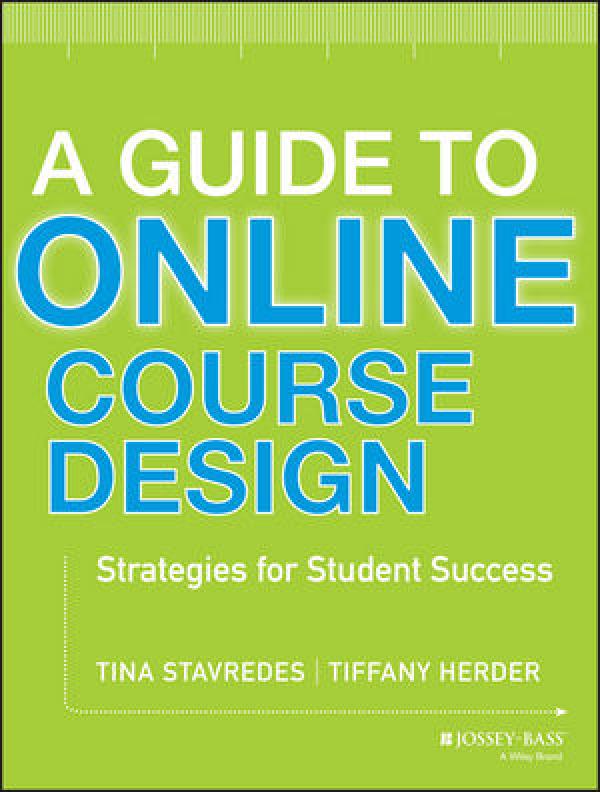
The first online course I ever viewed appeared to be a simple transfer of teaching materials from the in-person format to the online environment. There were scans of handwritten lecture notes, a few documentary links, and a couple of ungraded discussion forums. This haphazard planning was a reminder that the virtual classroom is a distinctly different environment from the traditional classroom and must be planned for and constructed in a very different way. This is where Stavredes and Herder’s An Online Guide to Course Design would have been useful, to navigate the opportunities an online course affords and to mitigate the problems of student retention and persistence sometimes seen with distance education. Stavredes and Herder advocate an outcomes-based design in order to plan an online course fully before it even begins. One starts by first asking what students should learn from the course, then asking how to assess what they have learned, and finally asking how they will learn this content. To this end the authors break course creation down into a four-part arc of (1) Analysis, (2) Design, (3) Development, and (4) Implementation and Evaluation. In the first step, “Analysis,” the instructor assesses the characteristics of the expected learners and articulates his or her goals for the course. The authors invoke Bloom’s Taxonomy to structure the goals of the course and they use this framework again in choosing course activities. The second phase, “Design,” takes up the bulk of the book. The authors helpfully recommend strategies for choosing and sequencing course activities. Of particular note is the role of the asynchronous classroom discussion, as discussions are one of the ways an instructor creates a social presence in the virtual classroom. Here we see that the online environment is fundamentally different from the face-to-face classroom. “If learners don’t feel a connection with you and their peers, it is difficult for them to persist online” (80). An instructor must deliberately foster a social presence to engage students in the online classroom. The authors recommend a problem-based approach to content-related discussions: present students with a real-world issue and let them draw inferences from the subject matter to solve the problem. In the “Development” phase the authors describe further how lecture notes, videos, and introductions can help enhance the sense of the online classroom as a social and collaborative community. The authors also offer advice for developing rubrics and how to write instructions for students accustomed to scanning information on the Internet rather than actively reading it. Finally, in the “Implementation and Evaluation” phase the authors recommend reflecting on the course to improve it according to specific standards. The authors develop a rubric for evaluating a course and they recommend eliciting feedback from students as well as from colleagues after each term, to discover areas for improvement. A real strength of this book is that the authors do not just explain what makes for good course design. They give examples of how to design well with a high degree of precision. For example, they offer clear guidelines for articulating course outcomes. In chapter 10 there is a chart quantifying the amount of time different activities in a course take, from assigned reading, to writing, to taking quizzes, in order to meet accreditation expectations. It is this concern with ensuring that all aspects of course design are planned and deliberate that makes this book an asset to anyone serious about developing an effective online course.
Eric D. Barreto Alright, not a strange land. It’s just Berkeley. Let me back up. I am currently about halfway through a teaching gig at Pacific School of Religion thanks to the intrepid work of the Hispanic Summer Program. For two weeks, I am helping a group of students find...

Roger S. Nam In my last post, I advocated for open source final exams, which focused on one’s ability to sort through the mass of information readily available on an iPhone. The response to that post was overwhelming, so I offer a follow-up conversation. Below I have paraphrased some of... Read more →
Kate Blanchard Is anyone else out there taken by surprise, year after year, at how absurdly crazy the weeks feel between AAR and winter break? I’m not complaining – I just had a wonderful time with 10,000 religion nerds in sunny San Diego (which included a video shoot with my...
Kate Blanchard, Associate Professor of Religious Studies, Alma College The main reason I don’t lecture is cowardice, plain and simple. I have never felt brilliant or knowledgeable or charismatic enough to carry a course on my own. Thankfully, though, I...

When I started teaching I relied, like many others, on the examples of my own teachers. When I was an undergraduate, the teachers who moved me most were never straight lecturers. So, I tried to adapt their styles. The more...