Resources
Most white, middle-class citizens see society from a monocultural perspective, a perspective that assumes, often unconsciously, that persons of all races are in the same cultural system together. This single-system form of seeing the world, is blind to its own cultural specificity. People who see persons of other races monoculturally cannot imagine the reality that those "others" think of themselves not in relation to the majority race but in terms of their own culturally specific identities. This paper presents an "interactive phase theory" with regard to race that is intended to reassess school curricula in terms of heightened levels of consciousness concerning race. In the context of U.S. history courses, five phases are presented: phase one: all-white history; phase two: exceptional minority individuals in U.S. history; phase three: minority issues, or minority groups as problems, anomalies, absences, or victims in U.S. history; phase four: the lives and cultures of people of color everywhere as history; and phase five: history redefined and reconstructed to include all people. (DB)
Journal Issue. (This issue, and all "Spotlight on Teaching" issues prior to 1999, are not available on the AAR website.)
This introductory course fulfills a number of goals for students and colleges, including recruitment ad screening of majors, provision of prerequisite knowledge, explorations of learning, commitment to college, and cognitive development.
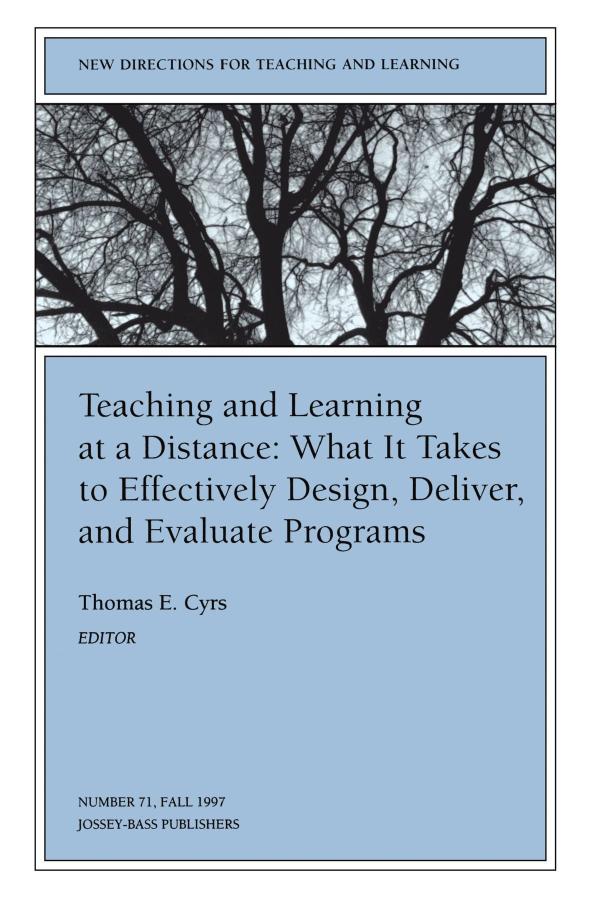
Teaching and learning at a distance is an area of education that is growing rapidly alongside the technology that makes it possible. But success in this area requires more than advanced technology; it requires skillful instructors, well-designed courses, and students ready to learn from the format. This issue of New Directions for Teaching and Learning provides insights from experienced practitioners into what is needed to make teaching and learning at a distance successful for everyone involved. This is the 71st issue of the quarterly journal New Directions for Teaching and Learning. (From the Publisher)

Susan Toohey focuses not on teaching techniques but on the strategic decisions which must be made before a course begins. She provides realistic advice for university and college teachers on how to design more effective courses without underestimating the complexity of the task facing course developers. In particular, she examines fully the challenges involved in leading course design teams, getting agreement among teaching staff and managing organizational politics. (From the Publisher)

Good teaching begins with good preparation. But many instructors and teaching assistants are unsure about how to plan their courses in order to teach more effectively. Charting Your Course is a systematic approach to course planning that applies to all disciplines and course types. Prégent stresses analysis, planning, critical thinking, and careful evaluation and provides step-by-step examples of how actual new courses were designed and prepared. Whatever type of course you teach, use Charting Your Course to complement your current planning. (From the Publisher)
Designing and Assessing Courses and Curricula reflects the best current knowledge and practice in course and curriculum design and connects this knowledge with the critical task of assessing and learning outcomes at both course and curricular levels. Tested and refined through long-term use and study, the change model presented in this book shows how to move from concept to actualization, from theory to practice. (From the Publisher)
Journal Issue.