Resources
Click Here for Book Review Abstract: Academic libraries are in the midst of significant disruption. Academic librarians and university administrators know they need to change, but are not sure how. Bits and pieces of what needs to happen are clear, but the whole picture is hard to grasp. Reimagining the Academic Library paints a simple straightforward picture of the changes affecting academic libraries and what academic librarians need to do to respond to the changes would help to guide future library practice. The aim is to explain where academic libraries need to go and how to get there in a book that can be read in a weekend. David Lewis provides a readable survey of the current state of academic library practice and proposes where academic libraries need to go in the future to provide value to their campuses. His primary focus is on collections as this is the area with the greatest opportunity for change and is the driver of most library cost. Lewis provides an accessible framework for thinking about how library practice needs to adjust in the digital environment. The book will be useful not only to academic librarians, but also for librarians to share with presidents and provosts who a concise source for understanding where and how to focus their expenditures on libraries. (From the Publisher)
Click Here for Book Review This unique study uncovers the lives and working conditions of a group of individuals who are usually rendered invisible on college campuses--the custodians who daily clean the offices, residence halls, bathrooms and public spaces. In doing so it also reveals universities’ equally invisible practices that frequently contradict their espoused values of inclusion and equity, and their profession that those on the margins are important members of the campus community. This vivid ethnography is the fruit of the year’s fieldwork that Peter Magolda’s undertook at two universities. His purpose was to shine a light on a subculture that neither decision-makers nor campus community members know very much about, let alone understand the motivations and aspirations of those who perform this work; and to pose fundamental questions about the moral implications of the corporatization of higher education and its impact on its lowest paid and most vulnerable employees. Working alongside and learning about the lives of over thirty janitorial staff, Peter Magolda becomes privy to acts of courage, resilience, and inspiration, as well as witness to their work ethic, and to instances of intolerance, inequity, and injustices. We learn the stories of remarkable people, and about their daily concerns, their fears and contributions. Peter Magolda raises such questions as: Does the academy still believe wisdom is exclusive to particular professions or classes of people? Are universities really inclusive? Is addressing service workers’ concerns part of the mission of higher education? If universities profess to value education, why make it difficult for those on the margins, such as custodians, to “get educated.” The book concludes with the research participants’ and the author’s reflections about ways that colleges can improve the lives of those whose underpaid and unremarked labor is so essential to the smooth running of their campuses. Appendices provide information about the research methodology and methods, as well as a discussion of the influence of corporate managerialism on ethnographic research. (From the Publisher)
CAEL is a nonprofit that works at all levels within the higher education, public, and private sectors to make it easier for people to get the education and training they need. Competency-Based Education suggests various alternative enrollment, assessment, and credentialing processes. 
The Lumina Foundation has been at the forefront of increasing the number of adults in higher education fro the past few years. This report discusses the merits and drawbacks of credentialing systems. 

Click Here for Book Review Abstract: It is no secret that American graduate education is in disarray. Graduate students take too long to complete their studies and face a dismal academic job market if they succeed. The Graduate School Mess gets to the root of these problems and offers concrete solutions for revitalizing graduate education in the humanities. Leonard Cassuto, professor and graduate education columnist for The Chronicle of Higher Education, argues that universities’ heavy emphasis on research comes at the expense of teaching. But teaching is where reforming graduate school must begin. Cassuto says that graduate education must recover its mission of public service. Professors should revamp the graduate curriculum and broaden its narrow definition of success to allow students to create more fulfilling lives for themselves both inside and outside the academy. Cassuto frames the current situation foremost as a teaching problem: professors rarely prepare graduate students for the demands of the working worlds they will actually join. He gives practical advice about how faculty can teach and advise graduate students by committing to a student-centered approach. In chapters that follow the career of the graduate student from admissions to the dissertation and placement, Cassuto considers how each stage of graduate education is shaped by unexamined assumptions and ancient prejudices that need to be critically confronted. Written with verve and infused with history, The Graduate School Mess returns our national conversation about graduate study in the humanities to first principles. (From the Publisher)
Much of what is written about colleges and universities ties rapidly rising tuition to dysfunctional behavior in the academy. Common targets of dysfunction include prestige games among universities, gold plated amenities, and bloated administration. This book offers a different view. To explain rising college cost, the authors place the higher education industry firmly within the larger economic history of the United States. The trajectory of college cost is similar to cost behavior in many other industries, and this is no coincidence. Higher education is a personal service that relies on highly educated labor. A technological trio of broad economic forces has come together in the last thirty years to cause higher education costs, and costs in many other industries, to rise much more rapidly than the inflation rate. The main culprit is economic growth itself. This finding does not mean that all is well in American higher education. A college education has become less reachable to a broad swathe of the American public at the same time that the market demand for highly educated people has soared. This affordability problem has deep roots. The authors explore how cost pressure, the changing wage structure of the US economy, and the complexity of financial aid policy combine to reduce access to higher education below what we need in the 21st century labor market. This book is a call to calm the rhetoric of blame and to instead find policies that will increase access to higher education while preserving the quality of our colleges and universities. (From the Publisher)
Click Here for Book Review Abstract: Higher education is facing a perfect storm as it contends with changing demographics, shrinking budgets and concerns about access and cost, while underrepresented groups – both in faculty ranks and students – are voicing dissatisfaction with campus climate and demanding changes to structural inequities. This book argues that, to address the inexorable changes ahead, colleges and universities need both to centralize the value of diversity and inclusion and employ a set of strategies that are enacted at all levels of their institutions. It argues that individual and institutional change efforts can only be achieved by implementing “diversity as a value” – that is embracing social change efforts as central and additive rather than episodic and required – and provides the research and theoretical frameworks to support this approach, as well as tools and examples of practice that accomplish change. The contributors to this book identify the elements that drive successful multicultural initiatives and that strengthen the effectiveness of campus efforts to dismantle systemic oppression, as well as the individual and organization skills needed to manage difference effectively. Among these is developing the capacity of administrators, faculty and student affairs professionals as conscious scholar practitioners to sensitively manage conflicts on campus, deconstruct challenging structures and reconstruct the environment intentionally to include in respectful ways experiences of historically marginalized groups and non-dominant ways of being in the world. The books’ focus on developing capacities for multicultural competence aligns with higher education’s increasing emphasis on civic engagement and institutional goals promote skills to interact in meaningful and responsible ways around difference, whether of people, ideas or identities. Designing Transformative Multicultural Initiatives provides guiding principles and practical strategies to successfully transform higher education to become fully inclusive and advance the success of all constituents and stakeholders. (From the Publisher)
Argues for a new system of credentials in place of university degree programs, focused on education for job skill acquisition and professional development.
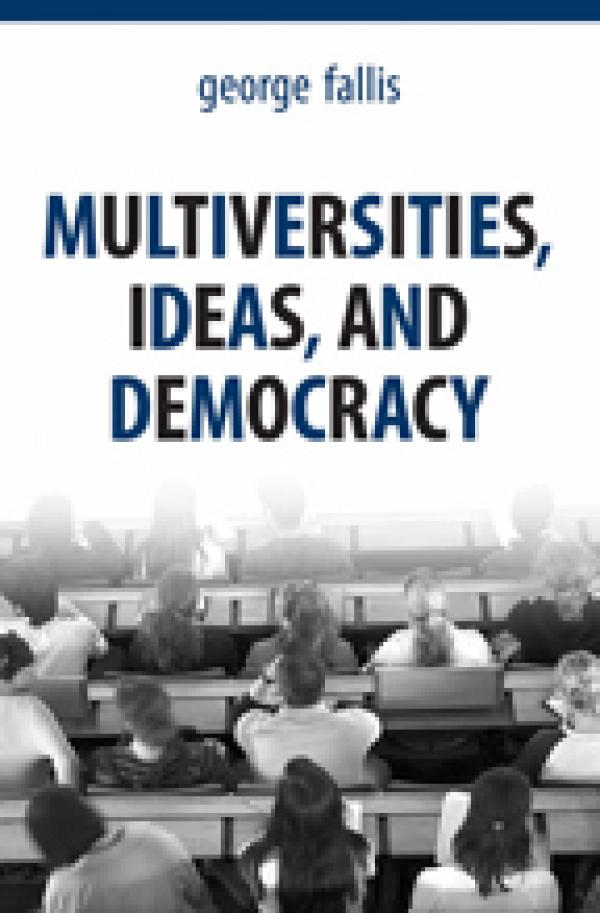
Multiversities are sprawling conglomerates that provide liberal undergraduate, graduate, and professional education. As well-springs of innovation and ideas, these universities represent the core of society's research enterprise. Multiversities, Ideas, and Democracy forcibly argues that, in the contemporary world, multiversities need to be conceptualized in a new way, that is, not just as places of teaching and research, but also as fundamental institutions of democracy. Building upon the history of universities, George Fallis discusses how the multiversity is a distinctive product of the later twentieth century and has become an institution of centrality and power. He examines five characteristics of our age - the constrained welfare state, the information technology revolution, postmodern thought, commercialization, and globalization - and in each case explains how the dynamic of multiversity research alters societal circumstances, leading to the alteration of the institution itself and creating challenges to its own survival. The character of our age demands reappraisal of the multiversity, Fallis argues, in order to safeguard them from so-called 'mission drift.' Writing from a multi-national perspective, this study establishes how similar ideas are shaping multiversities across the Anglo-American world. Ultimately, Multiversities, Ideas, and Democracy seeks to uncover the ethos of the multiversity and to hold such institutions accountable for their contribution to democratic life. It will appeal to anyone interested in the role of education in society. (From the Publisher)