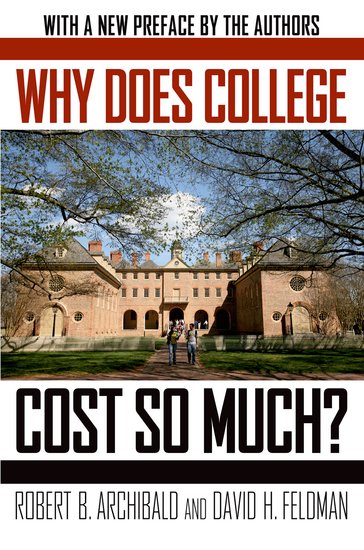
- Author
- Archibald, Robert B.; and Feldman, David H.
- Publisher
- Oxford University Press, Oxford, NY
- ISBN
- 9780190214104
- Table of Contents
-
Part 1 - Introduction
ch. 1 The Landscape of the College Cost Debate
ch. 2 Is Higher Education All That Unusual?
Part 2 - Costs
ch. 3 Higher Education is a Service
ch. 4 The Costs of Employing Highly Educated Workers
ch. 5 Cost and Quality in Higher Education
ch. 6 The Bottom Line: Why Does College Cost So Much?
ch. 7 Is Higher Education Increasingly Dysfunctional?
ch. 8 Productivity Growth in Higher Education
Part 3 - Tuition and Fees
ch. 9 Subsidies and Tuition Setting
ch. 10 List-Price Tuition and Institutional Grants
ch. 11 Outside Financial Aid
ch. 12 The College Affordability Crisis
Part 4 - Policy
ch. 13 Federal Policy and College Tuition
ch. 14 Financial Aid Policy
ch. 15 Rewriting the Relationship between States and Their Public Universities
ch. 16 A Few Final Observations
Appendix 1: Data on Costs and Prices
Appendix 2: Granger Causality Tests of the Bennett Hypothesis
Much of what is written about colleges and universities ties rapidly rising tuition to dysfunctional behavior in the academy. Common targets of dysfunction include prestige games among universities, gold plated amenities, and bloated administration. This book offers a different view. To explain rising college cost, the authors place the higher education industry firmly within the larger economic history of the United States. The trajectory of college cost is similar to cost behavior in many other industries, and this is no coincidence. Higher education is a personal service that relies on highly educated labor. A technological trio of broad economic forces has come together in the last thirty years to cause higher education costs, and costs in many other industries, to rise much more rapidly than the inflation rate. The main culprit is economic growth itself.
This finding does not mean that all is well in American higher education. A college education has become less reachable to a broad swathe of the American public at the same time that the market demand for highly educated people has soared. This affordability problem has deep roots. The authors explore how cost pressure, the changing wage structure of the US economy, and the complexity of financial aid policy combine to reduce access to higher education below what we need in the 21st century labor market.
This book is a call to calm the rhetoric of blame and to instead find policies that will increase access to higher education while preserving the quality of our colleges and universities. (From the Publisher)
This finding does not mean that all is well in American higher education. A college education has become less reachable to a broad swathe of the American public at the same time that the market demand for highly educated people has soared. This affordability problem has deep roots. The authors explore how cost pressure, the changing wage structure of the US economy, and the complexity of financial aid policy combine to reduce access to higher education below what we need in the 21st century labor market.
This book is a call to calm the rhetoric of blame and to instead find policies that will increase access to higher education while preserving the quality of our colleges and universities. (From the Publisher)