Home » Resources » Scholarship on Teaching » The Lives of Campus Custodians Insights into Corporatization and Civic Disengagement in the Academy
Scholarship
March 29, 2017
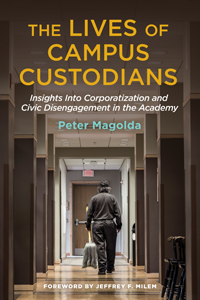
The Lives of Campus Custodians Insights into Corporatization and Civic Disengagement in the Academy
- Author
- Magolda, Peter M.
- Publisher
- Stylus, Sterling, VA
- ISBN
- 9781620364604
- Table of Contents
-
Acknowledgements
Foreword
Preface: “I See You”
Part I: The Research Study, Research Sites and Researcher
ch. 1 You Must Have Done Something Wrong
The Right Kind Of Wrong
What’s Wrong?
Writing Wrongs
ch. 2 Research Sites Insights
Cleaning Insights
Research Sites
Historical And Political Insights
Insights Unseen
ch. 3 Coming Clean—Ethnographic Origins and Milieus
The Subjective “I” And “Eye”
Lessons Learned
Part II: The Custodial Life: Family and Fear
ch. 4 Pathways To A Cleaner [’s] Life
Career Immobility
Upward Mobility
Downward Mobility
The Allure Of Custodial Work On College Campuses
Left Behind And Losing Ground
ch. 5 The Custodian Life
Grime Scenes
ch. 6 The Supervising Life
The Clean Team
The Buffer
Worker-Manager Strife
ch. 7 Fear the Worst
Primal Fear
Fear Factors
Caste-Away Fears
ch. 8 Family Matters
Family Feuds
The Compton University Family
The Harrison University Family
Family Therapy
Part III: Corporate Managerialism and Civic Disengagement
ch. 9 The Corporate Creep
Business As [Un] Usual
How’s Business? Not So Good
Getting Down To Business
A Corporate Managerialism Business Model
Going Out Of Business
ch. 10 Soiled Educational Aspirations and Civic Disengagement
Doing More Harm Than Good
The Good, The Bad, And The Ugly
Too Bad
Part IV Education and Possibilities
ch. 11 The Courage to Be [In Trouble]
Urine Trouble
Trouble Makers
Trouble In Paradise
ch. 12 A Dog’s Life
Having A Dog’s Chance
Teaching Old Dogs New Tricks
Dog-Ma
Epilogue
Compton University Staff Updates
Harrison University Updates
Miami University Updates
Appendix A: Research Methodologies And Methods
Philosophical Foundations
Fieldwork Methods Influences
Writing
Goodness Criteria
Appendix B: Unsanitized Tales From The Field
Omissions Accomplished
Fools Rush In Where Angels Fear to Tread
Conclusion
References
Index
Click Here for Book Review
This unique study uncovers the lives and working conditions of a group of individuals who are usually rendered invisible on college campuses--the custodians who daily clean the offices, residence halls, bathrooms and public spaces. In doing so it also reveals universities’ equally invisible practices that frequently contradict their espoused values of inclusion and equity, and their profession that those on the margins are important members of the campus community.
This vivid ethnography is the fruit of the year’s fieldwork that Peter Magolda’s undertook at two universities. His purpose was to shine a light on a subculture that neither decision-makers nor campus community members know very much about, let alone understand the motivations and aspirations of those who perform this work; and to pose fundamental questions about the moral implications of the corporatization of higher education and its impact on its lowest paid and most vulnerable employees.
Working alongside and learning about the lives of over thirty janitorial staff, Peter Magolda becomes privy to acts of courage, resilience, and inspiration, as well as witness to their work ethic, and to instances of intolerance, inequity, and injustices. We learn the stories of remarkable people, and about their daily concerns, their fears and contributions.
Peter Magolda raises such questions as: Does the academy still believe wisdom is exclusive to particular professions or classes of people? Are universities really inclusive? Is addressing service workers’ concerns part of the mission of higher education? If universities profess to value education, why make it difficult for those on the margins, such as custodians, to “get educated.”
The book concludes with the research participants’ and the author’s reflections about ways that colleges can improve the lives of those whose underpaid and unremarked labor is so essential to the smooth running of their campuses.
Appendices provide information about the research methodology and methods, as well as a discussion of the influence of corporate managerialism on ethnographic research. (From the Publisher)
This unique study uncovers the lives and working conditions of a group of individuals who are usually rendered invisible on college campuses--the custodians who daily clean the offices, residence halls, bathrooms and public spaces. In doing so it also reveals universities’ equally invisible practices that frequently contradict their espoused values of inclusion and equity, and their profession that those on the margins are important members of the campus community.
This vivid ethnography is the fruit of the year’s fieldwork that Peter Magolda’s undertook at two universities. His purpose was to shine a light on a subculture that neither decision-makers nor campus community members know very much about, let alone understand the motivations and aspirations of those who perform this work; and to pose fundamental questions about the moral implications of the corporatization of higher education and its impact on its lowest paid and most vulnerable employees.
Working alongside and learning about the lives of over thirty janitorial staff, Peter Magolda becomes privy to acts of courage, resilience, and inspiration, as well as witness to their work ethic, and to instances of intolerance, inequity, and injustices. We learn the stories of remarkable people, and about their daily concerns, their fears and contributions.
Peter Magolda raises such questions as: Does the academy still believe wisdom is exclusive to particular professions or classes of people? Are universities really inclusive? Is addressing service workers’ concerns part of the mission of higher education? If universities profess to value education, why make it difficult for those on the margins, such as custodians, to “get educated.”
The book concludes with the research participants’ and the author’s reflections about ways that colleges can improve the lives of those whose underpaid and unremarked labor is so essential to the smooth running of their campuses.
Appendices provide information about the research methodology and methods, as well as a discussion of the influence of corporate managerialism on ethnographic research. (From the Publisher)