Scholarship on Teaching
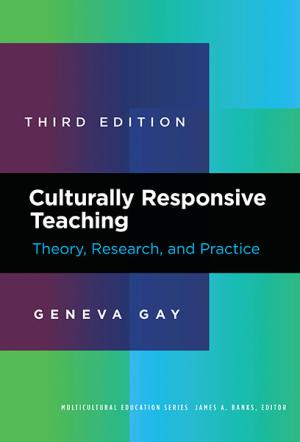
Geneva Gay is renowned for her contributions to multicultural education, particularly as it relates to curriculum design, professional learning, and classroom instruction. Gay has made many important revisions to keep her foundational, award-winning text relevant for today’s diverse student population, including: new research on culturally responsive teaching, a focus on a broader range of racial and ethnic groups, and consideration of additional issues related to early childhood education. Combining insights from multicultural education theory with real-life classroom stories, this book demonstrates that all students will perform better on multiple measures of achievement when teaching is filtered through students’ own cultural experiences. This perennial bestseller continues to be the go-to resource for teacher professional learning and preservice courses. While retaining its basic organization and structure, the Third Edition features: -New research that validates the positive effects of culturally responsive teaching. -Examples that broaden the racial and ethnic groups that can benefit from culturally responsive teaching. -More information on the needs and benefits of culturally responsive teaching with young children. -More attention to the quality of life for students of color in colleges and universities. -The addition of Practice Possibilities at the end of chapters that describe how culturally responsive teaching can be implemented. (From the Publisher)
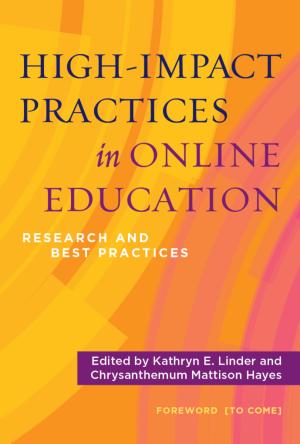
Click Here for Book Review This is a valuable collection of well-researched essays focused on the use of high-impact practices in online education. Readers will find both theory and best practices that can strengthen distance, blended, or face-to-face courses. - Gary Eller, University of Nebraska - Omaha This volume offers the first comprehensive guide to how high-impact practices (HIPs) are being implemented in online environments and how they can be adjusted to meet the needs of online learners. This multi-disciplinary approach will assist faculty and administrators to effectively implement HIPs in distance education courses and online programs. With a chapter devoted to each of the eleven HIPs, this collection offers guidance that takes into account the differences between e-learners and traditional on-campus students. A primary goal of High-Impact Practices Online is to share the ways in which HIPs may need to be amended to meet the needs of online learners. Through specific examples and practical suggestions in each chapter, readers are introduced to concrete strategies for transitioning HIPs to the online environment that can be utilized across a range of disciplines and institution types. Each chapter of High-Impact Practices Online also references the most recent and relevant literature on each HIP so that readers are brought up to date on what makes online HIPs successful. The book provides guidance on how best to implement HIPs to increase retention and completion for online learners. (From the Publisher)
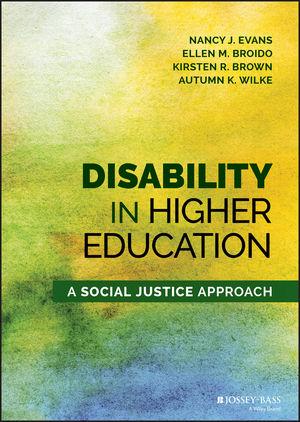
Disability in Higher Education: A Social Justice Approach examines how disability is conceptualized in higher education and ways in which students, faculty, and staff with disabilities are viewed and served on college campuses. Drawing on multiple theoretical frameworks, research, and experience creating inclusive campuses, this text offers a new framework for understanding disability using a social justice lens. Many institutions focus solely on legal access and accommodation, enabling a system of exclusion and oppression. However, using principles of universal design, social justice, and other inclusive practices, campus environments can be transformed into more inclusive and equitable settings for all constituents. The authors consider the experiences of students, faculty, and staff with disabilities and offer strategies for addressing ableism within a variety of settings, including classrooms, residence halls, admissions and orientation, student organizations, career development, and counseling. They also expand traditional student affairs understandings of disability issues by including chapters on technology, law, theory, and disability services. Using social justice principles, the discussion spans the entire college experience of individuals with disabilities, and avoids any single-issue focus such as physical accessibility or classroom accommodations. (From the Publisher)
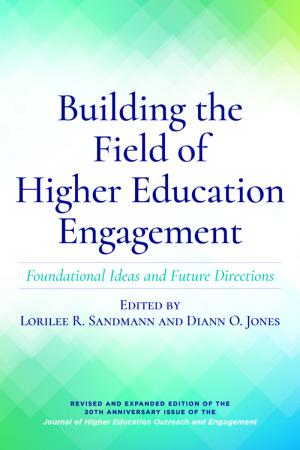
Community engagement has evolved as a respected field and now occupies a seat at the academic table. In the past, this work had often been relegated to the institutional fringes of higher education, its practitioners marginalized, and the work often portrayed as service, not scholarly. Today, higher education community engagement is a dynamic and continually evolving field of scholarship and practice that carries ever-increasing academic respect. This book contributes to the ever-under-construction edifice by presenting a scaffolding of the scholarship that has been part of the building process, documenting and analyzing the past, speculating about the future, and framing a continuing conversation about and for the field. There are three parts to this book designed to promote a continuing field-building conversation: a look back at foundational documents of the field; a set of provocative questions interrogating those foundational works; and a look to the future by the next generation of leaders in the field. The central part is the special 20th anniversary issue of the Journal of Higher Education Outreach and Engagement, which brings together key documents of the scholarship of engagement with reflections on those documents by key scholars and/or the authors of the original works. In addition to highlighting the foundations and evolution of the field, this work also looks ahead to the next generation of voices and views as input to the conversation, with a closing chapter that includes invited essays by nine outstanding community-engaged thinkers and writers of the next 20 years who share their ideas about probable futures. (From the Publisher)
Click Here for Book Review During times of rapid social and religious change, leadership rooted in tradition and committed to the future is the foundation upon which theological schools stand. Theological education owes itself to countless predecessors who paved the way for a thriving academic culture that holds together faith and learning. Daniel O. Aleshire is one of these forerunners who devoted his career to educating future generations through institutional reforms. In honor of Aleshire’s decades of leadership over the Association of Theological Schools, the essays in this book propose methods for schools of various denominational backgrounds to restructure the form and content of their programs by resourcing their own distinctive Christian heritages. Four essayists, former seminary presidents, explore the ideas, doctrines, and ways of life in their schools’ traditions to identify the essential characteristics that will carry their institutions into the future. Additionally, two academic leaders focus on the contributions and challenges for Christian schools presented by non-Christian traditions in a rapidly pluralizing landscape. Together, these six essays offer a pattern of authentic, innovative movement for theological institutions to take toward revitalization as they face new trials and possibilities with faithfulness and hope. This volume concludes with closing words by the honoree himself, offering ways to learn from and grow through Aleshire’s legacy. (From the Publisher)
Click Here for Book Review Positive mentoring relationships are essential to the formation of strong Christian leaders. This simple truth is often held as self-evident, but why? How can theological and biblical insights inform mentoring relationships? And what do these vital relationships look like across a range of Christian experience? Opening multiple angles of vision on the practice of mentoring, Dean K. Thompson and D. Cameron Murchison have assembled an eminent group of scholars to reflect on these and other pressing questions. With contributions from twenty-one remarkable writers, this broad-ranging volume explores mentoring in biblical and theological perspective, within the context of diverse national and international communities, and across generations. (From the Publisher)

Click Here for Book Review This book presents the views of leading scholars, academics, and educators on the renewal of Islamic schools in the Western context. The book argues that as Islamic schools in Western contexts have negotiated the establishment phase they must next embrace a period of renewal. Renewal relates to a purposeful synthesis of the tradition with contemporary educational practice and greater emphasis on empirical research substantiating best practices in Islamic schools. This renewal must reflect teaching and learning practices consistent with an Islamic worldview and pedagogy. It should also inform, among other aspects, classroom management models, and relevant and contextual Islamic and Arabic studies. This book acquaints the reader with contemporary challenges and opportunities in Islamic schools in the Western context with a focus on Australia. (From the Publisher)
A rich collection of essays about the inner, shared experiences of participants engaged in second-person approaches to contemplative practice. Catalyzing the Field presents a diverse series of applied case studies about the second-person dimension of contemplative learning in higher education. As a companion volume to the editors’ previous book, The Intersubjective Turn, the contributors to this book explore various pedagogical scenarios in which intentional forms of practice create and guide consciousness. Their essays demonstrate that practice is not only intellectual, but somatic, phenomenological, emotional, and spiritual as well. Along with their first book, Contemplative Learning and Inquiry across Disciplines, the editors craft an essential body of work that affirms the fundamental importance of contemplative practice in institutions of higher learning. (From the Publisher)
Click Here for Book Review This book examines various intersubjective approaches to contemplative learning and inquiry in higher education. It would interest contemplative studies scholars, and instructors with a previous background in contemplative pedagogy. - Beverley McGuire, University of North Carolina Wilmington A first of its kind, this book maps out current academic approaches in higher education to second-person contemplative education, which addresses contemplative experience from an intersubjective perspective. Until recently, contemplative studies has emphasized a predominantly first-person standpoint, but the expansion and embrace of second-person methods provides a distinctive learning context in which collective wisdom and shared learning can begin to emerge from dialogue among students and groups in the classroom. The contributors to this volume, leading researchers and practitioners from a variety of institutions and departments, examine the theoretical and philosophical foundations of second-person contemplative approaches to instruction, pedagogy, and curricula across various scholarly disciplines. (From the Publisher)

Teaching Religion in a Changing Public University reviews the teaching of religious studies in public universities, with exploration of the challenges and opportunities for the future. Dr. Gravett assesses the current status of the field within the challenges facing universities in general and humanities in particular as we move into the twenty-first century. She notes that: “Revolutionary changes in the higher education landscape call for sustained reflection on impact of these items on the structures in which academic work in religious studies happens and the conditions of faculty life. The advent of new educational technologies, the needs of more diverse student bodies, and alterations in the relationships between universities and communities also raise questions about how religious studies scholars and the programs they provide will evolve.” From this understanding, she provides a succinct and insightful analysis of the types of courses taught in religious studies programs and how these fare (or not) in new modalities impacted by technological change and digital learning. Dr. Gravett’s discussion of the challenges of an increasingly multicultural environment, with its religious pluralism, and the possible roles of religious studies scholars and programs, orient the reader toward present complexities and the potential of religious studies to not only survive but add increasing impact in the future. (From the Publisher)