- Author
- Gravett, Sandie L.
- Publisher
- ATLA Press
- Table of Contents
-
Introduction
Ch 1.
Introduction
What Is Religious Studies? Definitions, Institutional Placements, and Mission
Developing a Religious Studies Faculty
The University as Business
Conclusions
Ch 2.
Introduction
Text-Based Classes
Traditions-Based Classes
Methodand Theory-Based Courses
Experiential Courses
Conclusions
Ch 3.
Introduction
The “Issues” With Online Instruction
A Brief and Selective History of Online Instruction in Religious Studies
Faculty Identity in a Wired World
Student Identity in a Wired Classroom
Redefining Every Classroom
Conclusions
Ch 4.
Introduction
Compositional Diversity in Religious Studies
Religious Studies, Controversy, and the Classroom
The Place of Religious Studies in Campus and Community Contestations
Conclusions
Ch 5.
Introduction
Religion, Institutions, and Millennials: The Necessity for New Models of Education
Community-Engaged Relevance and Religious Studies
Conclusions
Endnotes
Notes from Introduction
Notes from Chapter 1
Notes from Chapter 2
Notes from Chapter 3
Notes from Chapter 4
Notes from Chapter 5
About the Author
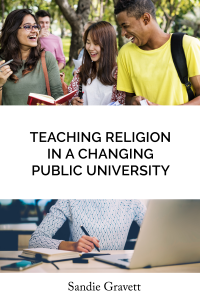
Teaching Religion in a Changing Public University reviews the teaching of religious studies in public universities, with exploration of the challenges and opportunities for the future. Dr. Gravett assesses the current status of the field within the challenges facing universities in general and humanities in particular as we move into the twenty-first century. She notes that:
“Revolutionary changes in the higher education landscape call for sustained reflection on impact of these items on the structures in which academic work in religious studies happens and the conditions of faculty life. The advent of new educational technologies, the needs of more diverse student bodies, and alterations in the relationships between universities and communities also raise questions about how religious studies scholars and the programs they provide will evolve.”
From this understanding, she provides a succinct and insightful analysis of the types of courses taught in religious studies programs and how these fare (or not) in new modalities impacted by technological change and digital learning.
Dr. Gravett’s discussion of the challenges of an increasingly multicultural environment, with its religious pluralism, and the possible roles of religious studies scholars and programs, orient the reader toward present complexities and the potential of religious studies to not only survive but add increasing impact in the future. (From the Publisher)
“Revolutionary changes in the higher education landscape call for sustained reflection on impact of these items on the structures in which academic work in religious studies happens and the conditions of faculty life. The advent of new educational technologies, the needs of more diverse student bodies, and alterations in the relationships between universities and communities also raise questions about how religious studies scholars and the programs they provide will evolve.”
From this understanding, she provides a succinct and insightful analysis of the types of courses taught in religious studies programs and how these fare (or not) in new modalities impacted by technological change and digital learning.
Dr. Gravett’s discussion of the challenges of an increasingly multicultural environment, with its religious pluralism, and the possible roles of religious studies scholars and programs, orient the reader toward present complexities and the potential of religious studies to not only survive but add increasing impact in the future. (From the Publisher)