Home » Resources » Scholarship on Teaching » Disability in Higher Education: A Social Justice Approach
Scholarship
April 15, 2019
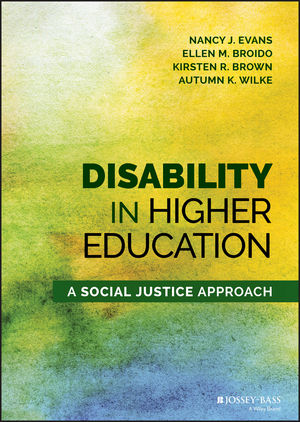
Disability in Higher Education: A Social Justice Approach
- Author
- Evans, Nancy J.; Broido, Ellen M.; Brown, Kirsten R.; Wilke, Autumn K.
- Publisher
- Wiley
- ISBN
- 9781118018224
- Table of Contents
-
List of Tables and Figures
Acknowledgments
Preface
About the Authors
Introduction: A Social Justice Foundation
Part One: Foundational Concepts
Ch 1. A History of Disability in Higher Education
Ch 2. Disability Models
Ch 3. Disability, Law, and Education in the United States
Ch 4. Dimensions of Impairment and Disability
Part Two: Population-Specific Experiences
Ch 5. Disability Identity Development and Multiple Aspects of Identity
Ch 6. Student Populations
Ch 7. Faculty and Staff with Disabilities
Part Three: Environmental Issues
Ch 8. The Campus Environment
Ch 9. The Campus Climate
Ch 10. Universal Design
Ch 11. Assistive and Learning Technology
Ch 12. Classroom Instructional Interventions
Part Four: Serving Students
Ch 13. Disability Resource Offices
Ch 14. Student Affairs
Ch 15. Transitions and Student Affairs
Conclusion: A Social Justice Approach to Disability in Higher Education: Strategies for Inclusion
Index
ABOUT
Disability in Higher Education: A Social Justice Approach examines how disability is conceptualized in higher education and ways in which students, faculty, and staff with disabilities are viewed and served on college campuses. Drawing on multiple theoretical frameworks, research, and experience creating inclusive campuses, this text offers a new framework for understanding disability using a social justice lens. Many institutions focus solely on legal access and accommodation, enabling a system of exclusion and oppression. However, using principles of universal design, social justice, and other inclusive practices, campus environments can be transformed into more inclusive and equitable settings for all constituents.
The authors consider the experiences of students, faculty, and staff with disabilities and offer strategies for addressing ableism within a variety of settings, including classrooms, residence halls, admissions and orientation, student organizations, career development, and counseling. They also expand traditional student affairs understandings of disability issues by including chapters on technology, law, theory, and disability services. Using social justice principles, the discussion spans the entire college experience of individuals with disabilities, and avoids any single-issue focus such as physical accessibility or classroom accommodations. (From the Publisher)
The authors consider the experiences of students, faculty, and staff with disabilities and offer strategies for addressing ableism within a variety of settings, including classrooms, residence halls, admissions and orientation, student organizations, career development, and counseling. They also expand traditional student affairs understandings of disability issues by including chapters on technology, law, theory, and disability services. Using social justice principles, the discussion spans the entire college experience of individuals with disabilities, and avoids any single-issue focus such as physical accessibility or classroom accommodations. (From the Publisher)