Scholarship on Teaching
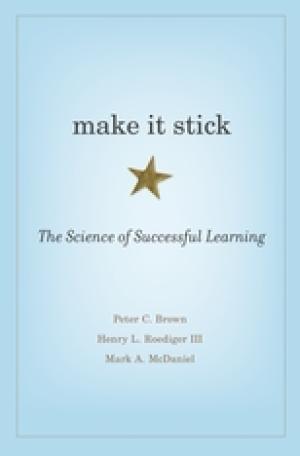
To most of us, learning something “the hard way” implies wasted time and effort. Good teaching, we believe, should be creatively tailored to the different learning styles of students and should use strategies that make learning easier. Make It Stick turns fashionable ideas like these on their head. Drawing on recent discoveries in cognitive psychology and other disciplines, the authors offer concrete techniques for becoming more productive learners. Memory plays a central role in our ability to carry out complex cognitive tasks, such as applying knowledge to problems never before encountered and drawing inferences from facts already known. New insights into how memory is encoded consolidated, and later retrieved have led to a better understanding of how we learn. Grappling with the impediments that make learning challenging leads both to more complex mastery and better retention of what was learned. Many common study habits and practice routines turn out to be counterproductive. Underlining and highlighting, rereading, cramming, and single-minded repetition of new skills create the illusion of mastery, but gains fade quickly. More complex and durable learning come from self-testing, introducing certain difficulties in practice, waiting to re-study new material until a little forgetting has set in, and interleaving the practice of one skill or topic with another. Speaking most urgently to students, teachers, trainers, and athletes, Make It Stick will appeal to all those interested in the challenge of lifelong learning and self-improvement. (From the Publisher)
This Forum explores what the Association of Theological Schools (ATS) has been learning about formation in online contexts through the Educational Models and Practices project. Deborah Gin's opening essay briefly enumerates operating assumptions, several widespread misconceptions, and emerging recommended practices. G. Brooke Lester proposes a definition of formation as transformation towards community, which is grounded in constructivist learning theory. He then reflects on the possibilities for this kind of community through online learning environments. Barbara Blodgett's contribution draws on “transactional distance theory” to analyze how a variety of pedagogical techniques (both online and face to face) can work to either exacerbate or minimize the distance between learners, which is an important contributor to formation and community. The Forum originated as panel presentations at the November 2017 Society of Biblical Literature and American Academy of Religion conferences.
This Forum explores what the Association of Theological Schools (ATS) has been learning about formation in online contexts through the Educational Models and Practices project. Deborah Gin's opening essay briefly enumerates operating assumptions, several widespread misconceptions, and emerging recommended practices. G. Brooke Lester proposes a definition of formation as transformation towards community, which is grounded in constructivist learning theory. He then reflects on the possibilities for this kind of community through online learning environments. Barbara Blodgett's contribution draws on “transactional distance theory” to analyze how a variety of pedagogical techniques (both online and face to face) can work to either exacerbate or minimize the distance between learners, which is an important contributor to formation and community. The Forum originated as panel presentations at the November 2017 Society of Biblical Literature and American Academy of Religion conferences.
One-page Teaching Tactic with information on how to get more out of in class quizzes.
One-page Teaching Tactic that addresses how to help students become better readers.
One-page Teaching Tactic in which students share their social location, to build community and set the stage for tough conversations about race, gender and privilege.
One-page Teaching Tactic that offers a stragety for improving students' participation in classroom discussions.
This article is for those educators who want to become more intentional in their craft of teaching. The authors introduce eight different pedagogies through their historical lineage, intending for readers to gain an appreciation for, and understanding of, the broader trajectory of educational philosophies, and illustrate how common teaching techniques can be shaped by the pedagogies. By familiarizing themselves with a specific educational philosophy or philosophies, educators begin to identify and name the ways they teach, how students best learn, what counts as knowledge, and the desired outcomes. In doing so, educators increase their opportunities to provide more meaningful and impactful education. This article also includes quick‚Äêreference guides to the pedagogies for readers to return to frequently.
This paper claims that programs in prisons are challenging the very who, where, how, and what of theological education. The author draws on research from the fields of pedagogy and prison studies, nearly a decade of experience teaching master's level seminary‚Äêstyle classes in prison, and the findings of a two‚Äêyear cohort of prison educators convened by the Association of Theological Schools for their Educational Models and Practices Project. Addressing displacement as a learning strategy, classroom diversity, the use of student experience, narrative grading strategies, and classroom ritual, the author shows how the teaching strategies emerging from prison classrooms provide vibrant models for the theological academy at large.
This article presents a pedagogical approach to training seminarians for faith leadership in the era of what Heidi Campbell has called “networked religion.” It argues that the increasing digital mediation of religious practice, expression, and community represents an opportunity for students to explore and inhabit ministry sites and roles from “within” the seminary classroom. Using education scholars' discussions of new digital geographies, gaming scholars' conception of game space, and reflection on classroom‐tested “quick challenges,” the author presents pedagogical principles for designing authentic new media learning experiences. Such activities bridge teaching spaces and ministry spaces to promote active learning through observation and immersion, simulation and role‐playing.