Home » Resources » Scholarship on Teaching » High-Impact Practices in Online Education: Research and Best Practices
Scholarship
April 24, 2019
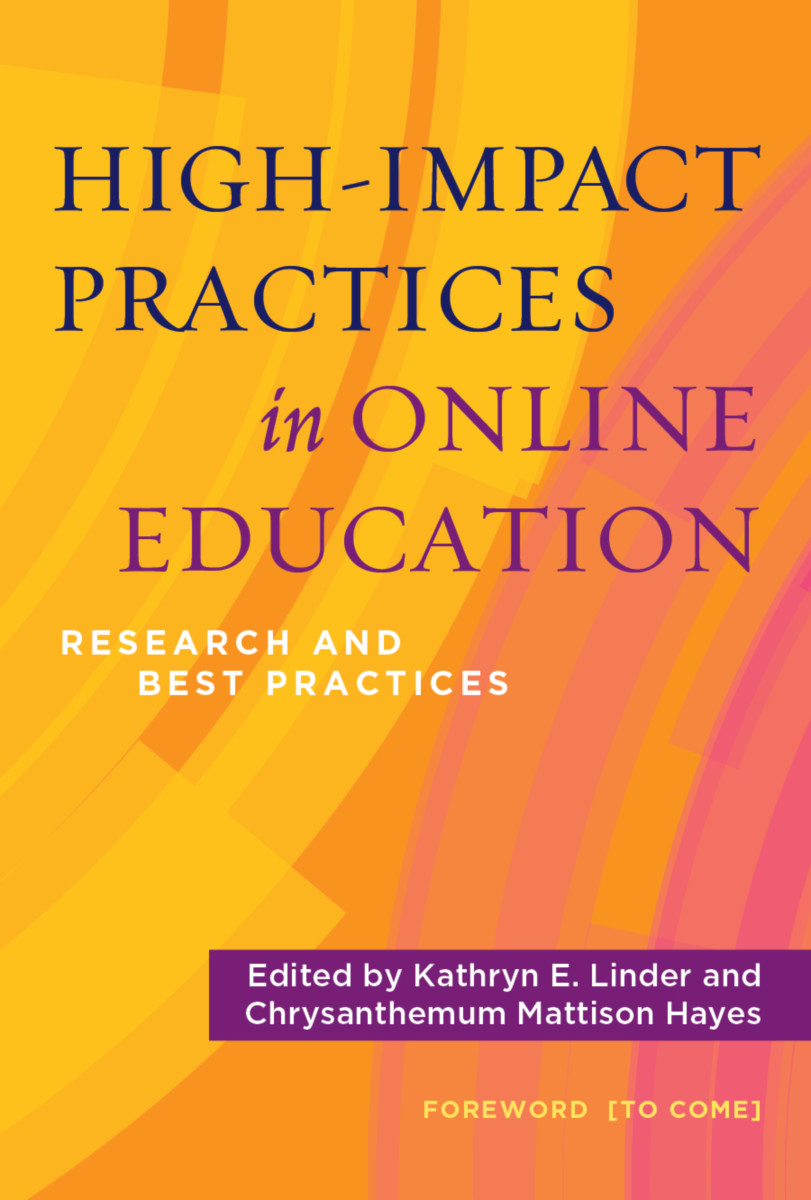
High-Impact Practices in Online Education: Research and Best Practices
- Author
- Linder, Kathryn E.; Mattison Hayes, Chrysanthemum, eds.
- Publisher
- Stylus Publishing, Llc.
- ISBN
- 9781620368473
- Table of Contents
-
Tables and Figures
Foreword (Kelvin Thompson)
Acknowledgments
Introduction (Kathryn E. Linder , Chrysanthemum Mattison Hayes)
Ch 1. First-Year Seminars (Jennifer R. Keup)
Ch 2. Common Intellectual Experience (Jason D. Baker, Michael Pregitzer
Ch 3. Learning Communities (Kathy E. Johnson, Amy A. Powell, Sarah S. Baker)
Ch 4. Writing-Intensive Classes (June Griffin)
Ch 5. Collaborative Assignments and Projects (Robert John Robertson, Shannon Riggs)
Ch 6. Undergraduate Research in the Humanities (Ellen Holmes Pearson, Jeffrey W. McClurken)
Ch 7. Undergraduate Research in the Sciences (Kevin F. Downing, Jennifer K. Holtz)
Ch 8. Diversity and Global Learning (Jesse Nelson, Nelson Soto)
Ch 9. eService-Learning (Jean Strait, Katherine Nordyke)
Ch 10. Internships (Pamela D. Pike)
Ch 11. Capstone Courses and Projects (Zapoura Newton-Calvert, Deborah Smith Arthur)
Ch 12. ePortfolios (Jennifer Sparrow, Judit Török)
Ch 13. High-Impact Practices and Library and Information Resources (Stefanie Buck)
Conclusion: Future Directions for High-Impact Practices Online
(Kathryn E. Linder, Chrysanthemum Mattison Hayes)
Editors and Contributors
Index
Click Here for Book Review
This is a valuable collection of well-researched essays focused on the use of high-impact practices in online education. Readers will find both theory and best practices that can strengthen distance, blended, or face-to-face courses. - Gary Eller, University of Nebraska - Omaha
This volume offers the first comprehensive guide to how high-impact practices (HIPs) are being implemented in online environments and how they can be adjusted to meet the needs of online learners. This multi-disciplinary approach will assist faculty and administrators to effectively implement HIPs in distance education courses and online programs.
With a chapter devoted to each of the eleven HIPs, this collection offers guidance that takes into account the differences between e-learners and traditional on-campus students.
A primary goal of High-Impact Practices Online is to share the ways in which HIPs may need to be amended to meet the needs of online learners. Through specific examples and practical suggestions in each chapter, readers are introduced to concrete strategies for transitioning HIPs to the online environment that can be utilized across a range of disciplines and institution types. Each chapter of High-Impact Practices Online also references the most recent and relevant literature on each HIP so that readers are brought up to date on what makes online HIPs successful.
The book provides guidance on how best to implement HIPs to increase retention and completion for online learners. (From the Publisher)
This is a valuable collection of well-researched essays focused on the use of high-impact practices in online education. Readers will find both theory and best practices that can strengthen distance, blended, or face-to-face courses. - Gary Eller, University of Nebraska - Omaha
This volume offers the first comprehensive guide to how high-impact practices (HIPs) are being implemented in online environments and how they can be adjusted to meet the needs of online learners. This multi-disciplinary approach will assist faculty and administrators to effectively implement HIPs in distance education courses and online programs.
With a chapter devoted to each of the eleven HIPs, this collection offers guidance that takes into account the differences between e-learners and traditional on-campus students.
A primary goal of High-Impact Practices Online is to share the ways in which HIPs may need to be amended to meet the needs of online learners. Through specific examples and practical suggestions in each chapter, readers are introduced to concrete strategies for transitioning HIPs to the online environment that can be utilized across a range of disciplines and institution types. Each chapter of High-Impact Practices Online also references the most recent and relevant literature on each HIP so that readers are brought up to date on what makes online HIPs successful.
The book provides guidance on how best to implement HIPs to increase retention and completion for online learners. (From the Publisher)