Resources
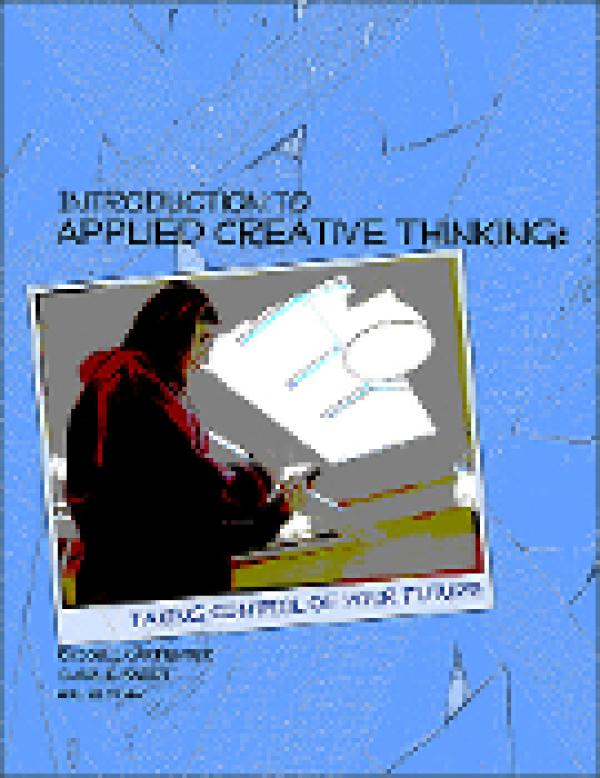
Click Here for Book Review Abstract: Here is a new text that fulfills an emerging need in both higher and public education and stands to break new ground in addressing critical skills required of graduates. When working on their last book, It Works for Me, Creatively, the authors realized that the future belongs to the right-brained. While Daniel Pink and other visionaries may have oversimplified a bit, higher education is ripe for the creative campus, while secondary education is desperately seeking a complement to the growing assessment/teach-to-the-test mentality. You don’t have to study the 2010 IBM survey of prominent American CEOs to know that the number one skill business wants is students who can think creatively. To meet the demand of new courses, programs, and curricula, the authors have developed a 200-page “textbook” suitable for secondary or higher education courses that are jumping on this bandwagon. Introduction to Applied Creative Thinking, as the title suggests, focuses not on just developing the skills necessary for creative thinking, but on having students apply those skills; after all, true creative thinking demands making something that is both novel and useful. Such a book may also be used successfully by professional developers in business and education. For this book, Hal Blythe and Charlie Sweet are joined in authorship by Rusty Carpenter. He not only directs Eastern Kentucky University’s Noel Studio for Academic Creativity but has co-edited a book on that subject, Higher Education, Emerging Technologies, and Community Partnerships (2011) and the forthcoming Cases on Higher Education Spaces (2012). Introduction to Applied Creative Thinking is student-friendly. Every chapter is laced with exercises, assignments, summaries, and generative spaces. Order copies now or contact the publisher for further information. (From the Publisher)
When Cathy Davidson and Duke University gave free iPods to the freshman class in 2003, critics said they were wasting their money. Yet when students in practically every discipline invented academic uses for their music players, suddenly the idea could be seen in a new light-as an innovative way to turn learning on its head. This radical experiment is at the heart of Davidson's inspiring new book. Using cutting-edge research on the brain, she shows how "attention blindness" has produced one of our society's greatest challenges: while we've all acknowledged the great changes of the digital age, most of us still toil in schools and workplaces designed for the last century. Davidson introduces us to visionaries whose groundbreaking ideas-from schools with curriculums built around video games to companies that train workers using virtual environments-will open the doors to new ways of working and learning. A lively hybrid of Thomas Friedman and Norman Doidge, Now You See It is a refreshingly optimistic argument for a bold embrace of our connected, collaborative future. (From the Publisher)
The Common Core State Standards clearly define the skills students need for success in college and the 21st century workplace. The question is, how can you measure student mastery of skills like creativity, problem solving, and use of technology? Laura Greenstein demonstrates how teachers can teach and assess 21st century skills using authentic learning experiences and rigorous, varied assessment strategies. Based on the best ideas of renowned experts in education, this book provides a framework and practical ideas for measuring • Thinking skills: critical thinking, problem solving, creativity, and metacognition • Actions: communication, collaboration, digital and technological literacy • Living skills: citizenship, global understanding, leadership, college and career readiness Included are numerous rubrics and checklists, a step-by-step model for developing your own classroom assessments, a lesson planning template, and sample completed lesson plans. Assessing 21st Century Skills gives you the tools and strategies you need to prepare students to succeed in a rapidly changing world. (From the Publisher)
Critical thinking is becoming increasingly prominent as an academic discipline taught and examined in schools and universities, as well as a crucial skill for everyday life. To be a successful critical thinker it is vital to understand how the different concepts and terms are defined and used. The terminology often presents a stumbling block for the beginner, since much of it is used imprecisely in everyday language. This definitive A to Z guide provides precise definitions for over 130 terms and concepts used in critical thinking. Each entry presents a short definition followed by a more detailed explanation and authoritative clarification. Armed with the tools and knowledge provided in these pages, the reader will be able to distinguish an assertion from an argument, a flaw from a fallacy, a correlation from a cause and a fact from an opinion. The book is an invaluable resource for teachers and students of critical thinking, providing all the tools necessary to effectively analyse, evaluate, question and reason for yourself. (From the Publisher)
A 1000 word essay in response to a Call for Papers on the wider context of your course.
One page Teaching Tactic: a free write exercise helps students reflect on and articulate their values.
This book explores the wide range of contexts in which research into creating connections in learning and teaching may take place. Creating connections can encompass making links, crossing divides, forming relationships, building frameworks, and generating new knowledge. The cognitive, cultural, social, emotional and/or physical aspects of understanding, meaning-making, motivating, acting, researching, and evaluating are explored as constituent forms of creativity in relation to such connections. From this exploration the authors identify varied connective contexts and means which include the learner, the educator, the organisation, and the relevant community. The crossing of divides, forming learner-educator relationships, bringing together diverse groups of learners, establishing networks and partnerships among educators, and establishing links between organisations and communities are all considered as connections which can be created by and within the learning and teaching dynamic. By examining the factors which help to facilitate and/or restrict the possibilities for creating connections in educational contexts, implications for and outcomes of learning and/or teaching arise from the connections created. The final chapter of this book will explicate the realisations that have emerged for educators and researchers working to create connections. These offer suggestions for future directions and enunciate what and how connections might contribute to both educational institutions and the broader society. (From the Publisher)
One page Teaching Tactic: students increase comprehension of reading by learning to analyze the structure of a text.
From the Publisher Understanding college students' intellectual development is at the heart of effective educational practice. How do college students learn? How can educators maximize intellectual development in the college environment for both sexes—both in and out of the classroom? In this book Marcia B. Baxter Magolda demonstrates how educators can use a deeper understanding of the way students learn to teach more effectively. Drawing on a unique longitudinal study of more than one hundred college students, both male and female—and presenting information not available in single-gender studies—the author explains surprising gender-related patterns that affect the way students develop. Baxter Magolda uses data gathered from in-depth interviews over a five-year period to reveal four distinct "ways of knowing." The book provides useful real-life examples of how instructional approaches, class expectations, peer interaction, evaluation methods, and other factors affect intellectual development in the classroom. Similarly, the author demonstrates how peer relationships, student organizations, educational advising, internships, employment, and international and cultural exchange can support and develop complex learning beyond the classroom. "Knowing and Reasoning in College" provides practical recommendations on how to respond to each of the four ways of knowing. It shows how, by designing instruction and interaction to reach students at every level, educators can maximize learning, promote skill acquisition and development of complex reasoning, and enrich students' overall college experience. (PsycINFO Database Record (c) 2012 APA, all rights reserved)
Synthesizing the best current thinking about learning, course design, and promoting student achievement, this is a guide to developing college instruction that has clear purpose, is well integrated into the curriculum, and improves student learning in predictable and measurable ways. The process involves developing a transparent course blueprint, focused on a limited number of key concepts and ideas, related tasks, and corresponding performance criteria; as well as on frequent practice opportunities, and early identification of potential learning barriers. Idea-based Learning takes as its point of departure the big conceptual ideas of a discipline that give structure and unity to a course and even to the curriculum, as opposed to a focus on content that can lead to teaching sequences of loosely-related topics; and aligns with notions of student-centered and outcomes-based learning environments. Adopting a backwards design model, it begins with three parallel processes: first, identifying the material that is crucial for conceptual understanding; second, articulating a clear rationale for how to choose learning outcomes based on student needs and intellectual readiness; and finally, aligning the learning outcomes with the instructional requirements of the authentic performance tasks. The resulting syllabi ensure cohesion between sections of the same course as well as between courses within a whole curriculum, assuring the progressive development of students’ skills and knowledge. Key elements of IBL include: * Helping students see the big picture * Building courses around one or more authentic performance tasks that illuminate the core concepts of the discipline * Clearly identifying performance criteria for all tasks * Incorporating practice in the competencies that are deemed important for students’ success * By placing the onus of learning on the student, liberating faculty to take on the role of learning coaches * Designing tasks that help students unlearn simplistic ideas and replace them with improved understandings Edmund Hansen expertly guides the reader through the steps of the process, providing examples along the way, and concluding with a sample course design document and syllabus that illustrate the principles he propounds. (From the Publisher)