Resources
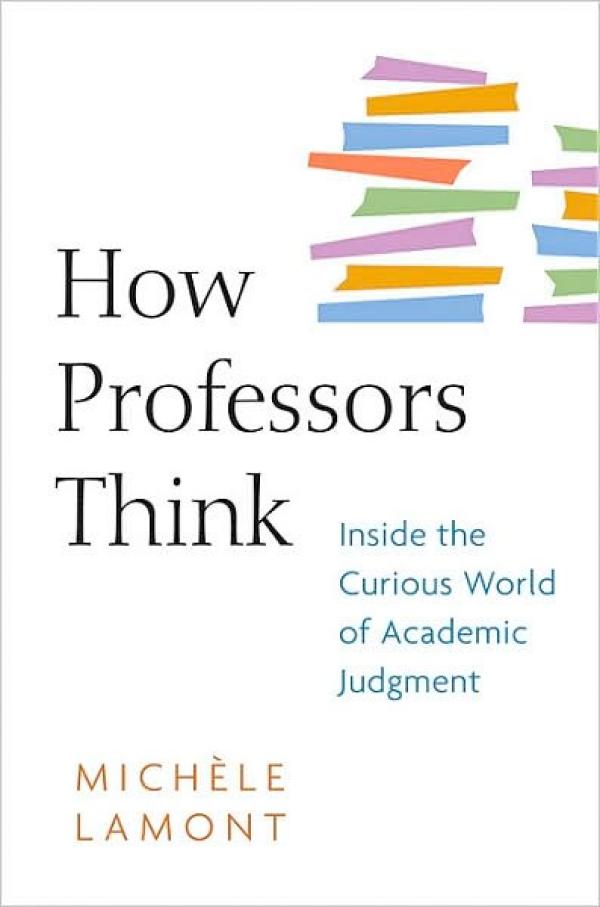
Excellence. Originality. Intelligence. Everyone in academia stresses quality. But what exactly is it, and how do professors identify it? In the academic evaluation system known as “peer review,” highly respected professors pass judgment, usually confidentially, on the work of others. But only those present in the deliberative chambers know exactly what is said. Michèle Lamont observed deliberations for fellowships and research grants, and interviewed panel members at length. In How Professors Think, she reveals what she discovered about this secretive, powerful, peculiar world. Anthropologists, political scientists, literary scholars, economists, historians, and philosophers don’t share the same standards. Economists prefer mathematical models, historians favor different kinds of evidence, and philosophers don’t care much if only other philosophers understand them. But when they come together for peer assessment, academics are expected to explain their criteria, respect each other’s expertise, and guard against admiring only work that resembles their own. They must decide: Is the research original and important? Brave, or glib? Timely, or merely trendy? Pro-diversity or interdisciplinary enough? Judging quality isn’t robotically rational; it’s emotional, cognitive, and social, too. Yet most academics’ self-respect is rooted in their ability to analyze complexity and recognize quality, in order to come to the fairest decisions about that elusive god, “excellence.” In How Professors Think, Lamont aims to illuminate the confidential process of evaluation and to push thegatekeepers to both better understand and perform their role. (From the Publisher)
Offering insights into the effective use of writing to teach students to think like professionals in various fields, this book is the result of a 7-year naturalistic study. The book documents how a writing specialist paired with an experienced professor in another discipline (business, history, psychology, and biology) to study: (1) teachers' expectations about "good" writing and thinking in each discipline; (2) the kinds of difficulties students encountered in trying to meet those expectations; and (3) how teachers' methods and students' strategies helped or hindered progress. Chapters in the book are: "Preview of the Book" (Barbara E. Walvoord and Lucille Parkinson McCarthy); "Research Theory and Methods" (Lucille Parkinson McCarthy and Barbara E. Walvoord); "Managerial Decision Making: Sherman's Business Course" (Barbara E. Walvoord and A. Kimbrough Sherman); "Arguing and Debating: Breihan's History Course" (Barbara E. Walvoord and John R. Breihan); "Using Social Science to Help Oneself and Others: Robison's Human Sexuality Course" (Barbara E. Walvoord and Susan Miller Robison); "Conducting and Reporting Original Scientific Research: Anderson's Biology Class" (Virginia Johnson Anderson and Barbara E. Walvoord); and "Conclusion" (From the Publisher)
This essay argues that teachers would be more effective at promoting students' willingness to work hard at course content that seems to them remote and abstract if teachers explicitly presented that content to students more as a means to their education rather than as the aim of their education. Teachers should confront the fact that most of the content they teach will be forgotten by students. Once this fact is accepted, then it follows that teaching content that teachers know will be forgotten as if it should never be forgotten is myopic and perhaps dysfunctional. An alternative teaching model is to use course content to stimulate the flourishing of developmental human skills--rationality, language, aesthetic responsiveness, imagination, introspection, moral and ethical deliberation, sociability, and physicality--in the service of a developmental notion of liberal education that can never go out of date and can never be forgotten because its effects become absorbed as developmentally advanced orientations of life, not crammed into short-term memory for the sake of passing tests.
This article draws six key lessons from cognitive science for teachers of critical thinking. The lessons are: acquiring expertise in critical thinking is hard; practice in critical thinking skills themselves enhances skills; the transfer of skills must be practiced; some theoretical knowledge is required; diagramming arguments ("argument mapping") promotes skill; and students are prone to belief preservation. The article provides some guidelines for teaching practice in light of these lessons.
Analysis of interview and classroom observation data collected through four institutional case studies reveals some consistent findings regarding how writing assignments and class discussions can be made conducive to critical thinking development.
This essay explores how one might use the "problem" of the hardening of Pharaoh's heart as a learning opportunity in the classroom. The author identifies two pedagogical aims: (1) cultivating more sophisticated, critical readers of the Bible; and (2) helping students reflect on the contextual nature of interpretation. The essay discusses in some detail various ways of teaching the text, including an exercise in close reading, examination of sources, and a selective study of the history of interpretation. It also explores various lessons to be learned from these exercises, and addresses applicability of the approaches to other teaching contexts. An earlier version of this paper was prepared for the "Problem Texts" group of the consultation "Teaching the Bible in the 21st Century," held at the Wabash Center in Crawfordsville, Indiana.
How does one teach critical thinking, the procedures of an academic discipline, and the composition of plausible interpretations and arguments to students who are more facile with visual than with written modes of expression? How does one make real to students the construction of meaning in that unfamiliar epistemological space between brute fact and mere opinion? The "argument poster," a pedagogical strategy that helps students translate their skills for critical thinking from a visual frame to a written frame, results in better quality historical essays and research papers.
The Bible is a non-western text subject to a variety of interpretations and applications – constructive and destructive. The academic study of the Bible, therefore, requires critical thinking skills and the ability to engage with diversity. The reality is that most first-year college students have not yet developed these skills. Rather than bemoan students' lack of development, the essay explores ways of teaching and applying critical thinking within the context of an introductory Religion course. The essay claims that first-year college students can better learn the content of the discipline and function in a pluralistic world if the teaching of critical thinking skills is a part of the pedagogy.
Engaging students in a course in the Sociology of Religion can be a challenge, particularly when working with student populations in a homogeneous region of the country who have limited experience with religious diversity. We approached the course from a sociological/anthropological perspective, requiring each student to complete an in-depth participation/observation research experience and write an ethnographic account of a religion or belief system different from his or her own. While other instructors have used a similar pedagogy, using ethnography with our student population was generally successful as a learning and writing tool.
This short, inexpensive guide is designed to help readers learn to think critically about any subject-matter. A combination of instruction and exercises shows how to use critical thinking to more fully to appreciate what they read, to see the connections of what they read to their day-to-day lives, and to become active readers rather than passive recipients of information. Using a fresh, lively approach, this book covers the definition of critical thinking; critical thinking within fields of study such as philosophy, biology, and sociology; the elements of reasoning; standards of critical thinking; and thinking through important critical-thinking questions. An excellent guide for those who want to improve their learning skills. (From the Publisher)