Resources

What might a school that wholeheartedly values thinking look like? How can we encourage students to be active learners instead of passive recipients of knowledge? In this engaging book, Boostrom invites readers to think about the ways in which the practice of teaching unintentionally promotes nonthinking. (From the Publisher)
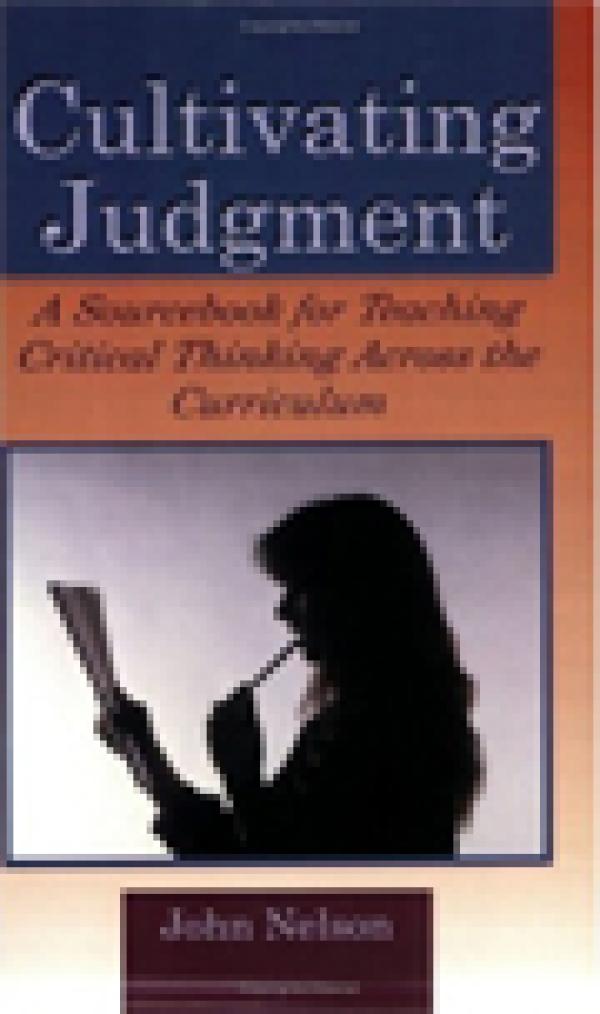
This fine sourcebook provides college and university teachers, across the curriculum, with specific classroom-tested activities and assignments to stimulate and develop student critical thinking. The book consists of fifty modules, each containing: * A description of a critical thinking assignment, * An explanation of the assignment's purposes and benefits, * A discussion of ways to use or modify the assignment in the classroom, and * Suggested related activities, including relevant bibliographical sources. Most modules were developed by the author; in other cases, the author shaped, refined, and expanded on material that has been developed and used by colleagues. Some modules are discipline-specific, some are suitable for a number of disciplines; and many can easily be modified for use in a wide variety of fields. The assignments vary in scope, difficulty and complexity. Some are deigned for introductory freshman courses, while others have been used in graduate courses but could be adapted for lower level courses. Each module stands alone, but the modules are loosely grouped into five sections: (1) Problems and Puzzles (2) Analyses and Critiques (3) Opinions, Decisions, Values (4) Projects, Experiments, Adventures (5) Student as Teacher, Teacher as Student. The sourcebook also includes an introductory chapter on the nature and importance of critical thinking, a cross-referencing of all activities by discipline, and a wide-ranging bibliography. Cultivating Judgment has been extensively tested in college classrooms, then revised, expanded and significantly improved. The author has conducted extensive research on the teaching of thinking skills, and discovered that discovered that no existing source filled the need for a book that spells out and demonstrates how to teach critical thinking in virtually any discipline, from liberal arts to more specialized career programs. You will find Cultivating Judgment to be an engaging book, and one that combines intellectual rigor with a playful, creative spirit – and, one that can be used as a textbook in a general course on critical thinking, or as a resource for teachers across the curriculum! (From the Publisher)
Recommends theoretically grounded and empirically supported strategies to improve the development and assessment of students’ thinking skills – with bibliography. Idea Paper no. 37, from the series developed by the Center for Faculty Evaluation and Development, Kansas State University.
The quality of our lives is determined by the quality of our thinking. The quality of our thinking, in turn, is determined by the quality of our questions, for questions are the engine, the driving force behind thinking. Without questions, we have nothing to think about. Without essential questions, we often fail to focus our thinking on the significant and substantive. When we ask essential questions, we deal with what is necessary, relevant, and indispensable to a matter at hand. We recognize what is at the heart of the matter. Our thinking is grounded and disciplined. We are ready to learn. We are intellectually able to find our way about. To be successful in life, one needs to ask essential questions: essential questions when reading, writing, and speaking; when shopping, working, and parenting; when forming friendships, choosing life-partners, and interacting with the mass media and the Internet. Yet few people are masters of the art of asking essential questions. Most have never thought about why some questions are crucial and others peripheral. Essential questions are rarely studied in school. They are rarely modeled at home. Most people question according to their psychological associations. Their questions are haphazard and scattered. The ideas we provide are useful only to the extent that they are employed daily to ask essential questions. Practice in asking essential questions eventually leads to the habit of asking essential questions. But we can never practice asking essential questions if we have no conception of them. This mini-guide is a starting place for understanding concepts that, when applied, lead to essential questions. We introduce essential questions as indispensable intellectual tools. We focus on principles essential to formulating, analyzing, assessing, and settling primary questions. You will notice that our categories of question types are not exclusive. There is a great deal of overlap. (From the Publisher)
Learning to think in a discipline is a demanding scholarly task that is not often associated with the development of university students. Although the intellectual development of postsecondary students is gaining increased attention, relating student development to the process of inquiry in different disciplines is unexplored terrain. This book attempts to come to a deeper understanding of thinking processes by exploring the approaches to thinking taken in different disciplines and then considering how these could be applied to student intellectual development. Drawing on more than twenty-five years of research, Janet Donald shows how knowledge is structured and how professors and students perceive learning in their fields-and offers strategies for constructing and using knowledge that will help postsecondary institutions to promote students' intellectual development within and across the disciplines. The author first creates a framework for understanding student intellectual development and for learning to think in different disciplines. In succeeding chapters, she describes the principal methods of inquiry in each discipline and their effects on learning to think, examining what this means for students and how we might use it to improve the instructional process. For faculty members, this book provides insight into the representation and development of curricula, courses, and programs to improve teaching and learning processes. Professors of education may find a specific use for the comparisons across disciplines in planning courses on teaching methods, as an aid in providing students with insight into how disciplines or fields of study are constructed, and in refining their own conceptual framework in their field. Administrators, particularly of programs and departments, will find suggestions for policy initiatives that are needed to create a supportive learning environment and for organizing teaching and learning. (From the Publisher)
There appears to be a significant gap between faculty expectations for incoming college students and these same students perceptions of their abilities. Incoming college students are not very confident of their critical thinking abilities, yet faculty expect students to enter college already being able to critically evaluate information and to reach conclusions based on a critical analysis of the data. The current study challenges the preconception that critical thinking cannot be taught and delineates a model for critical thinking that can be employed regardless of one’s discipline. Outcome data strongly suggests critical thinking can lead to both proximal and distal increases in student success.
The contributors to Education for Judgement maintain that the elements of great teaching can be identified and consciously practiced. Many of the essays describe the building blocks of successful group leadership: negotiating a "contract" governing the conduct of the group; orchestrating a constructive process of questioning,listening,and responding; encouraging independent thinking; and guiding participants toward useful roles in their interaction with one another. The other chapters in the volume take a broader,more philosophical view of discussion leadership. They cover the ethical considerations of discussion teaching,the special challenges of teaching technical material using this method,and one pioneering effort ot introduce a participative mode of medical education. First-person accounts of discussion leaders' experiences provide useful insights into the joys and pitfalls of teaching by the discussion method. (From the Publisher)
(Text not available on web.) This paper focuses on methods to improve the reading abilities of college students. A list of five elements college instructors (who are not reading specialists) should establish in a content reading agenda is offered; (1) an instructional basis for the reading process which will work for them; (2) content literacy environments; (3) insights into the skill level characteristics of readers; (4) working relationships with the campus reading program; and (5) inclusion of reading strategies in their content instruction. Stating that students must know the purpose of the course and understand what is to be done with the information provided through lectures and textbook reading assignments to successfully interact with the text, the paper offers methods of establishing the five elements suggested. Also addressed are the unique challenges of social science, mathematical, and scientific reading instruction. The paper concludes with a brief summary and suggestions for collaboration between the content specialist and the reading staff.