Resources
This interview was recorded in November 2012 in Jonathan Z. Smith's Hyde Park graystone. Professor Smith offers insights into how he thinks about his classroom teaching and his students' learning through descriptions of various assignments and classroom activities he has developed over more than forty years of teaching. The discussion ranges broadly over such topics as: how students read, the failure to adequately prepare graduate students as teachers, students' faith commitments, the use of newspapers (and humor) in the classroom, and the role of definition, de-familiarization, and critique of the study of religion in introductory classes. The discussion presents vivid glimpses into Jonathan Smith's teaching practice and his teaching persona, including the time a student brought a minister to class to do an exorcism because she thought he was the Devil.
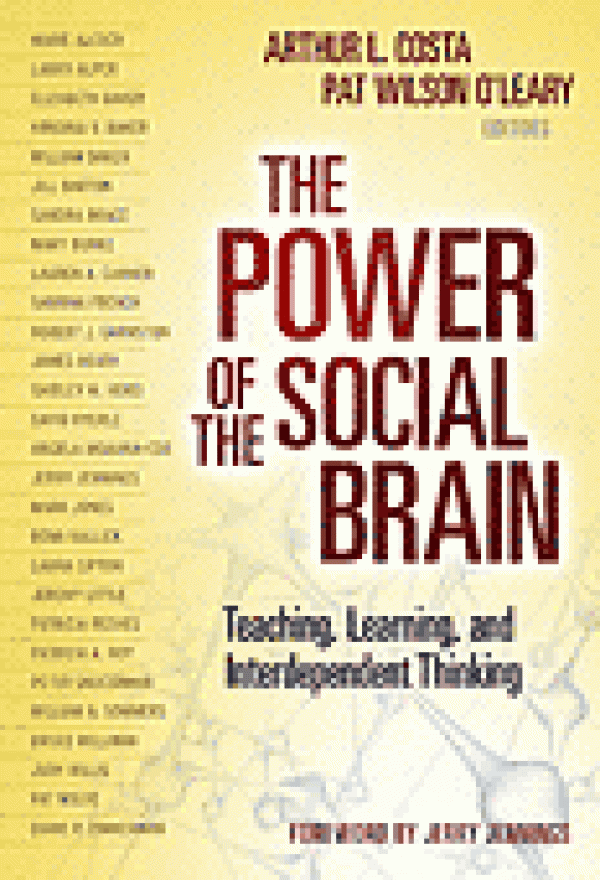
Click Here for Book Review Abstract: Research has demonstrated that cooperative learning is one of the most highly effective teaching strategies, while new findings from neuroscience confirm the brain’s natural inclination to think socially. But simply putting students in a group is not enough. The authors of The Power of the Social Brain see “interdependent thinking” as the missing piece of the collaborative puzzle. This authoritative book provides practical strategies, informed by research from neuroscience and education, to help groups function more effectively and thoughtfully. By adding the “cognitive dimension” to cooperative learning, this book will help readers apply new protocols and strategies for more successful, affirming, and productive group work in classrooms and professional educational learning communities. Book Features: Fresh parallel insights on interdependent thinking from the arts, architecture, business, the community, and sports. Approaches for leveraging cooperative learning to improve thinking, problem solving, performance, and mutual support across a wide range of settings, including classrooms, teams, and professional learning communities. Instructional strategies from experienced classroom teachers for teaching young people to think and work interdependently at home and at school. Reflective questions at the end of each section to help guide thinking, stimulate conversation, and catalyze change within a learning community or classroom. (From the Publisher)
An extensive website with multiple diagrams and links to extended presentations on the various aspects of the Bloom taxonomy of learning styles.
A unique tool designed to assess and promote the improvement of critical thinking and real-world problem solving skills. The instrument is the product of extensive development, testing, and refinement with a broad range of institutions, faculty, and students across the country. The National Science Foundation has provided support for many of these activities.
A report from the Social Science Research Council (SSRS) that extends findings reported in the 2010 book "Academically Adrift" to document practices associated with improved student performance, as well as differences across individuals and institutions in the level of learning.
A brief annotated list that succinctly articulates what we mean by “critical thinking, assembled by the Foundation for Critical Thinking.
Reviews research and explains several concrete best practices on how to motivate students. Idea Paper no. 1, from the series developed by the Center for Faculty Evaluation and Development, Kansas State University.
Recommends theoretically grounded and empirically supported strategies to improve the development and assessment of students’ thinking skills – with bibliography. Idea Paper no. 37, from the series developed by the Center for Faculty Evaluation and Development, Kansas State University.
A short article in which a teacher-scholar defines what she means by “active and meaningful learning,” discusses unstructured cooperative learning and critical thinking, and reflects on experience in using these concepts in the courses she teaches and the textbooks she writes. Idea Paper no. 34, from the series developed by the Center for Faculty Evaluation and Development, Kansas State University.
Purdue University site helping students evaluate bibliographic citations, content in a source, as well as internet sources. Links to further resources.