Resources
For students, a concise review of how to evaluate the authority, usefulness, and reliability of the information found through the process of library research. Including: books, periodical articles, multimedia titles, or Web pages – whether looking at a citation, a physical item in hand, or an electronic version on a computer. Links to lengthier discussions.
Ithica College library site, with 6 quick suggestions, 6 more criteria, and several exercises/assignments to test students’ discernment skills.
A New Mexico State University Library site, with examples, suggestions, criteria, and bibliography.
A quick scannable overview with solid advice.
For those who learn through spatial representation, the skills and activities associated with Bloom's Taxonomy are laid out here in a complex diagram (various selections found in google search).
A classic matrix for thinking through classroom learning objectives as progressively more complex tasks and expectations
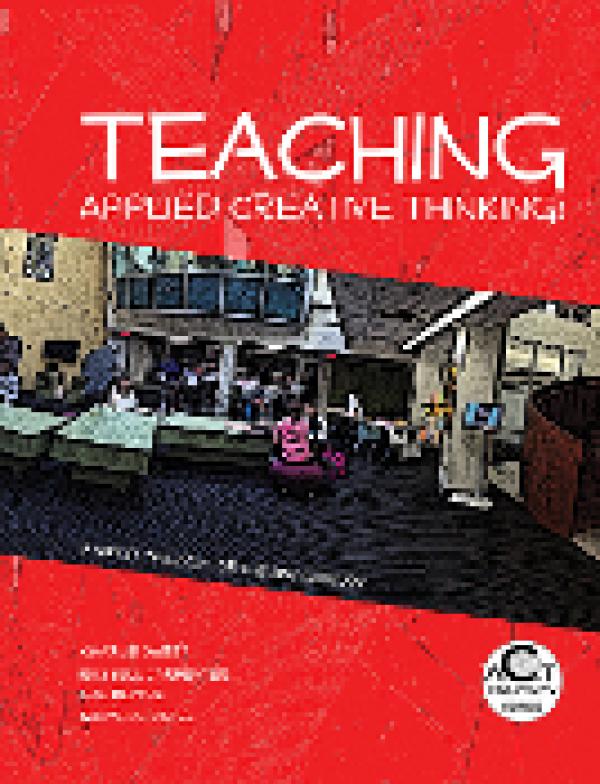
Click Here for Book Review Abstract: The authors of Teaching Applied Creative Thinking: A New Pedagogy for the 21st Century believe this book to be the first in the field about teaching creative thinking in the new millennium. While many books talk about creativity and provide the justification for adding creative thinking as a student learning outcome, this book focuses on applying creativity to the teaching and learning process. The authors ask, “does anyone truly believe the world’s problems are going to be solved by students with only a high proficiency in common core competencies?” With student learning outcomes as a goal, we must rethink teaching and learning to include creativity. Posed for the 21st-Century learner, their new paradigm, Mentor-from-the-Middle, replicates scholarly inquiry by developing a scholarly frame of mind. The teacher assumes new roles in this paradigm of scholar, mentor, facilitator, coach, model, and critical reflector. These roles in turn combine to help transform the learner into an active creative thinker. "The authors’ goals in writing this book are to fill a void, to transform teaching, to create a new model, and to develop a new approach to teaching and learning. In the old world, before the coming of Google, the transfer of knowledge was the work of the teacher; now knowledge is available at the tip of our fingers. But the Google cannot solve the world’s problems. We will always need great teachers to transform and synthesize knowledge into skills, to teach creative thinking, to apply learning, and to create a love for learning that lasts a lifetime. The authors discuss new brain research, advanced technologies, the teaching environment, and pedagogy. They synthesize this knowledge in a wonderful way to encourage the reader to think deeply about how this research might affect the teacher and the learner. (From the Publisher)
One page Teaching Tactic: students apply earlier material to assess current reading assignment.
In this article I propose a method of selecting and assigning readings in the religious studies or theology classroom, such that these readings complicate one another, rather than standing in opposition or as simple alternatives. Such a strategy emulates key pedagogical insights of twelfth-century sentence collection, an activity at the very heart of the earliest universities in Europe. It also draws support from the theories of intellectual development advanced by William G. Perry, Jr. and the Women's Ways of Knowing Collaborative. Both precedents suggest a principle of “complicating views” that can be flexibly employed in a variety of ways and diverse pedagogical contexts, as illustrated by examples from several classes. Such strategies aim to avoid reinforcing intellectual patterns of dualism or undifferentiated relativism; instead, they attempt to promote students' ability to integrate discordant voices and to appreciate diverse points of view, while also staking their own claims relative to them.