Resources
Cláudio Carvalhaes Associate Professor McCormick Theological Seminar I am delighted to be writing this blog with two other fantastic teachers I admire greatly: Lynne Westfield and Tat-siong Benny Liew. The Wabash Center has been a fantastic place that has empowered so many teachers, and has expanded resources and possibilities for
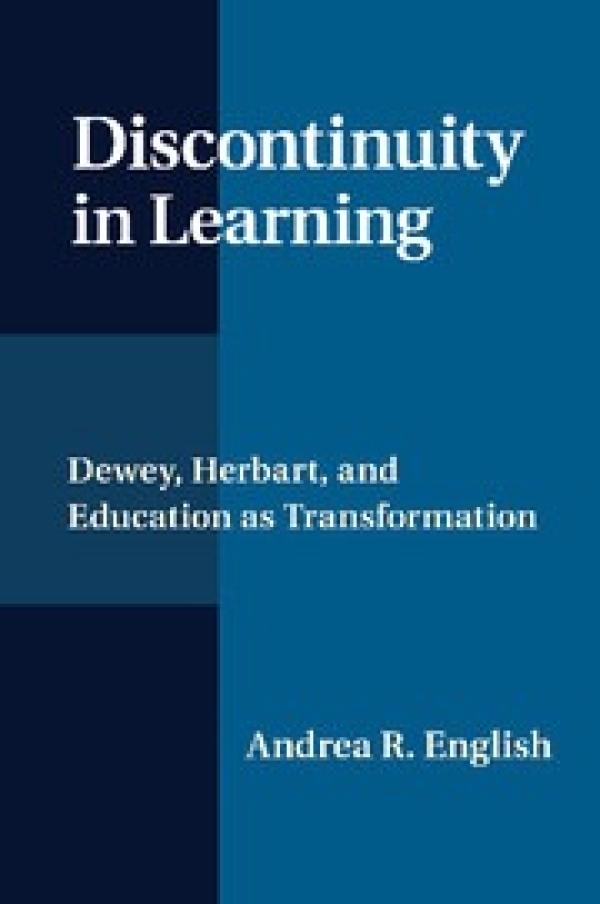
Andrea R. English’s Discontinuity in Learning re-links the work of Johann Friedrich Herbart with that of John Dewey. Dewey criticized Herbart’s work, causing, English argues, future critics to separate Dewey’s thought from its European predecessors (xx). English argues for continuity, that both thinkers want to identify and develop ways “for learners to recognize and respond to the other in judgments and actions” (104), through the experience of discontinuity. English’s excellent analysis of Herbart focuses on discontinuity, offering frameworks to analyze educational theories and practices that ignore discontinuity and reconnecting Anglo-American and Continental philosophies of education (xxiii-xxiv). I cannot do justice to this rich book here. I will focus on its main idea: education as discontinuity. English examines Herbart’s analysis of the educational possibilities in his contemporary’s (Kant’s) Categorical Imperative. To act so as not to treat others as things and as any other ethical person would act, one engages in moral choice. Herbart argues that educators can work with the experience of the discontinuous that emerges in encounter with the “other,” identifying where a learner already acts out of inner freedom (46) to move that learner to greater freedom, the capacity beyond “self-interested desires,” in recognition of and respect for the other (7). Discontinuity causes a pause (34) at the limits of one’s abilities and/or knowledge (xxii). This “in-between” (Dewey), “distance” (Herbart 16, 27), or “break” (English, 17) is a site of struggle (59) to transcend a limit. There, the learner can “identify and potentially change” her relation to the other (65). A teacher does not choose for the student, but designs an intellectual experience, to use Donald Finkel’s term, to scaffold the struggle (17), while, simultaneously, being open to improvisation on the design. Dewey agrees with Herbart: discontinuity is to “undergo or suffer the world” that upsets stable understandings (66), a starting-point for reflection (68). In learning, teacher and student struggle together in ongoing “critical self-relation.” For Dewey, the classroom is not just a site of moral struggle but of democratic action (89). Arriving at the social, as well as personal, “limits of thought and ability” (102), one learns, potentially, to choose for the good of all. Both the classroom and democratic society should support the deep learning that ensures freedom. For Dewey and Herbart, the goal of learning is right orientation to the other (105) through disorientation and reorientation, guided by the teacher who listens intently and generates dialogue, moving students to greater inner freedom and just action. The skilled teacher deploys “pedagogical tact” (50ff, 126ff.), discerning when to intervene in student learning and when to improvise (129) on the learning design. Neither teaching nor learning, therefore, can be determined as complete in outcomes and measured fully by evaluations. Nowadays we experience such “urgency” (55) about measures that we want to “predetermine” and “guarantee” learning (156). English argues, instead, for cherishing the discontinuous and valuing the improvisational space of the classroom in which teachers “acquaint the next generation” with their present world and prepare them for a “future yet to be discovered” (160).
Molly Bassett Associate Professor of Religious Studies Georgia State University It’s week nine here and this is my seventh post for the Center’s blog on teaching. We’ve reached the point where I’d like to take you out for coffee and find out how it’s going. I’d love to hear about...
Molly Bassett Associate Professor of Religious Studies Georgia State University “If I wanted to write, I would have taken an English class.” – Anonymous in my intro course Looking back I’ll admit that it was more last straw than “Aha!” In fact, I’m sure there were times when analogous thoughts...
Dr. Molly Bassett Associate Professor of Religious StudiesGeorgia State University “Timeliness is next to cleanliness and godliness; we don’t want to waste a minute. Plus, I’ve been looking forward to this moment since at least January, and it was hard to sleep a week ago.” That’s how we began..
Nancy Lynne Westfield Associate Professor of Religious Education Drew Theological School Teach students where they are! This forthright adage is deceptively difficult. The question becomes – where are they in proximity to my own location? In other words, what does it mean for the effectiveness of my teaching if the.

While this book is dedicated to students, chapters showcase the dedication of professors to providing effective learning formats in diverse fields. An Illinois Sampler: Teaching and Research on the Prairie highlights teaching methods at the University of Illinois that can be applied elsewhere. It would be an excellent book for a new professor, including one looking for field opportunities for their students. The nineteen chapters are very short, but in essence provide quickly consumable case studies of everything from inmate education and research abroad to flipped classrooms and the standard lecture format. It would work well for a small group discussion of education students who could read it together while in session. Topics for small group discussion could include holistic education, teaching from the sciences and humanities, and student-centered learning. Higher education administrators might also appreciate an overview of some of the programs at the University of Illinois. However, these chapters are just glimpses of the authors’ insights; some readers might need to pursue further research. Examples like Rosu’s highlights of the iFoundry program created by the engineering faculty and Denofrio-Corrales and Lu’s innovative Chemistry and Biology of Everyday Life (CBEL) course structure organize around students’ interests. Precisely how they do it could be the theme for another book. Instead of a recipe, we are given a taste of the passion and flavor of University of Illinois teaching practices. This book is dedicated to students. The authors capture a learning environment that alumni and current students can be proud of, but the Illinois Sampler shows that across the spectrum, the professors dedicate their work to their students. In pages of reflection by faculty in the humanities and sciences serving traditional and nontraditional students, teaching with traditional and nontraditional methods, An Illinois Sampler teaches what it means to teach: It is a statistics professor trying to make numbers lead to a better quality of life. It is a lecturer uncovering the living complexity of once simple fairy tales. It is an education behind bars professor who liberates minds. It is the professor learning from collaboration with their students, and reigniting a teaching passion for and by them. This book acts as a sampler in its composition, moving from highlights in music to math to literature to science to dance. Unconventionally juxtaposed, one discipline does not outweigh the other. Everyone will be able to find something appealing in it because of the broad inclusion, and, readers will gain knowledge from perspectives across disciplines. It should also be noted that contributors “vary not only by expertise but also in age, gender, nationality, career stage, and even their position in the academic hierarchy” (ix). The real success of this book is the variety. An Illinois Sampler is both a recommended read and endeavor.
Kate Blanchard Editor’s note: Today’s blog is Kate’s final individual entry for this year of Stories from the Front (of the Classroom). Look for our final collaborative post on Tuesday May 19.For those of us who are lucky enough to work on a traditional academic calendar, the end of...

Roger Nam Editor’s note: Today’s blog is Roger’s final individual entry for this year of Stories from the Front of the Classroom. Look for our final collaborative post on Tuesday May 19. As my yearlong sabbatical in Korea comes to a conclusion, I have been thinking about the multiple seasons...
Eric D. Barreto Comparing myself to an aging piece of technology might not have been the smartest move. In the cover letter I sent with my application to Luther Seminary, I noted that I hoped that my students would someday see my teaching as they might an old computer with..