Resources
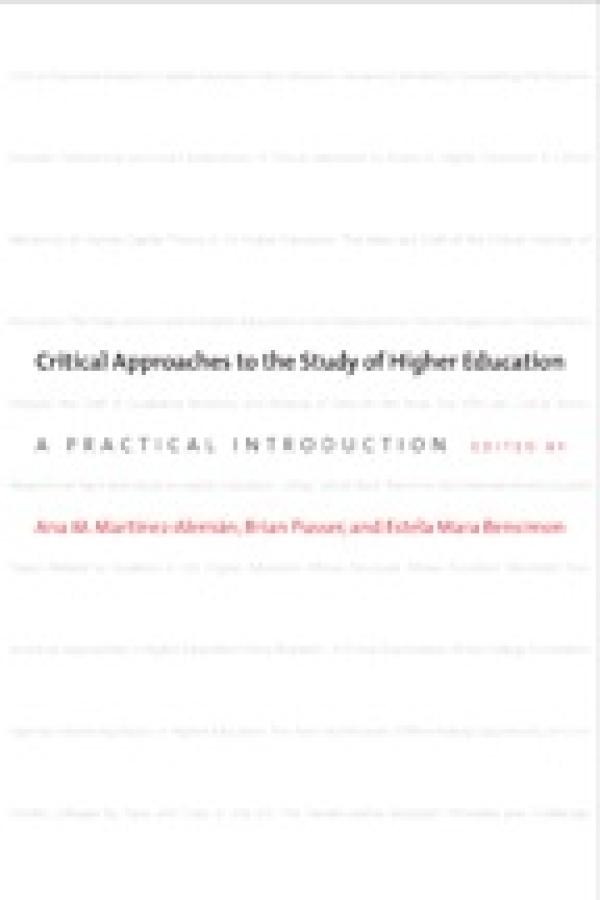
The goal of the contributors to Critical Approaches to the Study of Higher Education is to apply critical theories to the study of higher education which, they insist, “has only begun to develop research using such essential approaches as critical feminist theories, critical race theories, critical discourse analysis, state theoretical approaches, or theories of power and marginalization.” Added to this genuine concern is the scarcity of published material “addressing key topics in higher education that are central to critical work elsewhere in the social sciences” (5). To meet this need, they marshal “critical theories, models, and research tools with a critical vision of the central challenges facing postsecondary researchers” hoping to shape future “scholars and scholarship in higher education” (5). They are convinced that these critical tools will “provide policymakers, the public, and institutional actors clear, reasonable, and authoritative information about higher education as it is experienced in a democracy” (1). The result is a fine compilation of well-written essays for teachers and researchers to adopt and exercise their critical edge with a view to innovating their teaching pedagogies and research. The vision Mertínez-Ahlemán, Pusser, and Bensimon have is to ensure a sustained exercise of critical theory in the service of humanity, namely “for understanding politics and policy making in higher education” (5). They carry their readers through fifteen intriguing arguments critically testing theory against lived experiences filled with autobiographical elements that share the same thread – an abiding concern and determination to ensure that justice and equity are exercised in higher education. After all, critical theory came into being for this purpose as exemplified in feminist criticism, critical race theory, and other critical studies dealing with various dimensions of human life such as marginalization, economic disparity, and power differential. Simply stated, things are not the way they seem and something must be done even if it might be subversive. This volume is, indeed, “long overdue” (5) as it provides salient insights on how to critically navigate the host of complex and challenging issues facing higher education. These dynamic tensions inherent in higher education include: areas of scholarship and lived experience, power differential, critical historiography, the making of globalization, policymaking, race, equity, opportunities, and institutional change, and so on. Quite frankly, this book is a gem with a delicate vision to motivate scholars and teachers alike to engage in the noble – yet difficult – task of effecting change, especially the kind of transformation that advocates justice and nurtures equity in higher education. Educators and researchers may strive to embody and diligently exercise its content in their classrooms or writing projects because of its timely and urgent call for action. In other words, justice and equity matter (311).
Cláudio Carvalhaes Associate Professor McCormick Theological Seminary In memory of William Klug and Ioan Petru Culianu Pedagogies are concerned with the study and practice of teaching and learning. Pedagogies are ways of organizing society as it has to do with ways of thinking and valuing life, shaping emotions, defining sense,
Tat-siong Benny Liew Class of 1956 Professor in New Testament Studies College of the Holy Cross [O]ne thing above all—to step to one side, to leave … spare moments, to grow silent, to become slow—the leisurely art of the goldsmith applied to language: an art which must carry out slow
Nancy Lynne Westfield Associate Professor of Religious Education Drew Theological School Imagine this scenario: “YOU TOOK MY JESUS!” said the first-semester student who is feeling displaced, disoriented, disappointed and enraged while being overwhelmed, even defeated, by the unexpected convergence of seminary courses’ too dense readings along with the absence of.
Cláudio Carvalhaes Associate Professor McCormick Theological Seminary Last time we talked about the body in the classroom. Our body, my body, the bodies of my students, are all shaped by institutional bodies that carry values, marks, love, deceptions, commitments and history. Just as our bodies carry constructions of race, gender,
Nancy Lynne Westfield Associate Professor of Religious Education Drew Theological School Regardless of how many times pedagogical guru Parker Palmer is asked, he refuses to comply. Dr. Palmer, in his writings, speeches, and workshops, resists reducing the mystical adventure of critically reflective teaching to “tips, tricks, and techniques.” While I
Nancy Lynne Westfield Associate Professor of Religious Education Drew Theological School Michael Callahan, brilliant Drew Theological School student, said in his response to a previous blog post, “Silence grants its own power to the one who wields it.” I love this idea! We are crisply aware of the power of..
Cláudio Carvalhaes Associate Professor McCormick Theological Seminary It was my first semester teaching. I was anxious and fearful. I was trying to know what to do, while pretending I knew everything. In my second or third class, as I was saying something critical of the US in relationship to 9/11
Tat-siong Benny Liew Class of 1956 Professor in New Testament Studies College of the Holy Cross Five years ago, Yale law professor Amy Chua published a controversial book, Battle Hymn of the Tiger Mother. According to Chua, there is a basic difference in parenting practices between those of Asian (particularly.
Nancy Lynne Westfield Associate Professor of Religious Education Drew Theological School My father, Lloyd R. Westfield, spent the majority of his career as a school psychologist with the Philadelphia public school system. He loved his job, and by many accounts, he was very good at his job. I have vivid